Quick Take
- Narration: Stephen Thorne reads Churchill’s prose with the rhetorical confidence it demands, capturing the young colonial administrator’s voice without tipping into parody.
- Themes: Imperial confidence and its limits, the politics of colonial development, landscape as political argument
- Mood: Expansive and self-assured, with an undercurrent of historical unease for contemporary listeners
- Verdict: An essential primary source for Churchill’s early political thinking, best approached as a document of imperial ideology dressed in landscape prose.
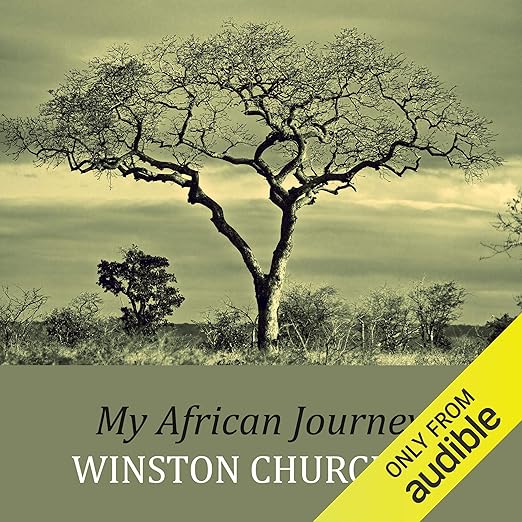
I was midway through the chapter on Uganda, somewhere around the Victoria Nile, when it occurred to me that Churchill was thirty-two years old when he made this journey. He was already Under Secretary of State for the Colonies, already confident in his judgments about how other people’s countries should be organized, already capable of writing sentences about the natural beauty of the Buganda Kingdom that sat in the same paragraph as administrative recommendations for labor extraction. The coexistence of the lyrical and the imperial in this text is not a bug. It is the document.
Stephen Thorne narrates just under five hours of material and does so with a quality I can only call appropriate gravity. Churchill’s prose in this period, the early rhetorical career, the polished parliamentary sentences, requires a voice that treats the text seriously without inflating it. Thorne hits that register. The famous description of Uganda as “the pearl of Africa” lands with the weight Churchill intended, and the sections on railway economics, which are genuinely dry, are handled with enough clarity that their political import stays legible.
What Churchill Was Actually Arguing
The synopsis notes that Churchill’s thoughts on settlement, race, and government provide insight into contemporary imperialism, and this is the correct framing. My African Journey is not primarily a travelogue. It is an argument. Churchill toured East Africa in 1907 with a specific political agenda: to make the case for railway investment as the engine of colonial development. The Uganda Railway, already built, was struggling to generate sufficient freight revenue. Churchill’s prescription was agricultural development through European and Indian settlement in the highlands, which would require displacing the existing populations and constraining their labor mobility through what he calls discriminatory laws without quite examining what that phrase means.
The logic is stated openly and without defensiveness, which is what makes this text so valuable as a historical document. Churchill was not concealing an agenda. He believed in what he was advocating. Understanding British colonial policy in East Africa in the early twentieth century requires understanding the thinking that produced it, and this text is a primary source for that thinking from someone who shaped policy directly.
The Churchill at Thirty-Two Problem
One reviewer describes Churchill’s “attitude re: British Empire building regardless of rights and sovereignty of native populations” and also notes his enthusiasm for the mass killing of wild animals, including a white rhino. Another calls it “an interesting salad of observations” with “railroad boosterism.” Both characterizations are accurate and not in conflict. Churchill was a supremely talented prose stylist in the service of an ideology that we now recognize as catastrophic for the populations it was applied to.
Thorne’s narration does not editorialize on this. He reads what Churchill wrote. That is the correct approach for a primary historical document. The listener does the critical work, not the narrator. Five hours is about the right amount of time to spend in this text: long enough to get a genuine measure of Churchill’s mind at this stage of his career, short enough that the unexamined colonial assumptions do not exhaust the listener’s patience.
The Nile Journey and the Landscape Writing
The book’s most purely pleasurable section for contemporary listeners is Churchill’s account of traveling the White Nile through Sudan to Egypt. The landscape writing here is among his best early prose, and the historical context of Sudan in 1907, barely a decade after Kitchener’s reconquest, gives the journey an additional layer that Churchill partially acknowledges. He is traveling through recently conquered territory and he knows it. How he writes about that knowledge, with imperial confidence and occasional glimpses of something more complicated, is the text’s most interesting register.
Who Should Listen, Who Should Skip
This is the audiobook for Churchill enthusiasts and for anyone studying British colonial policy in East Africa in the early twentieth century. It is not for listeners expecting straightforward travel writing; the policy arguments are as central as the landscape descriptions. The 4.1 average with 139 ratings reflects the mixed experience of listeners who came for the travelogue and found the imperial ideology more present than they expected. Approach it as what it is: a young politician’s manifesto dressed in landscape prose, and it becomes one of the more revealing primary sources in the colonial library.
Frequently Asked Questions
How does this book fit into Churchill’s overall bibliography, and is it necessary to read his other early works first?
My African Journey is part of the Winston S. Churchill Early Works series and stands fully independently. It requires no prior Churchill knowledge. Listeners who have read The Story of the Malakand Field Force or The River War will recognize the same rhetorical voice applied to a different colonial theater, but the East Africa journey is self-contained.
Does Churchill engage with the Kenyan settler community and the tensions around land allocation that would define the colony’s future?
Yes, though more in terms of policy prescription than social observation. Churchill advocates for settler agriculture in the highlands as the economic engine for railway revenue, and he discusses the labor questions this raises with the directness of someone who sees them as administrative rather than moral problems. The seeds of the conflicts that would eventually produce the Mau Mau uprising are visible in his proposals.
Is the hunting content significant, and how graphic is it?
Churchill describes big game hunting as a regular part of the safari, including the killing of animals that would now be protected species. The passages are not graphic in the way of Patterson’s Tsavo account, but they reflect the wholesale slaughter of wildlife that characterized colonial East Africa in this period. At least one reviewer flagged the killing of a white rhino specifically.
How does Thorne’s narration handle Churchill’s rhetorical set pieces?
Thorne reads with appropriate weight and clarity. Churchill’s parliamentary cadences, the building periods and the confident conclusions, come through without the narration feeling like a performance. For listeners used to Churchill’s own recordings of speeches, Thorne’s voice is obviously different, but the prose style is recognizable and well-served.