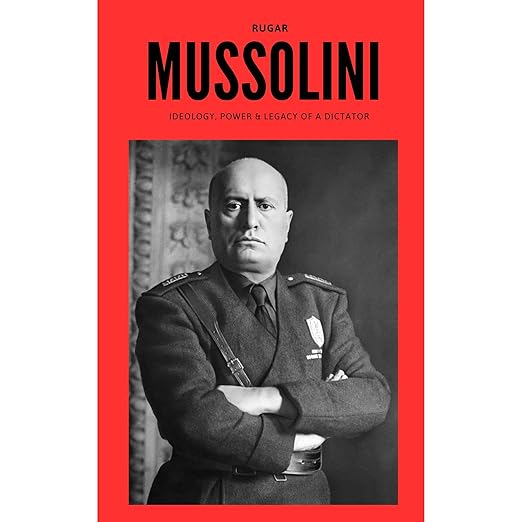
Twenty-one hours and twenty-six minutes is a long stretch of listening to hand over to a machine, and that is the first fact this audiobook puts in front of you. The narrator field does not name a person. It names Virtual Voice, the synthesized reading option, which means every sentence of Ruben Garcia's biography of Benito Mussolini reaches you through text-to-speech, with no human decision anywhere about how it should sound. Whether that disqualifies the title depends entirely on what you came for, and what the description promises is considerably more demanding than a life-and-times narrative told from the cradle forward.
A Style of Politics That Outlasts the System
The description sets out a thesis instead of a chronology. It says the book moves beyond caricature to examine how Fascism was conceived, exercised, and remembered, and it is explicit that the ideology under examination kept changing shape. Garcia's framing rejects two convenient positions at once: that Mussolini was a static tyrant, and that Fascism was a rigid doctrine. What replaces both is messier and more useful, a leader whose authority depended as much on compromise as coercion. That single clause tells you the register of the whole thing. This is an argument with evidence attached, not a procession of anecdotes.
Three movements are laid out in the copy. The first begins with the roots in revolutionary socialism and traces the transformation into the architect of Fascism, with violence, myth, and mass mobilization taking the place of coherent theory. The second concerns how power actually worked once it was held. The third handles the collapse of the regime, the civil war, the Italian Social Republic, and what became of Fascist symbols after 1945. The last sentence of the description is the one worth holding onto: Fascism survives less as a system than as a style of politics. Everything before it exists to earn that claim.
A Dictatorship Obliged to Negotiate With a King
The most interesting promise here is structural. Instead of treating the regime as a machine that simply did what its leader wanted, the description says power was exercised through alliances with the monarchy, the Church, industrial elites, and the bureaucracy. That is a claim about limits. A dictatorship obliged to negotiate with a king, a religious institution, and its own civil service is a very different object from the one in the propaganda photographs, and the copy commits to exactly that: the contradictions and failures hiding behind a carefully constructed image of total control.
Afterlife material is the second reason to give this the hours. Regime histories tend to stop at the body and the square. This one carries on into memory, denial, and political reuse, which is where a biography of a dictator turns into a book about the present, not the 1930s. The description closes on a warning about how authoritarianism adapts, endures, and returns. You can decide for yourself whether the argument earns that pivot, but at least it announces its ambitions in advance instead of smuggling them in during the final hour.
Length is doing real work at this scale. A short treatment can assert that Mussolini's ideology shifted; twenty-one hours and change has room to show the shifting, with the socialist beginnings, the alliances, and the collapse each given a stretch of listening in place of a summarizing paragraph. The tradeoff is obvious enough. If the prose matches the density of the description, this is not a title you drift through while doing something else with your hands. Budget it the way you would budget a course, an hour at a time, and expect to lose the thread if you do not.
No Voice Decided How to Deliver These Hours
Virtual Voice is the thing to settle before you spend anything. A synthesized reading means nobody has made a decision about how to deliver a single one of these twenty-one hours. No performer has weighed a quoted speech against the analysis surrounding it, or worked out how to say the Italian names and institutions the subject keeps requiring. Some listeners genuinely do not mind, and plenty of dense nonfiction gets consumed at high speed regardless. Others find the format unusable across a chapter, let alone across a book this size. Sample it before you commit.
Fields on this listing disagree with its own description. The product title reads simply Mussolini, while the copy inside names the book Mussolini: Ideology, Power & Legacy of a Dictator, so the subtitle that tells you what kind of biography this is never reaches the page you buy from. The series field holds the word History with no position number attached, which makes it a shelf category wearing a series label. The single tag is Military & War, on a book whose stated business is domestic politics: monarchy, Church, industry, bureaucracy, memory.
Nobody has written a review, which is the least surprising fact on the record. Publication is dated February 2, 2026, so the title is barely out, and the two ratings it has collected average 3.0. Those two votes have to add up to exactly six points out of a possible ten between them, and neither voter left a syllable explaining where the missing four went. That is not enough to judge a paragraph by, let alone a book. The publisher field reads Independently Published, with no editorial credit of any kind attached to the record.
The Mechanics of a Regime Over Its Silhouette
Listeners who want the mechanics of a regime rather than its silhouette will find that this description was written for them. If you have read the narrative accounts and came away wanting the part about the bureaucracy, the monarchy, and the industrial elites, that is precisely the ground the middle section claims. Anyone interested in political language will get something from the last third as well, since the material on symbols and reuse after 1945 is where the book stops being history and starts being commentary on the decade you are living in.
Skip it if you want a life told forward, with scenes and dialogue and a sense of the man in a room, because nothing in the copy suggests that book exists here. Skip it too if synthesized narration is a problem for you, since a twenty-one-hour commitment is an unusually large one to make to a format most people test on something short first. And skip it if you need a settled reception before spending the time, because two silent votes give you nothing to lean on. Approach it as a long argument with a reading assignment attached, and the runtime starts to look like the point rather than the obstacle.
How does the Virtual Voice credit change what this audiobook is?
The narrator field names a text-to-speech option, not a person, so no performer has made an interpretive decision anywhere across the twenty-one hours and twenty-six minutes. That weighs more heavily here than on a short title, because the subject brings a steady supply of Italian names and institutions with it. Sample a few minutes before committing to the full length.
Does the title on the listing match the one inside the description?
It does not. The product title reads simply Mussolini, while the description names the book Mussolini: Ideology, Power & Legacy of a Dictator. That subtitle is the part telling you this is a study of ideology and afterlife instead of a narrated life, and it never reaches the listing. Read the description first.
Is this audiobook a narrative biography or a work of political analysis?
The description points firmly at analysis. What it promises is a regime forced to negotiate with a king, a church, an industrial class, and its own civil service, and it finishes on Fascism as a style of politics more than as a system. Expect argument and structure ahead of scenes, dialogue, and a man alone in a room.