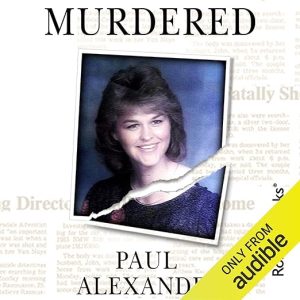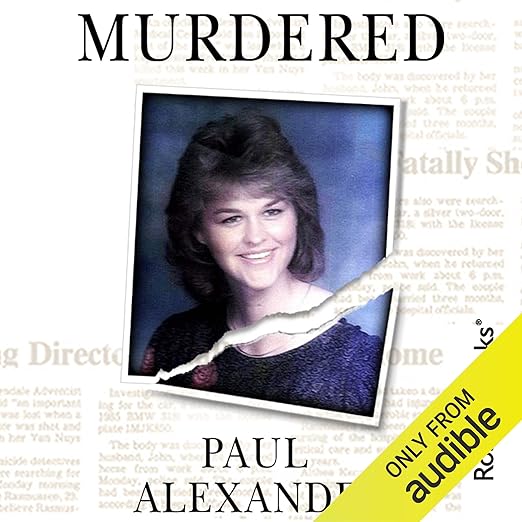
Murdered arrived in my listening queue almost by accident. I was researching a longer project about true crime audio and came across this 2013 Audible Studios production while following a trail of related titles. At an hour and twenty-two minutes, it is among the shorter audiobooks I have reviewed this year, closer to a long magazine article in audio than a full-length book. I want to establish that distinction upfront because it shapes what Murdered can and cannot do, and being honest about that is more useful to you than pretending the format limitation does not exist.
The story at the center of the book is genuine and genuinely disturbing. Sherri Rae Rasmussen was a twenty-nine-year-old newlywed murdered in Los Angeles in 1986. The case went unsolved for more than two decades. Paul Alexander, whose journalistic work on this case predates much of the subsequent media coverage, assembled the available evidence into what the synopsis accurately describes as a police procedure report in style: factual, sequenced, and focused on documentation rather than dramatization. The cover-up that accompanied the original investigation is the subject of the book's most pointed sections, and Alexander handles the institutional accountability dimension of the story with appropriate gravity.
What We Made of It
One reviewer, writing shortly after the book's original release, observed that the production reads essentially as a compilation of police records, news clips, and witness statements, organized and made accessible but not particularly transformed by the author's voice. That is a fair characterization, and it is worth sitting with. Alexander is operating in the tradition of accountability journalism rather than narrative nonfiction. He is not trying to put you inside Sherri Rasmussen's life or to build toward a revelation you could not have anticipated. He is documenting what happened, what was concealed, and how the concealment was eventually undone.
For the listener who finds that approach satisfying, Murdered delivers. The pace is efficient, the evidence presented clearly, and the eighty-two minute runtime means nothing is padded. For the listener who wants the full Oliver and Blackburne experience, the three-hundred-page reconstruction of motive, character, and forensic detail, this will feel like a promising chapter rather than a complete work. The reviewer who described it as only just beginning to peel back the layers was correct. There is a substantially larger story here that this production gestures toward without fully telling.
Paul Christy narrates with exactly the quality the synopsis promises: journalistic and no-nonsense. His voice does not manipulate the listener toward an emotional response. He reads Alexander's text with professional precision, trusting the story's inherent weight to carry the necessary impact rather than adding interpretive affect. In a genre where narrators sometimes lean into salacious horror or performative outrage, Christy's restraint is a genuine aesthetic choice and the right one for this material.
At eighty-two minutes, there is not enough runtime for Christy to demonstrate significant range. What we hear is competent and well-suited to the material, but listeners looking for a performance that matches the emotional complexity of the subject will find the clinical approach somewhat constrained by the brevity of the production.
Weak Spots in Murdered
The case's timeline spans from the 1986 murder through the approximately 2012 period of Alexander's writing, with a trial eventually following. Listeners approaching this now, more than a decade after the book's original 2013 release, will likely already know how the case resolved if they have followed the true crime genre at all. The Rasmussen case became well-known through subsequent media coverage, and the outcome that Alexander was working toward as the book went to press is now a matter of public record. That does not eliminate the value of the original journalism, but it does change the listening experience for anyone who comes to this after the story has been more fully told elsewhere.
For listeners who are genuinely encountering this case for the first time, Murdered serves as an effective and efficiently told introduction. For true crime followers with existing knowledge of the case, it functions as a primary source document, interesting for the texture of the reporting at a particular moment in the investigation rather than for its revelatory power.
Is This One for You?
Pick this one up if you appreciate spare, journalistic true crime that trusts the reader rather than manipulating them, and if you are prepared for a listen that ends feeling like the first act of a larger story. Skip it if you want the full investigative treatment that this case eventually received in other formats, or if you find eighty-two minutes insufficient for the emotional investment a murder case requires. At no cost, the accessibility makes it easy to recommend as an entry point, with the caveat that your appetite will almost certainly exceed what this production can satisfy.