Quick Take
- Narration: John Pirkis delivers the English text with clarity and warmth, though Arabic passages present a real stumbling block, at least one Arabic-speaking reviewer found the pronunciation difficult enough to skip those sections entirely.
- Themes: Prophetic biography as human story, historical context and civil legacy, interfaith resonance
- Mood: Intimate and cinematic, written at the pace of a biographical novel
- Verdict: Jebara’s Muhammad, the World-Changer offers a rare and genuinely fresh approach to prophetic biography, essential for anyone who wants more than military timelines and doctrinal summaries.
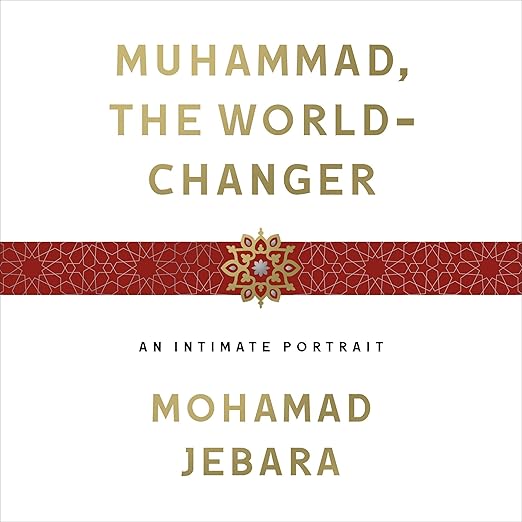
I came to this audiobook knowing the broad outlines of Muhammad’s life but finding that most available accounts either addressed a strictly devotional audience or approached the subject with an anthropologist’s cool distance. Mohamad Jebara’s Muhammad, the World-Changer occupied neither of those positions, and I noticed the difference within the first chapter. The book opens with a six-year-old child losing his mother, a scene rendered with emotional specificity rather than historical summary, and it does not let up on that human register throughout its fourteen-plus hours.
Reza Aslan’s blurb calls it a beautifully written, immaculately researched meditation on the impact of the Prophet Muhammad on the modern world, which is accurate but undersells the texture of the writing. Jebara, who describes himself as fusing details long known to Muslim scholars with a style accessible to popular audiences, has clearly thought hard about what kind of biography this field was missing.
Our Take on Muhammad, the World-Changer
The biography’s central argument is that Muhammad was primarily a civil reformer and social visionary rather than a military strategist, a reading that contradicts the emphasis of many prior accounts, including classical ones. Jebara makes this case through character rather than polemic, showing rather than asserting. One reviewer, a native Arabic-speaking Syrian physician who had read ibn Hisham, ibn Ishaq, Karen Armstrong, and Martin Lings, concluded that this was the book he had always been searching for: one that showed Muhammad as a civil man rather than centering the political and military dimensions of his life. That is a meaningful endorsement from a reader who knew what he was comparing it against.
The women in Muhammad’s life receive sustained attention, they are described as dynamic figures who nurture and shape the protagonist rather than peripheral presences. The same is true of the Jewish and Christian mentors Jebara depicts as influences on Muhammad’s thinking. This is not hagiography flattening a complex world into simple reverence. It is a biographer making a case for why a seventh-century figure still matters to the present.
Why Listen to Muhammad, the World-Changer
The format works. This is the kind of biographical writing that rewards audio because the prose moves like a novel, one reviewer described the experience as feeling the author present in a movie-style writing where you get to feel and live with him from his birth till after his death. John Pirkis’s narration carries the English text with the appropriate gravity without tipping into ponderousness. The audiobook runs nearly fifteen hours, and the pacing earns that length.
For non-Muslim listeners approaching Muhammad’s life for the first time, the book offers genuine orientation without requiring prior theological knowledge. For Muslim listeners, it provides unfamiliar scholarly angles on familiar events. Several reviewers noted that it felt equally rewarding from both positions.
What to Watch For in Muhammad, the World-Changer
The Arabic passages are a known weak point. One reviewer described the narrator’s Arabic pronunciation as difficult enough to skip whenever it appeared. This is worth noting because some of the most culturally specific material in the book, names, titles, phrases that carry weight in the original language, is the material that suffers most under mispronunciation. It does not derail the experience, but it is a real distraction for listeners who know the language.
The book is also structured to move through multiple registers: personal memoir, historical analysis, theological context, and narrative biography. These shifts are largely handled well but do mean that the listening experience is not uniformly paced. Some chapters move quickly; others are more discursive. Come to it ready to engage rather than passively absorb.
Who Should Listen to Muhammad, the World-Changer
Anyone curious about Islam’s founding figure who has found prior biographies either too academic or too devotional will find this a genuinely useful middle path. It is suited to general listeners with an interest in religious history, to students of Islamic studies looking for a humanizing supplement to more traditional accounts, and to readers who enjoyed Aslan’s No God but God or Lings’s Muhammad and want something that approaches the subject from a different angle. Arabic-speaking listeners should be prepared for the narration’s limitations in those passages.
Frequently Asked Questions
Is Muhammad, the World-Changer written for Muslim readers specifically, or is it accessible to non-Muslims?
Multiple reviewers explicitly address this. The book is written to be accessible to readers regardless of faith background, and several non-Muslim listeners found it a strong introduction to the subject. The author’s framing is scholarly and humanizing rather than devotional.
How does Jebara’s biography differ from earlier accounts like Karen Armstrong’s or Martin Lings’s Muhammad?
One extensively-read reviewer who had worked through those accounts concluded that Jebara’s key difference is his emphasis on Muhammad as a civil reformer rather than centering political and military history. The women, mentors, and social dimensions of his life receive more sustained attention than in most prior biographies.
Does John Pirkis handle the Arabic content in the narration effectively?
This is a consistent weak point noted by reviewers. At least one Arabic-speaking listener found the pronunciation of Arabic passages difficult enough to skip them. For listeners without Arabic fluency this may be less disruptive, but it is a real limitation of the production.
At nearly 15 hours, is the pacing consistent throughout, or does the book drag in places?
The pacing varies because the book moves between narrative biography, historical analysis, and theological context. Most reviewers found the overall experience compelling and several noted they could not stop listening, but the structural shifts do mean some chapters are more discursive than others.