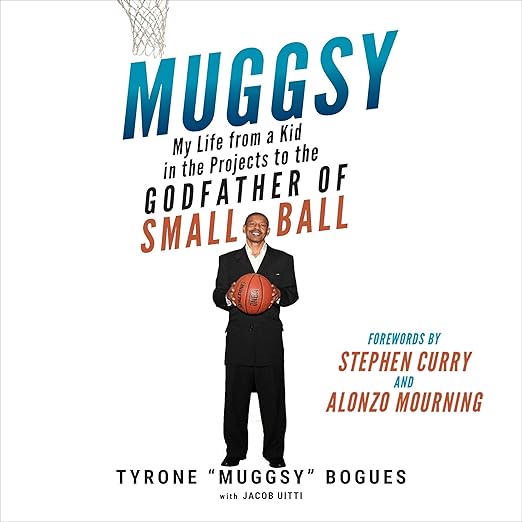
- Voice: Cary Hite voices a first-person life story whose subject never appears on the file, which is not what a memoir cover normally implies.
- Big ideas: Being underestimated in measurable terms, East Baltimore and Dunbar High, the eighties and nineties NBA, family and loyalty
- Atmosphere: Warm, plain-spoken and unbothered
- Worth it?: One of the more genuinely affecting basketball memoirs, with a language register the listing never declares and a voice that is not the subject's.
Twenty years after receiving his first basketball as a toddler, Tyrone Bogues stood five foot three as the starting point guard for the Charlotte Hornets, and this audiobook is his account of how that arithmetic worked out. Dreamscape Media released it on 12 April 2022 at eight hours and twenty-eight minutes, with Cary Hite credited as the reader. The nickname came off the East Baltimore playground courts, earned by muggin' opponents for possession of the ball, and it followed him into the league and out the other side.
Identification Is the Whole Transaction Here
Its shape is familiar and its details are not. Told he should do something else, anything besides basketball, Bogues never acknowledged the doubters except by proving them wrong in public, and the book tracks that from the Baltimore courts through Dunbar High School, where he played alongside future professionals, into a starting role in the NBA. What keeps it from being a motivational poster is that the copy treats the early years as the formative part rather than the prologue.
An April 2023 response explains exactly who this lands hardest on. That listener became a fan as a child in the mid nineties, was not particularly athletic, and was amazed and inspired that somebody their own height could turn professional. The entry calls the book an eye-opening look at the career and the personal life, with touching and even tear-jerking moments, and singles out how Bogues writes about close friends and family and what they did for him. Identification is the whole transaction here.
Anecdote inventory is unusually strong for a sports memoir. Legendary matchups against Michael Jordan and John Stockton, playoff runs in Charlotte, filming Space Jam, and watching a young Steph Curry grow up: that last one puts a whole second era inside a book about the first. The copy describes the register as conversational and clear-sighted, which is the correct combination for a subject who has been underestimated professionally and knows it.
A Disqualification That Was Measurable in Inches
Overcoming obstacles is the whole appeal, and a May 2022 five-star names it without decoration: a shining example of not letting anybody tell you that you are not good enough, a life spent overcoming obstacles, and a journey that entry calls life-affirming. Sports memoirs promise that constantly and deliver it rarely, because the promise usually requires the subject to have been merely doubted rather than physically disqualified. Here the disqualification was measurable in inches, which changes the arithmetic of the whole genre.
Era is the second draw, and the listing underrates it. Jordan, Stockton and the other generational stars of eighties and nineties basketball are described in the copy as a golden period for the league, and this is a first-person account from inside it by someone who guarded those players rather than watching them. First-hand testimony from that specific decade is getting scarcer every year, and eight and a half hours of it is a reasonable price.
Length is well judged here. Eight hours and twenty-eight minutes is enough to cover a childhood, a high school, a professional career and a film set without any of them turning into a chapter of filler, and it is short enough that a listener who came for the basketball does not have to endure a decade of post-retirement business ventures to get there. Memoirs of this kind routinely run twelve hours. This one does not.
Hite Holds the Credit, Bogues Does Not
An autobiography read by somebody else is a real decision, and this listing does not flag it. The whole proposition of a first-person sports memoir is the voice: the phrasing, the timing, the way a person tells a story they have told a hundred times. Cary Hite holds the reading credit on the file and Bogues does not. That is an ordinary production choice and it is also the largest single difference between this recording and the book a buyer is probably imagining.
Good for Kids or Spoiled by Vile Language
Who this book is for is the sharpest disagreement on the page. A five-star from August 2024 calls it a good book for kids, in an entry that otherwise reports on the condition of a used physical copy arriving like new. A three-star from February 2025 says the opposite in the strongest available terms: that the story and the personality are inspiring but the book is spoiled by vile, obscene language, that the subject was poorly served by an editor or a ghost writer, and that it should never be put in the hands of a young person. Two entries, one flat contradiction, and a parent needs the second one.
Nothing on this record carries a content advisory either way. Eight hours and twenty-eight minutes running from Baltimore playgrounds through a professional locker room was never going to be sanitized, and the listing says nothing about register, language or intended age. That omission is the practical failure here. Sports memoirs vary enormously along this axis, from locker-room verbatim to something a school library would shelve without a second thought, and the metadata declines to place this one anywhere on it.
The Warning Label This Listing Never Printed
League followers from the eighties and nineties are the core audience, along with readers who like sports memoirs that spend real time on the years before the money, and anyone wanting a first-hand account of guarding Michael Jordan from somebody who did it repeatedly. The April 2022 entry, filed five days after release, describes exactly that payoff: insight and detail about a favorite player, from the player.
Pass on it if you want tactical basketball analysis or a season-by-season record; the copy sells anecdote and reflection, and that is what it delivers. Pass also if the reading credit matters to you as much as the story does, because the subject's own voice is not on this file.
The language question is the one thing this page should have settled and did not, so anyone buying for a young listener should treat the three-star as the warning label the listing never printed.
Good to Know
Does Muggsy Bogues read the audiobook himself?
No. Cary Hite is the credited reader on this record. For a first-person memoir that is a meaningful difference, since the phrasing and timing of a subject telling their own stories is part of what the format normally delivers, and the listing gives no indication either way before purchase.
Is the audiobook suitable for a young basketball fan?
The page declines to say. No content advisory, no age band and no publisher guidance appear anywhere on the record, on a memoir running from playground courts through a professional locker room. Sampling a stretch before gifting is the only way to settle it, and on this title it is worth settling.