Quick Take
- Narration: Xanthe Elbrick’s measured, warm delivery is ideal for this material, she brings the quality of a knowledgeable friend walking you along the foreshore rather than a performer staging a production.
- Themes: Urban archaeology and found history, solitude and wandering as practice, what objects reveal about the people who used them
- Mood: Meditative and quietly absorbing, the Thames as time machine
- Verdict: Lara Maiklem’s memoir of mudlarking the Thames is one of the most genuinely original audiobooks I have encountered in the travel-and-place category, rewarding patience and rewarding it well.
I found this audiobook at exactly the right moment: a period when I was spending a lot of time walking without particular destination, thinking about what it means to pay attention in a city. I had passed through London several times without ever giving much thought to the Thames below the tourist-facing embankments, and something about Lara Maiklem’s opening pages, the way she describes arriving at the foreshore in the predawn dark, the specific suck of mud under her feet, the discipline of looking before seeing, made me slow down and listen differently. By the time she described pulling a Roman hairpin from the mud of what was once a road through the marshes east of the old city, I understood that this was not a book about treasure hunting. It was a book about time.
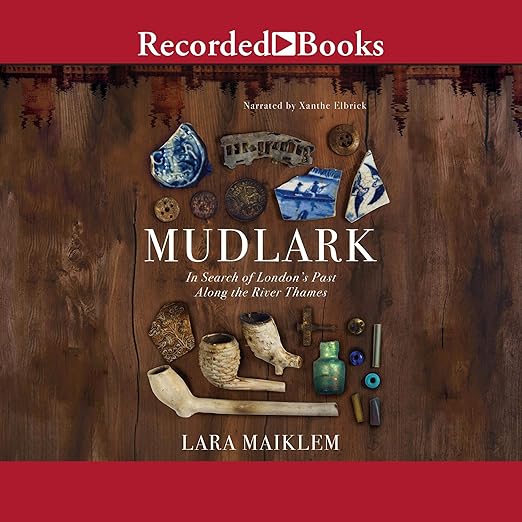
Mudlark takes its structure from the Thames itself, moving from the river’s upper reaches west of London down to its eastern mouth, organizing each chapter around a stretch of river and the kinds of objects it yields. The organizing principle is simple and deeply effective: Maiklem traces her own mudlarking practice, she is widely recognized as the leading practitioner and a source of expertise for archaeologists, while interweaving the history of London that the objects she finds carry with them. A medieval coin, a Victorian clay pipe, a Georgian shoe buckle. Each find is a thread pulled from the larger fabric of the city’s eight-hundred-year occupation of these banks.
What Objects Know That Documents Don’t
The book’s intellectual heart is an argument about materiality and evidence that archaeologists will recognize but general listeners will find genuinely revelatory. Written history preserves the concerns of literate, powerful people; the objects in the Thames mud preserve the concerns of everyone else. The clay pipes Maiklem finds by the hundreds were smoked by dockers, sailors, market traders, washerwomen. The children’s toys she uncovers were loved and lost by children whose names no record holds. The hobnails from Roman sandals walked on roads whose purpose and users are entirely unknown. When Maiklem says that the Thames foreshore is a place where “others only see the detritus of city life,” she is making a point about attention as much as archaeology, about the capacity to read significance in what most people step over.
Her prose handles this material with the quirky enthusiasm one reviewer mentioned: she is clearly a person who finds Roman hairpins exciting in a way that does not require justification, and that genuine delight drives the narrative forward without requiring drama. She is also honest about the physical conditions of her practice, the cold, the mud, the risk of getting caught by the tide, the permit process that governs legal mudlarking on the Thames foreshore. One reviewer described reading it slowly specifically because they did not want it to end, and that pacing, the book as something to inhabit rather than consume, is characteristic of its best readers.
Personal History Woven Into Historical Landscape
Maiklem does not keep herself entirely offstage. Her own life surfaces in the memoir sections that intersperse the historical and archaeological material: her childhood, her sense of herself as someone who has always needed to be alone in the way that the foreshore is alone, the particular pull that the act of searching has for her. These passages are handled with restraint; she does not make herself more interesting than her subject, which is the right call. But they give the book a dimension that pure archaeology writing lacks, the sense of a person shaped by a practice, not just someone describing it from outside.
The structure progressing from west to east, from the upper Thames where the objects are primarily post-Roman through to the broader estuary where maritime history dominates, gives the listening experience a geographical coherence that is satisfying in a way pure chronological organization would not provide. You feel yourself moving downstream, which is both literally accurate and emotionally resonant. The Thames carries things, and the book is structured to carry you with it.
Xanthe Elbrick and the Foreshore as Sound
Xanthe Elbrick’s narration deserves more credit than audiobook reviews typically give performers for material like this. The risk with a book this meditative, with this much quiet looking and careful observation, is that narration becomes static, that the listener’s attention drifts without the locomotion of plot to keep it moving. Elbrick prevents this through the quality of her attention in the delivery: she reads as if she is actually interested in what she is describing, which sounds obvious but is surprisingly rare. Her pacing gives the historical digressions room to breathe while keeping the personal sections warmer. Over nine and a half hours, the consistency of her performance means you never lose the sense of being on the foreshore alongside Maiklem.
Who Will Love This and Who Should Read the Blurb Carefully
Anglophiles will find this a nearly perfect audiobook, the London history alone is worth the runtime. History readers who are interested in material culture and what everyday objects reveal about ordinary lives will find Maiklem’s interpretive intelligence a genuine pleasure. And listeners who enjoy the company of someone deeply expert in a niche subject, narrating that expertise with personal warmth rather than professional distance, will want to stay until the very last stretch of river.
Listeners expecting conventional narrative tension or a more dramatic memoir structure should know what they are getting. Nothing very dramatic happens in Mudlark. People find things in the mud. The things are interesting, the history is real, and the writing is good. If that is not enough for you, this is not your book. If it is more than enough, and for the right reader it will be, this audiobook is one of the better listening experiences the travel-and-place category offers.
Frequently Asked Questions
Do you need to know London well to get the most out of the Mudlark audiobook?
Not at all. Maiklem explains the geography and history as she goes, and the book progresses from west to east along the river in a way that provides its own orientation. Anglophiles and frequent London visitors will recognize place names with extra pleasure, but the book is accessible to listeners who have never visited.
Is this primarily a book about archaeology, or is it more of a personal memoir?
It is genuinely both, blended throughout. The archaeological and historical content, what specific objects reveal about London’s past, is the primary engine of the book, but Maiklem weaves in personal reflection on why this practice matters to her and what solitude in the searching means. Neither strand overwhelms the other.
How does Xanthe Elbrick’s narration handle the meditative pace of the book?
Very well. The risk with material this reflective is that a narrator’s attention flags and the listener’s follows. Elbrick’s delivery maintains genuine interest throughout the nine and a half hours, with pacing that allows the historical digressions room to breathe without losing momentum. She does not perform the material so much as inhabit it.
Is mudlarking something listeners can actually try, or is this a purely observational read?
Mudlarking on the Thames is a real and regulated practice. The book describes the permit process required for legal searching on the foreshore, and there is an active community of mudlarkers. Maiklem herself has become a significant figure in promoting responsible practice. The book functions as both memoir and introduction to the practice for anyone genuinely curious about trying it.