Quick Take
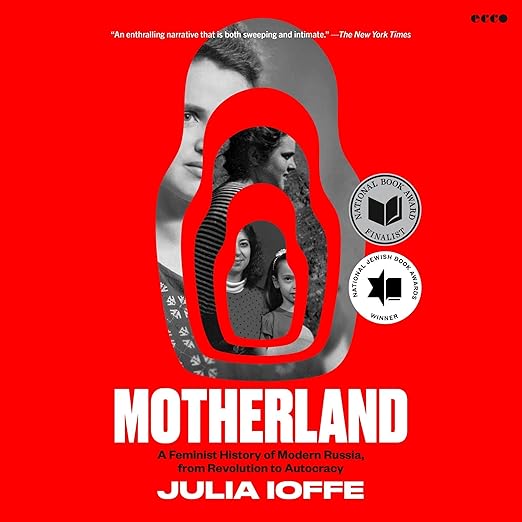
- Narration: Julia Ioffe reads her own work with the authority of someone who lived the material, her voice carries the emotional weight of family memory alongside journalistic precision.
- Themes: Women’s history as national history, Soviet feminism versus Putin-era conservatism, memoir as historical method
- Mood: Dense, deeply felt, and essential
- Verdict: One of the most rigorous and readable feminist histories of modern Russia available in audio, the self-narration elevates it further.
I started listening to Motherland during a week when Russia had launched another round of missile strikes on Ukrainian cities. The timing made Julia Ioffe’s central argument, that the story of Russia today is inextricably tied to the history of its women, feel less like a thesis and more like a diagnosis. By the time I reached the chapters on Pussy Riot and Yulia Navalnaya, I had already filled half a notebook with references I wanted to chase down.
Ioffe is one of the sharpest Russia correspondents working in English, and Motherland is the book she was always going to write, a history that runs on a parallel track to the one we usually get, built from women’s lives rather than men’s decisions. The result is nearly eighteen hours of audio that consistently surprises, not because the facts are unknown but because the angle of vision transforms them.
Our Take on Motherland
The structural ambition here is considerable. Ioffe moves from her own physician great-grandmothers through Lenin’s feminist revolutionary lover, through the hundreds of thousands of Soviet girls who fought in World War II, through the single mothers who rebuilt a devastated postwar country, all the way to the contemporary opposition. At each stop she asks the same question in different registers: what did this political moment mean to the women living through it, and what did they make possible or foreclose for the women who came after?
The memoir strand, Ioffe herself fleeing the Soviet Union at age seven, returning to Moscow nearly twenty years later to find Soviet women doctors and engineers seemingly replaced by women desperate to marry rich, gives the historical argument a personal urgency that keeps the density manageable. One reviewer called it a book that reads like a novel. That is accurate, but the scholarship underneath is real and meticulous.
Why Listen to Motherland
The self-narration matters enormously here. Ioffe reads with the controlled emotion of someone who knows these women personally, some of them are her own family, and the journalistic clarity of someone who has covered Putin’s Russia for over a decade. The combination produces a narration that is neither sentimental nor detached. At seventeen hours and fifty-two minutes, the runtime is substantial, but the pacing earns it. Ioffe does not pad; she layers.
The supplemental PDF that accompanies the audiobook is worth downloading. Ioffe’s work draws on archival research and personal interviews, and the supporting material deepens what the audio delivers. For listeners who want to pursue the scholarship, the book functions as a map as much as a text.
What to Watch For in Motherland
Ioffe’s feminist perspective is present throughout, and it is worth naming directly: this is a book written from an explicitly feminist historical framework, and Ioffe does not pretend otherwise. For readers who consider that a bias to be corrected for, the book will feel tendentious. For readers who consider it a corrective to the overwhelmingly male-centric historiography of modern Russia, it will feel like oxygen.
The book covers a century of Russian history at considerable speed. Readers unfamiliar with the basics of Soviet history, collectivization, the Great Patriotic War, the collapse of 1991, will find it richer with some grounding. Ioffe explains what she needs to explain, but this is not an introductory survey; it assumes a reader curious enough to look things up.
Who Should Listen to Motherland
Anyone trying to understand how Russia became what it is under Putin will find Motherland more illuminating than most conventional political histories of the period. Readers of Anne Applebaum, Orlando Figes, or Masha Gessen will recognize the landscape and find Ioffe’s angle genuinely complementary. The memoir dimension also makes this accessible to readers who might otherwise find Russian history too remote. If you have ever wondered what it felt like from the inside to watch a country reverse course on gender equality, Ioffe provides an answer that is both personal and analytically rigorous.
Frequently Asked Questions
Do I need prior knowledge of Russian history to follow Motherland?
Basic familiarity helps, the Soviet period, World War II on the Eastern Front, and the 1991 collapse are assumed rather than explained in full. But Ioffe writes accessibly enough that motivated listeners can follow along and fill gaps as they go.
How does Ioffe’s personal family history integrate with the broader historical narrative?
Ioffe uses her own family, particularly her great-grandmothers and her experience emigrating and returning, as recurring anchors throughout. The personal strand is never just decoration; it grounds the historical argument in lived stakes and gives the reader an emotional through-line across a century of upheaval.
Is Motherland fair to different political perspectives on Russia, or is it advocacy?
It is advocacy in the sense that Ioffe makes no secret of her feminist historical framework and her opposition to Putin’s politics. It is fair in the sense that she is meticulous about evidence. Readers looking for a neutral survey of Russian history will want a different book; those looking for a rigorous, beautifully written argument will find this deeply satisfying.
At nearly eighteen hours, is the audiobook paced well enough for a sustained listen?
Yes. Ioffe’s narration moves with journalistic purpose, she does not linger in ways that feel indulgent, and the structural shifts between historical chapters and personal memoir sections create natural breathing room. Several listeners report moving through the book faster than expected despite its length.