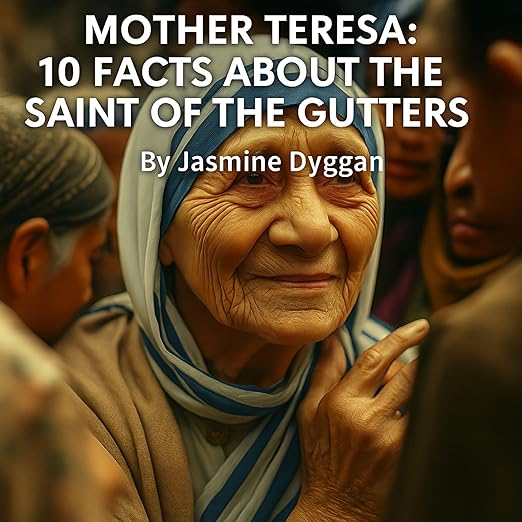
Skopje, not Kolkata, is where this book begins, and that choice tells you what kind of biography it intends to be. Jasmine Dyggan's account gives the audiobook two hours and twelve minutes, read by Michelle Marie and published by Zentara UK in September 2025. The title on the listing is two words long. The title inside the description is Mother Teresa: 10 Facts About the Saint of the Gutters, which is an entirely different promise, and the missing half is the half that tells a buyer what the book actually does with its short running time.
The Missing Half of a Two-Word Title
Subtitle aside, the ten-fact structure is the design decision everything else follows from. Dyggan works through ten carefully chosen chapters, each built around a single fact and used as a gateway into something larger. That format suits this length exactly: no chapter outstays its welcome, each has a clean point of entry, and a listener whose attention wanders for a minute can rejoin at the next number without having lost a thread. For a life documented this thoroughly elsewhere, the format also answers the obvious question of why another book about Mother Teresa needs to exist at all. The answer it offers is coverage rather than depth: ten entry points into one life, each shaped so that a listener who arrives knowing nothing has something solid by the end of the chapter, and none of them assuming the previous nine.
Albanian roots are the first fact and the least familiar one. Born Anjezë Gonxhe Bojaxhiu in Skopje, far from the Kolkata slums with which she would later become synonymous, she grew up in a childhood the book describes as shaped by deep faith and sudden loss. Starting there rather than in the slums is the right instinct, because it turns the later choices into choices rather than destiny. The call within a call, the transformation that led her to leave her teaching post and walk alone into the slums, lands very differently once a listener has spent twenty minutes with the person who made that walk.
The Darkness Behind the Nobel Prize Symbol
Darkness is where this book earns its keep. Awarded the Nobel Peace Prize in 1979 and known everywhere as a symbol of compassion, she was at the same time wrestling with an enduring spiritual darkness that stayed hidden from the public while she lived, and that her letters, published after her death as Come Be My Light, finally made visible. A short popular biography could skip that entirely and most would. This one puts it inside the frame, and it is the fact that turns a plaster saint back into a person, giving two hours a center of gravity that a chronology of good works could never supply.
Controversy gets its own space too, which is far from guaranteed at this length. The copy states plainly that critics challenged her austere methods, the conditions in some of her facilities and her choices of political allies, and that Dyggan does not shy away from those complexities. Whether a book this brief can do justice to arguments that have filled whole ones is a fair question to ask. What matters to a buyer is that the argument is acknowledged rather than airbrushed out, because a hagiography and a critical biography are different purchases, and this one is openly trying to sit between them.
A Flat Five Stars With Nothing Written Beneath
Two hours and twelve minutes is the constraint every ambition here runs into. A life spanning Skopje and Kolkata, the founding of the Missionaries of Charity in 1950, a Nobel, decades of homes for the dying, orphanages and leprosy clinics, and a posthumous publication that exposed private doubt, cannot be covered in the time a short drive takes. The ten-fact structure handles that honestly by never pretending to be comprehensive. Listeners should still expect a briefing rather than a biography, and anyone who wants the argument about her legacy in full will need somewhere to go afterward.
Zentara UK is the publisher, and the series field on this record reads Behind the Name: A Zentara UK Famous Lives Book Series, with no volume number attached and no companion titles displayed. A series field carrying the publisher's own name is a catalog artifact rather than information, and a buyer cannot tell from it whether this is the first of forty short lives or a single experiment. The badge above it sits at a flat five stars with no written account anywhere beneath it, so nothing on this page describes the reading, the pace or the tone of what you would be buying.
Two Hours of Groundwork Before the Longer Biographies
Students are the obvious audience, along with readers who want an orientation before committing to something longer. If you know the outline of Mother Teresa's life but not the Albanian childhood, not the call within a call, and not the correspondence that revealed how much of her certainty had drained away, this fills those gaps efficiently and without padding. The ten-chapter shape also makes it easy to use in a classroom or a reading group, since each fact arrives as a discussion prompt with a beginning and an end attached to it. Anyone preparing to tackle one of the long contested biographies will also find this a sensible two hours of groundwork, because it names the disputes without settling into either camp, and it supplies the dates and the places a longer book will assume you already have.
Serious readers of religious biography will find this too short to satisfy, and specialists already know every fact inside it. Anyone wanting a defense of her work, or a prosecution of it, should look for a book that argues rather than one that summarizes, because this presents both cases and settles neither on purpose. What remains is a well-shaped two-hour introduction to a life most people know in outline and almost nobody knows in detail, sold under a title that has been stripped of the words explaining what it is.