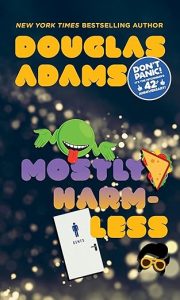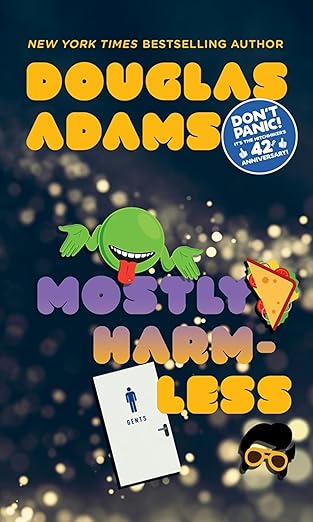
I read Mostly Harmless for the first time on a rainy November afternoon in my second year of university, having ploughed through the first four Hitchhiker's books in about ten days. The experience was disorienting in a way I did not fully understand at the time. The book was funny - Adams was incapable of writing anything that was not at least intermittently very funny - but it did not feel the same as the earlier books. The humor had a different weight to it. I remember setting it down at the end and feeling oddly flattened, which is not a common response to a comic novel. Returning to it now, in audio form, that feeling came back immediately.
Mostly Harmless is the fifth and final book in what Adams called a trilogy in five parts, a description that is itself a joke about the series' refusal to follow its own announced structure. It follows Arthur Dent attempting to find stability in a universe that appears structurally committed to denying it, and Tricia McMillan navigating an alternate Earth where things almost went differently. The premise is characteristically inventive, and the execution contains passages of genuinely brilliant comic writing. It also contains something that the earlier books did not: a pervasive sense that the joke might be at the expense of everyone involved, including the reader.
The Verdict, Briefly
Adams later said that he wrote this book during a prolonged depressive episode, and that context is visible in the text even without being told. The novel's relationship to resolution, to the possibility of characters finding somewhere they actually belong, is fundamentally different from the first three books and even from So Long, and Thanks for All the Fish. Where that fourth book offered Arthur something resembling a home and a love, Mostly Harmless withdraws it. The ending is genuinely bleak, and Adams himself expressed some regret about having written it that way.
This is important information for listeners who have come through the series in order and are approaching this fifth entry with the expectations established by the earlier books. Those expectations will not be fully met, and the disjunction is worth understanding in advance. Mostly Harmless is not a failed Hitchhiker's book. It is a different kind of Hitchhiker's book, one that has absorbed the philosophical implications of the series' central joke and decided to take them seriously.
Why Mostly Harmless Works as an Audiobook
If you have made it through the first four books, you are almost certainly going to listen to this one. That is the practical reality of serialized comic fiction with a dedicated fanbase. And the reasons to do so are real: the novel contains some of Adams's finest standalone passages, the invention around the Guide Mark II and its implications for information and truth is prescient in ways that resonate more sharply now than they likely did in 1992, and Trillian's alternate-Earth storyline is genuinely affecting in its quiet melancholy.
The audio format suits Adams's prose well because the rhythms of his sentences are fundamentally spoken-word rhythms. His writing sounds like someone thinking out loud, following a train of logic wherever it leads with deliberate cheerfulness about the fact that it will lead somewhere absurd. That quality is always present in the text, and a good narrator makes it even more apparent.
Points to Consider
The narrative credit for this specific edition is unclear, which is a practical consideration for listeners trying to choose between audio versions. The Hitchhiker's series has a well-regarded unabridged recording narrated by Martin Freeman, and there are other productions with strong reader histories. Worth confirming before purchasing which edition you are getting, since the narrator matters considerably for this particular series.
The slim synopsis available for this edition does not capture the thematic weight of what Adams actually wrote. This is described as following Arthur Dent adjusting to new circumstances after his spaceship crashes, which is accurate but understates the tonal shift the book represents. New readers who arrive expecting five-part harmony with the early novels will find something more discordant, deliberately so.
Who Should Listen to Mostly Harmless
Readers who have worked through the Hitchhiker's sequence will want to complete it here, with the understanding that the emotional register is meaningfully darker than the first four books. Those coming to the series for the first time should absolutely start with The Hitchhiker's Guide to the Galaxy and work forward. New listeners who have heard that the series is funny and want the most immediately pleasurable entry point should also start earlier. Mostly Harmless rewards the investment of the whole sequence. It does not make a compelling case for itself as a starting point.
Quick Take
- Voice: The narrator credit for this edition is unclear, but the Hitchhiker's Guide series has a strong audio tradition and the material rewards dry, deadpan delivery above all else.
- Big ideas: Meaninglessness and acceptance, the futility of trying to go home, parallel realities as a source of melancholy rather than wonder
- Atmosphere: Darker and more resigned than its predecessors, with Adams's humor tinged by something he later acknowledged was a difficult period in his life
- Worth it?: An essential completion of the Hitchhiker's sequence for those who have made it this far, but noticeably different in emotional register from the earlier books - something fans should know going in.
Is Mostly Harmless noticeably darker in tone than the earlier Hitchhiker's books?
Yes, meaningfully so. Adams himself acknowledged writing it during a difficult period in his life, and the novel's relationship to resolution and belonging is fundamentally more resigned than its predecessors. The humor is still present but carries a different weight. The ending in particular is genuinely bleak.
Which audio edition is this, and who narrates it?
The narrator credit in the listing is unclear for this specific edition. The Hitchhiker's series has multiple audio productions, including a well-regarded unabridged version narrated by Martin Freeman. Confirm the narrator before purchasing if that matters to your listening experience.
Adams expressed regret about the ending of Mostly Harmless. Does that regret affect how the book should be read?
It is useful context rather than a warning to avoid the book. Adams had planned a sixth Hitchhiker's novel that would have lightened the ending's implications, and that unfinished intention gives the existing conclusion a slightly unresolved quality. Eoin Colfer's authorized sequel, And Another Thing, attempts to address this for readers who want a less bleak conclusion.