In Brief
- Narrator: The listing pairs Jeff Hays with Soundbooth Theater, a production credit sitting unusually prominently for a comedy where the laugh often lives in a pause rather than in a line.
- Subjects: A shapeshifter maintaining a public persona, comic fantasy about status, a war between nations you are assumed to know
- Tone: Raunchy, fast, gleefully dark
- Bottom line: Excellent if you have read the previous five, and genuinely impassable if you have not.
Book six of a series is an odd place to find a single rating, and that is what this listing shows: one rating, a 4.8 average, and five people who wrote full paragraphs. One rating cannot produce a 4.8, because a single grade lands on a whole number. Whatever those two fields are counting, they are not counting each other, and the five paragraphs are the only part of this audiobook page that will tell a buyer anything useful.
They tell you that people arrive at book six already committed. "It's always a good day when a Boxxy book gets released", one of them opens, before instructing newcomers to "Start with the first one". Four of those five were written months ahead of the July 2021 recording, which means the enthusiasm collected here belongs to readers who had finished the story months before a recording of it went on sale.
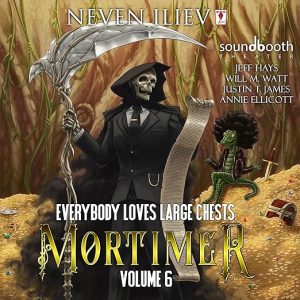
Armageddon Day is where the description opens, in the aftermath of a battle in which two Overlords fought through the streets of New Whitehall and left the Ishigar Republic and the Lodrak Empire both unable to continue. Boxxy, the series protagonist, spent the whole event going comatose. That paragraph is a fair sample of what book six expects: proper nouns arriving without introduction, a war whose sides you are assumed to know, and a Goddess who has inexplicably fallen silent. The Lodrak Empire is described as gripped by unease overnight for exactly that reason, which is the sort of development a sixth volume can drop without pausing to explain itself.
Grammar is the most interesting thing about Boxxy. The publisher's copy refers to the character as it, consistently: its public persona, its plans, its primal instincts. One five-star reader writes he. That slippage is the joke and the engine at once, because Boxxy is a shapeshifter whose entire arc is about maintaining a persona, and even the readers who love the series cannot settle on a pronoun for the thing.
Longevity is both this run's most impressive feature and its central risk. A five-star response names that risk out loud: "Sometimes when a series hits 4,5 or even 6 books it becomes stale. That is not the case here." I believe the second sentence more because the reader troubled to write the first. Twelve hours and eighteen minutes at book six is a real commitment, and the page's job is to say whether the well has run dry. It says no, and it says so from readers who have every reason to have grown bored.
The Strengths
Comedy is the genre most improved by being read aloud and most damaged by being read badly, and this is comic fantasy about a monster impersonating a hero. The humor in the description is structural rather than verbal: a creature that cares nothing for the war it just ended is now stuck being publicly celebrated for it. Timing carries that. A joke about status has to land on a beat, and twelve hours of it either works from the first chapter or does not work at all.
The reading goes to Jeff Hays, with Soundbooth Theater as publisher, and the demand this text places on a recording is easy to describe and hard to satisfy. The description alone names two nations, a city, a divine figure, a character called Teresa, an Overlord, a Hero of Chaos, and a shapeshifter maintaining a public identity alongside a private one. A page gives you capitalization and the ability to look back. Audio gives you a voice, which has to keep the persona and the creature clearly apart, because the whole plot of book six is that the two have been confused in public.
Another five-star response compresses the series' method into two sentences: "Never losing makes it dull. Not knowing what's coming makes it interesting." That is a real observation about how a long comic fantasy sustains itself past the point where most series flatten out, and it is the reason a sixth volume can still surprise a reader who has been there since the first. The description backs it up by promising escalation rather than repetition: a revealed identity, a target on the alter ego, and the shapeshifter's own instinct that too much attention leads somewhere fatal. Escalation of that kind is easier to follow in one continuous run than in the stop-start reading most people give a long series.
Before You Commit to Mortimer
Newcomers face a genuine entry-point problem. A four-star response opens by calling this "The 6th installment of the series" before offering any judgment at all, and the four-word notice further down praises the book and the series in the same breath, which is what people do once the two have merged into one object in their minds. Nothing in the description would carry a newcomer through the first hour.
That four-star response is also the most useful critical voice here, and its complaint is specific. "What do you call the opposite of plot armor?" it asks, answers itself with plot vulnerability, and adds that it "was a factor in this book." A reader saying the protagonist took damage the plot had not earned is naming precisely the failure mode a series built on survival by cleverness has to avoid, and it is worth knowing that somebody who enjoyed the book still flagged it.
The content warning is not decoration. The description prints it in full: profanity, gore, violence, explicit adult content. A funny monster on the cover does not make this suitable for a younger fantasy reader, and the comedy is aimed squarely and unapologetically at adults.
Recommended For
Anyone who has read the first five and wants the sixth will be well served here. So will listeners who enjoy fantasy that treats its own conventions as raw material for jokes, and anyone who finds a monster forced to keep up a public reputation as a hero inherently funny. It is inherently funny, and it helps that the joke is the premise rather than decoration hung on it. The shortest notice on this page needs four words to say so: "Good book, great series."
Skip it if you are new to Boxxy, because this is emphatically the wrong door. Skip it too if profanity, gore and explicit content are not what you want from your comedy, or if you want a fantasy that plays its Overlords and its Goddesses straight. Returning readers who have been away a while should budget some disorientation at the start, because the opening assumes you watched the battle whose aftermath it describes.