D. Keating dated a review of this biography January 17, 2011. The audiobook carries a release date of January 21, 2011, which places that response four days ahead of the recording it now sits beneath. Small thing, useful thing: it tells you at a glance that the column here belongs to the book, a book that took the National Book Award for Biography and the Los Angeles Times 1981 Book Prize for Biography, and that reached audio thirty years afterward with its print reception already bolted on.
What Runger Does Here Goes Unrecorded
Teddy Roosevelt at the opening of this book is a sickly child, brought close to death on a recurring basis by asthma, and the transformation into the war hero and president everybody has heard of is the arc the description advertises. What that same description also says, in a clause easy to skim straight past, is that the metamorphosis gets seen in the context of a very uncommon household. That qualifier turns out to be the entire book.
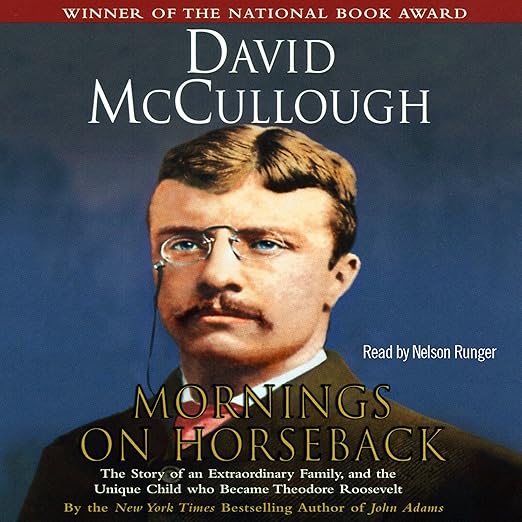
McCullough is not writing a presidential biography, and the most careful reviewer in this column noticed. Michael I. opens by describing the cover, a young Teddy Roosevelt staring past the reader, rugged and confident, then warns against being fooled by it: the former president is not this book's true focus, because were that the case, this would be one more Roosevelt biography among many. It is the story of a family, and of an age that swelled with exuberance and possibility. No sentence written about this record is more accurate.
Nelson Runger reads it, and that exhausts what the listing offers about the production. Nineteen hours and twenty-two minutes is a serious commitment, and for a narrative historian operating at this length the reading matters enormously, because McCullough's method is accumulation, one specific detail laid against the next, and a voice that goes slack over nineteen hours converts accumulation into sheer weight. What Runger does with that stretch goes unrecorded here.
They Came for a President, Stayed for Relatives
Credentials on this one are not decorative. The National Book Award for Biography. The Los Angeles Times 1981 Book Prize for Biography. A masterpiece, according to John A. Gable in Newsday, and a story filled with fresh detail according to The New York Times Book Review. The copy identifies McCullough as the author of Truman, the one piece of shorthand a browsing listener actually needs. The description makes a larger claim still, that the book does away with several old myths and breaks entirely new ground, which is the sort of sentence publishers write and historians have to earn. Decades after publication this remains the book people mean when they refer to the young Roosevelt.
The household is the reason to stay. The father, the first Theodore Roosevelt, arrives as a figure of unbounded energy and selflessness, a god in the eyes of his small, frail namesake. The mother, Mittie Bulloch Roosevelt, is a Southerner and a celebrated beauty and, the copy insists, considerably more besides, which the book is said to make clear as never before. Sisters Anna and Corinne. Brother Elliott, who would become the father of Eleanor Roosevelt. And Alice Lee, TR's first love, called lovely and tragic in a single breath.
Readers keep reporting the same pleasant surprise. Ely Grace expected information about Roosevelt and received a great deal of family backstory alongside it. Fun2mom concedes the book was not what had been expected at the point of ordering, then describes a family with all its quirks, virtues and flaws, historically correct and never once dry or humdrum. D. Keating, writing before anybody on earth could have heard the audio, praises the research, the prose and the family story together. Three separate people came for a president and stayed for his relatives.
Five Written Entries, a Counter That Reads Three
A displayed 4.5 sits on top of three votes, and those two figures cannot both be true. No rounding convention produces 4.5 out of three whole-star votes, so one of the numbers is wrong before you begin. Compounding it, five written responses sit underneath a counter that reads three, which means at least two people who took the trouble to write go uncounted. Treat the average as decoration and read the five entries.
Filed under Politics and Activism, this record points at the wrong doorway entirely. The most substantial review present spends its opening lines arguing that the presidency is not the subject, and the description backs that reading: asthma, a household, a mother from the South, a first love, and mornings on horseback beneath the wide skies of the Badlands. Anyone arriving for political history gets a childhood instead. A superb childhood, but a childhood. The title comes from the last line of that description, where the blessed mornings on horseback happen beneath the wide blue skies of the Badlands, and the book is named for the boy, not the office.
This column doubles as a fifteen-year archaeological record. Entries run from January 2011 through to March 2026, and their vocabulary is print vocabulary from end to end: a cover described in detail, a reader who cannot wait to turn the page, another mentioning having read one of Roosevelt's own titles, Hunting Trips of a Ranchman, the previous year. One response filed in December 2025, headed Informative and interesting, consists of the single word Excellent. Between them the five cover most of this book's life on paper and nothing of its life aloud.
This Pays Out Slowly, Then All at Once
Narrative history at full length is the taste this rewards, so anybody who enjoyed Truman and wants that method applied to a smaller canvas should start here. Family sagas work here too, since the Roosevelt household, with its inexhaustible father, its Southern mother and its four children, stands up as a nineteenth-century family story regardless of who any of them grew up to be. Anyone curious about how a frail asthmatic boy became the figure on that cover has the account that won the prizes.
Nineteen hours is the wrong shape for a listener who wants the presidency, since the book stops well short of it, and the wrong shape again for anybody needing a brisk survey, because McCullough builds by accumulation and the payoff only arrives at the far end. Whether one unbroken voice holds up across that distance is a question this page leaves completely open. For everyone else the reward is proportional to the time given: this is a book that pays out slowly and then all at once. Nineteen hours and twenty-two minutes rewards patience and punishes impatience in roughly equal measure.
Before You Press Play
- Read by: Nelson Runger is credited with the whole nineteen hours and twenty-two minutes, an unbroken solo reading of a historian who builds by accumulation.
- At its heart: Childhood illness and endurance, a nineteenth-century household, the making of a president, first love and loyalty
- Vibe: Patient, richly detailed and quietly warm
- Short version: A prize-winning family portrait wearing a politics tag, and worth nineteen hours when the household is what you came for.
Good to Know
Is this audiobook a full biography of Theodore Roosevelt?
No. It covers the making of the young Roosevelt, from a childhood of near-fatal asthma attacks through to manhood, set inside an unusual family. The most detailed reviewer here argues outright that the former president is not the true subject. Expect a household portrait, not an account of the presidency.
Which Roosevelts appear in this audiobook?
The elder Theodore Roosevelt, described as tireless and selfless; Mittie Bulloch Roosevelt, a Southerner and celebrated beauty; sisters Anna and Corinne; brother Elliott, who became the father of Eleanor Roosevelt; and Alice Lee, called Teddy's first love. The book treats them as a single interlocking subject.
Should listeners start here or with McCullough's Truman?
They stand independently, and the copy names Truman only to place the author. This one runs shorter in scope though longer in intimacy, since it stays inside one household across a childhood. Start here for family history and character formation, and go to Truman for a life told at full presidential scale.