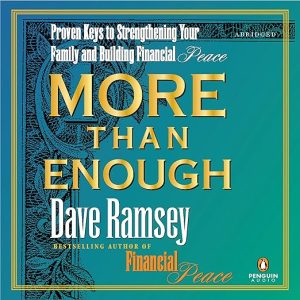
The Short Version
- Performance: Dave Ramsey narrates his own book with the direct, folksy authority that built his brand; the conversational delivery suits the material and makes the two-hour runtime feel like a concentrated coaching session.
- What it covers: Wealth-building, family financial unity, values-driven money management
- Feel: Direct and motivating, with warmer emotional undercurrents than Ramsey's radio persona suggests
- Our call: A short, dense audiobook that bridges Ramsey's debt-elimination framework with the harder question of what financial freedom is actually for.
Dave Ramsey wrote More than Enough as the follow-up to his first bestseller, Financial Peace, and the craft choice embedded in that sequencing is worth examining at the outset. This audiobook, narrated by Ramsey himself, assumes you have already done the debt-elimination work or are at least committed to it, and pivots directly to the more philosophically demanding question: once the debt is gone, what do you build, and with whom? The runtime is two hours and five minutes, which is unusually brief for a personal finance book from a major author. That brevity is not a flaw. Ramsey writes here the way a contractor who has already laid the foundation works on the upper floors: he is not re-explaining the ground-level principles, he is showing you what you can construct on top of them.
The ten keys Ramsey structures the book around include values, goals, patience, discipline, and giving back, along with five others that function less as separate chapters than as interconnected arguments about the relationship between money and family cohesion. He draws from years of work with thousands of couples and corporate employees, and the case histories he includes move the book away from abstract principle toward the specific friction points where financial disagreements actually happen: different spending values between partners, misaligned retirement expectations, children who watch what parents do rather than what they say.
First, the Big Picture
The audiobook's most important contribution is its insistence that financial peace is relational before it is numerical. Ramsey is direct about this: your balance sheet can be impeccable while your household is collapsing, because the habits that build wealth can also produce rigidity, resentment, and the slow erosion of partnership. The ten-key framework keeps returning to this point. Giving is one of the keys not as charity virtue-signaling but as a corrective to the psychological trap of accumulating without purpose. Community investment appears as a structural element of what Ramsey calls marital bliss around the issue of finances, not merely an ethical obligation layered on top of personal financial goals.
Ramsey narrating his own book is both the audiobook's primary asset and its most obvious qualification. His down-home delivery, the folksy voice his radio audience has associated with financial competence for decades, brings authority and accessibility simultaneously. Reviewers describe feeling the book is written with unusual generosity, as if Ramsey is sharing everything of value he has accumulated about family and money rather than holding material back for subsequent products. The short runtime amplifies that sense: this is concentrated, not padded, and the difference is audible in a delivery that does not linger on any point longer than it needs to.
Why More than Enough Works as an Audiobook
The two-hour runtime makes this audiobook worth treating differently from most financial titles. It is not a comprehensive system. It is a values argument, tightly structured, delivered by someone who has watched what happens to families after the financial mechanics are in place. That specificity of focus makes the listen unusually concentrated. The Bible quotations woven through the text will read as appropriate in some listening contexts and intrusive in others. Ramsey does not apologize for the spiritual grounding and frames it as foundational rather than decorative. For listeners from his core evangelical Christian audience, this integration adds depth. For listeners from other traditions, the scriptural content is frequent enough to notice but the practical advice still translates across belief contexts without requiring shared faith assumptions.
The relational content around marital communication about money is notably specific. Ramsey addresses the common pattern where one spouse manages the finances and the other disengages, and his corrective has practical texture grounded in case histories from his counseling work with thousands of families. He treats the financial relationship between partners as a discipline in its own right, not just a by-product of getting the budget numbers right, and this framing distinguishes the audiobook from the personal finance genre's more common solo-practitioner focus.
A Few Reservations
Watch for the distinction Ramsey draws between wealth as accumulation and wealth as legacy. The audiobook's most argued point is that financial success without intentional values transmission becomes meaningless within a generation. The case histories he cites support this thesis with enough variety to feel observed rather than constructed, and the ten-key framework circles back to this point from multiple angles across the two hours. For a short audiobook, the argument has unusual structural coherence that holds up on a second listen.
The worksheets and exercises referenced in the audio are not included in the audiobook format itself. Listeners who plan to work through the material actively rather than absorb it passively will benefit from having the print edition available. The exercises are designed to be completed with a partner, which makes the relational framing operational rather than aspirational for couples working through the book together and wanting to move from principle to practice.
Who Should Pick Up More than Enough
Best suited for listeners who are past the debt-crisis stage and thinking about what financial stability actually means for their household and family. Those already familiar with Ramsey's earlier work will get the most from this, but it reads cleanly without that background. Couples navigating different financial values or life-stage transitions will find the relational content especially applicable. Listeners outside a Christian framework will find the scriptural references frequent but the practical arguments broadly accessible. Not recommended as a starting point for someone in acute financial difficulty, where Financial Peace covers that ground more directly and with more diagnostic depth.