Quick Take
- Narration: Jess Lenouvel reads her own book, which gives the material immediacy and personal authority, though at three hours it moves fast enough that note-taking during audio requires patience.
- Themes: digital marketing and real estate, systematizing for scale, business identity and burnout
- Mood: Direct, practical, and candid about the industry’s chronic problems.
- Verdict: A concise, honest framework for real estate agents who have been working the old-model hustle and want something more sustainable in the social media era.
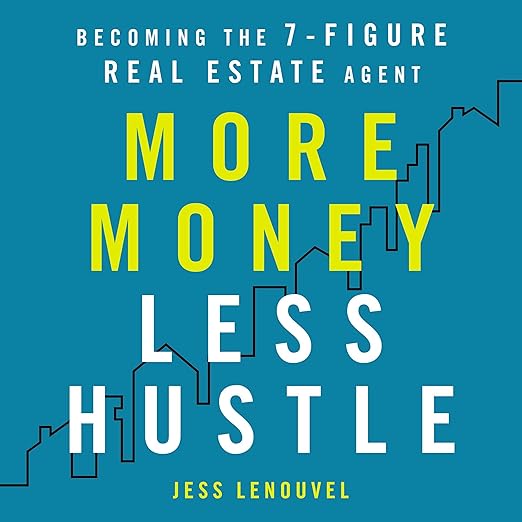
I came to More Money, Less Hustle already knowing something about its author’s reputation in real estate marketing circles. Jess Lenouvel built a following by telling agents things they didn’t want to hear about their own businesses, and this audiobook, at just over three hours, is concentrated in that same spirit. I listened to it on a Saturday morning while going through my notes from a conversation I’d had the week before with someone who runs a small brokerage, and the alignment was almost uncomfortable. Nearly everything Lenouvel identifies as structural dysfunction, I had just watched being lived out in real time.
The central argument of the book is that the real estate industry evolved in a pre-digital era and most of its training still reflects that. Cold calling, mass mailers, pursuit-based marketing: these were built for a world where agents competed primarily on local visibility and the phone was the only direct channel to potential clients. Lenouvel’s contention is that social media has fundamentally changed what works, not marginally, but structurally, and that agents who haven’t internalized that shift are working harder than they need to for worse results than they should be getting.
Our Take on More Money, Less Hustle
Lenouvel organizes her methodology around six pillars, which she walks through sequentially across the book’s compact runtime. The pillars address online presence, content strategy, relationship systems, team culture, and the psychological infrastructure that underlies sustainable success. She is specific rather than motivational: less about mindset at a general level, more about the precise mechanics of why most agents’ online presence fails to convert and what the structural fixes look like.
One reviewer who has been in the industry for thirty years described the book’s approach as empathetic and intuitive, contrasting it with the aggressive, volume-based methods that dominated real estate training for decades. That contrast is real. Lenouvel writes from a position of having built a seven-figure practice herself, and she includes honest reflection on the cost of the old model, including what it did to her marriage when her business was built on constant availability and reactive client service. That autobiographical candor gives the framework credibility that pure theory wouldn’t have.
Why Listen to More Money, Less Hustle
Author narration here is a significant asset. Lenouvel’s delivery is direct and conversational rather than scripted, and she brings genuine urgency to the sections where she describes what it feels like to be trapped in the hustle model, working constantly and still feeling like the business could collapse if you stopped. That experiential authenticity translates to audio in a way that a hired narrator reading someone else’s convictions simply cannot replicate.
The brevity is also worth noting as a deliberate feature rather than a limitation. At three hours, this is a book that respects the listener’s time and trusts them to apply the principles rather than padding the methodology with filler examples. One reviewer described reading the entire book in two sittings and going back immediately to re-read sections while taking notes. The audio version rewards the same kind of active engagement: pause, reflect, implement.
What to Watch For in More Money, Less Hustle
The book is explicitly targeted at real estate agents, and specifically at agents who already have a baseline of industry experience. If you are newer than a year or two, some of the structural critiques may not yet resonate because you haven’t lived the dysfunction being described. The framework’s strength is in helping experienced agents diagnose what isn’t working; it is less useful as an entry-level guide to building a practice from scratch.
Three hours is also a real limitation for certain kinds of learning. The six pillars receive a thorough introduction but not exhaustive development. Lenouvel is pointing to systems and principles rather than providing fully detailed implementation guides, and listeners who need step-by-step tactical instructions for social media strategy will need to supplement this with additional material. The book is the why and the what; the exact how requires further work.
Who Should Listen to More Money, Less Hustle
Real estate agents with two or more years of experience who feel like they are working too hard for their results, especially those who know their online presence isn’t converting but can’t identify why, will find this the most efficient diagnostic tool available in audio. It is also relevant for team leaders and broker-owners evaluating their office culture and systems. Skip it if you are brand new to the industry or if you are looking for a comprehensive social media marketing course; this is a strategic framework, not a tactical manual.
Frequently Asked Questions
Is More Money, Less Hustle relevant for agents in any real estate market, or is it US-specific?
The principles are broadly applicable to any market where social media and digital marketing have become primary client-acquisition channels, which is most markets. Lenouvel’s specific examples skew toward North American real estate dynamics, but the framework translates reasonably well internationally.
How does the author-narrated format affect the listening experience?
Positively, particularly for the autobiographical sections where Lenouvel describes her own experience building a seven-figure practice while dealing with burnout. The personal urgency she brings to those passages would be harder to convey through a hired narrator. The downside is that the pace can feel fast when taking notes on the six pillars.
Is this book appropriate for new real estate agents just starting their careers?
It’s worth a listen, but the full value comes from recognizing patterns you’ve already experienced. Lenouvel’s critique of the old hustle model is most resonant if you’ve already been through a cycle or two of cold-calling and high-pressure tactics. Brand-new agents may find the framework motivating but abstract.
What are the six pillars Lenouvel describes, and does she go into enough detail on each?
The pillars cover online positioning, content creation, audience building, relationship systems, team culture, and business mindset. In a three-hour audiobook, each receives a solid introduction and key principles rather than exhaustive implementation detail. Think of it as a strategic map that directs you where to go deeper.