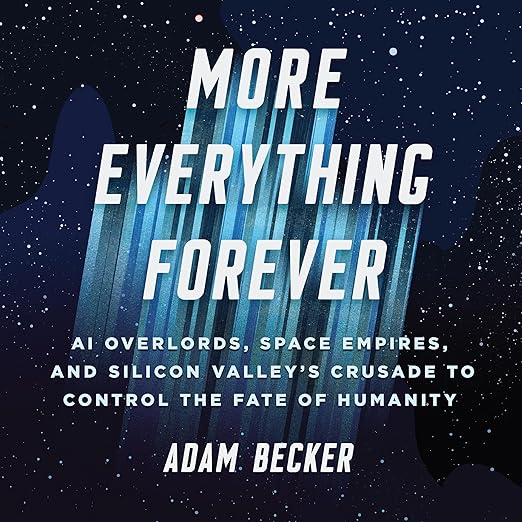
Quick Take
- Narration: Greg Tremblay delivers Becker’s sharp, measured critique with calm authority, his dry, unhurried pace suits the book’s scientific methodicism perfectly.
- Themes: Tech utopianism and its ideological roots, billionaire power under the guise of progress, the cost of distraction from real-world problems
- Mood: Intellectually bracing and quietly furious
- Verdict: For anyone trying to understand why Silicon Valley’s wildest ideas deserve more skepticism than awe, this audiobook is a rigorous and well-argued place to start.
I was driving back from a long weekend away when I started this one, and I made the mistake of letting it play while stuck in traffic. By the time I reached the highway, I had mentally drafted two angry letters I will never send. That is probably the most honest description of what Adam Becker’s More Everything Forever does to you: it makes you feel simultaneously smarter and considerably more unsettled about the present moment.
Becker is a science journalist, and his background shows throughout. He does not write as a tech skeptic with a political ax to grind. He writes as someone with the academic grounding to actually evaluate the claims being made by Elon Musk, Sam Altman, Jeff Bezos, and their ideological neighbors, and to find them wanting. What he uncovers is not just foolishness but a specific kind of dangerous foolishness: ideas dressed up in scientific language that have very little actual science behind them.
Our Take on More Everything Forever
The book’s central argument is that the techno-utopian vision, trillions of humans living in space, digital immortality, superintelligent AI that will either save or destroy us, is not just implausible but actively harmful. These are not fringe ideas. They are being funded at scale, discussed seriously in policy circles, and shaping the allocation of resources away from problems we know how to address: climate change, poverty, public health infrastructure. Becker is methodical in dismantling the scientific credibility of each pillar. One reviewer called out his line after describing a hypothetical plan to harvest energy from distant galaxies: Why do Oxford ethicists want this? It is a genuinely funny moment in a book that otherwise keeps its tone dry and rigorous.
What distinguishes this from the typical tech-critique genre is Becker’s willingness to trace the ideology backward. He connects names and movements that most readers will not have linked before, shallow futurism, effective altruism’s more extreme offshoots, and what he describes as racist pseudoscience at the intellectual roots of some of these visions. That historical scaffolding is where the book earns its most serious weight.
Why Listen to More Everything Forever
Greg Tremblay is an excellent choice for this material. His narration has a measured, even-keeled quality that suits Becker’s voice: the book does not rant, and neither does Tremblay. There is an almost clinical calm to the delivery that makes the damning passages land harder than they would with a more theatrical narrator. When Becker describes these visions as coming from a jumbled mix of shallow futurism and racist pseudoscience, Tremblay reads it like a doctor delivering a diagnosis. That restraint is its own kind of power.
At just under eleven hours, the runtime feels appropriate. Becker does not pad. Each chapter builds on the last, and by the midpoint the cumulative effect is genuinely affecting. The listener who went in mildly curious about the AI debate will emerge with a more precise vocabulary for why these conversations have gone sideways.
What to Watch For in More Everything Forever
The book’s strongest sections are the ones where Becker examines what these visions actually require us to believe, and how poorly those beliefs hold up to scrutiny. The AI existential risk argument, for instance, is not dismissed as obviously wrong but dissected carefully: Becker shows how fear of a rogue superintelligence has become a funding and attention sink that benefits the very companies best positioned to build that superintelligence. That circularity is maddening once you see it.
The weaker moments come when the book pivots from debunking to prescription. Becker is more comfortable tearing down than building up, and his suggestions about what we should do instead of chasing Silicon Valley’s fantasies are relatively brief. For a book that runs nearly eleven hours dismantling bad futures, a few more pages on plausible good ones would not have hurt. This is a minor structural complaint, not a fatal flaw.
Who Should Listen to More Everything Forever
This audiobook will reward readers who follow technology news but want a more rigorous analytical framework than journalism typically provides. It is also worthwhile for anyone who has felt vaguely uncomfortable with the AI discourse but lacked the conceptual tools to explain why. Scientists, policy professionals, and anyone working in or adjacent to tech will find this especially useful. Listeners looking for a neutral overview of AI capabilities or a straightforward technology guide should look elsewhere, this is a critique, not a primer. And if you already believe every word of Sam Altman’s TED talks, this will not be a comfortable listen.
Frequently Asked Questions
Does Adam Becker address the more mainstream AI concerns, or is this focused only on extreme longtermism?
Becker covers both. He addresses everyday AI fears and their relationship to the more extreme longtermist arguments, showing how the two feed each other in ways that distort public debate.
Is More Everything Forever balanced, or does it read as a one-sided polemic?
It is explicitly critical rather than neutral, but Becker grounds his arguments in scientific evidence and careful sourcing. Reviewers have consistently noted the calm, methodical tone rather than emotional outrage.
How does Greg Tremblay’s narration handle the book’s technical and philosophical sections?
Tremblay keeps a steady, authoritative tone throughout, he does not dramatize or editorialize, which serves the material well. The more philosophical passages benefit from his measured pacing.
Does the book discuss specific companies and individuals by name?
Yes, Elon Musk, Jeff Bezos, Sam Altman, Peter Thiel, and Marc Andreessen are all discussed directly, with their stated positions quoted and examined against the scientific record.