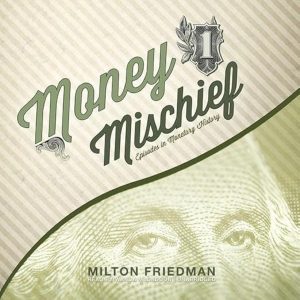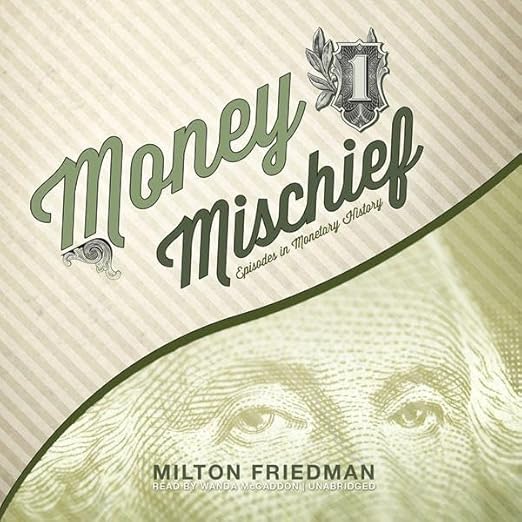
I was on a stretch of reading economic history when I came back to Milton Friedman, and Money Mischief arrived in my queue between a general history of the Federal Reserve and a more recent account of quantitative easing. Placed in that company, Friedman's 1992 collection reads like the baseline text that makes the others intelligible. The book's central argument, that misunderstandings of monetary systems have caused enormous real-world damage, from the destruction of political careers to the inadvertent tilting of geopolitical power, sounds almost conspiratorial until Friedman lays out the evidence, at which point it sounds simply true.
The Nobel laureate organizes Money Mischief as a series of essays on monetary theory and history, arranged to move from the curious and accessible to the highly technical. The opening chapters deal with the history of different monetary systems, from stone money on the island of Yap to the role of gold and silver in American politics, and these are among the most engaging hours in the audiobook. Friedman is at his best here: using counterintuitive examples to illuminate how value is socially constructed rather than inherent, and how that construction shapes everything downstream.
Two Scottish Chemists Who Sank Bryan's Campaign
The claim embedded in the synopsis, that two obscure Scottish chemists inadvertently destroyed William Jennings Bryan's presidential prospects, is the kind of hook that makes you trust an author. It involves the unexpected discovery of a process to extract gold from low-grade ore, which shifted the monetary politics of late nineteenth-century America in ways that Bryan's silver-centered campaign could not survive. Friedman traces this connection with the pleasure of someone who genuinely finds economic history delightful, and that quality carries the listener through the more demanding passages.
The more challenging sections involve Friedman's technical analysis of silver policy and his "what if" counterfactual scenarios, particularly in chapter four. He himself suggests that readers may want to skip this chapter, and at least one experienced reader concurred, noting that later chapters return to accessibility. On audio, there is no skipping mechanism as clean as in print, so listeners should know in advance that the middle section is where patience pays off.
Nadia May's Pace for Dense Monetary Argument
Nadia May's narration is well-chosen for this material. She reads Friedman's analytical prose with enough pace to maintain momentum without rushing past the conceptual turns that require time to process. There is nothing theatrical about her performance, which is exactly right, Friedman's arguments depend on being understood rather than felt, and a more emotive reader would have distorted the register.
The book also illustrates something important about Friedman as a communicator. Unlike his more explicitly polemical work such as Free to Choose, Money Mischief is addressed primarily to readers already familiar with economic thinking. One reviewer accurately described it as aimed at monetary economists rather than a general audience. At six hours and twenty-three minutes, the audiobook is not long, but the density of ideas per hour is considerably higher than most popular economics titles.
FDR's Silver Policy and China's Destabilization
The most politically striking section of the book concerns Franklin Roosevelt's decision to purchase large quantities of silver to placate senators from silver-producing western states, a decision that, Friedman argues, had the unintended consequence of destabilizing Chinese monetary policy and ultimately strengthening the conditions that allowed the Communist Party to consolidate power. This is the kind of argument that economic historians debate with considerable fervor, and Friedman presents his case without hedging. Listeners coming from different political traditions will want to bring their own skepticism to his conclusions, even as they benefit from the analytical method he models.
The discussion of inflation, what causes it, how monetary policy either addresses or exacerbates it, and why the political incentives around monetary management so consistently push in the wrong direction, is as relevant now as when Friedman wrote it. The specific case studies feel dated in places, but the underlying theory does not.
Best Paired With Friedman's Bigger Books
Listeners who have already read Friedman's A Monetary History of the United States or Free to Choose will find this a satisfying companion. Those coming to monetary economics for the first time will benefit more from starting elsewhere and returning to this once the foundational concepts are in place. The writing assumes familiarity with basic monetary theory, and the middle chapters will be rough going without it.
Key Details
- Narration: Nadia May brings a composed, unhurried clarity to Friedman's analytical prose, appropriate for a text that rewards careful attention over speed.
- Themes: Monetary history, inflation causation, the political consequences of economic misunderstanding
- Mood: Intellectually rigorous, historically grounded, occasionally daunting
- Verdict: An essential listen for anyone serious about monetary economics, though readers new to the subject should approach chapter two and three with patience and possibly a notepad.
Common Questions
Is Money Mischief accessible to readers without an economics background?
Only partially. The opening and closing chapters are readable without specialist knowledge, but chapters two and three cover technical monetary theory that readers have found challenging even with some economics training. Friedman himself suggests skipping chapter four if the technical detail becomes a barrier.
Does Nadia May's narration handle the technical economic passages well?
Yes. Her measured, unhurried delivery suits analytical prose that rewards attention. She doesn't rush past complex passages, which matters considerably in a text where the logic builds across paragraphs.
Is the content still relevant given that this was published in 1992?
The specific case studies involve historical episodes, but Friedman's analysis of inflation causation and the political incentives around monetary management remains directly applicable to contemporary policy debates. The history has dated; the theory has not.