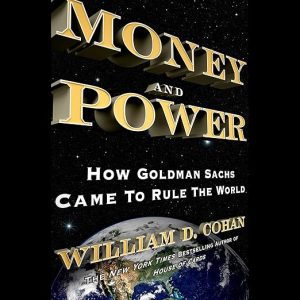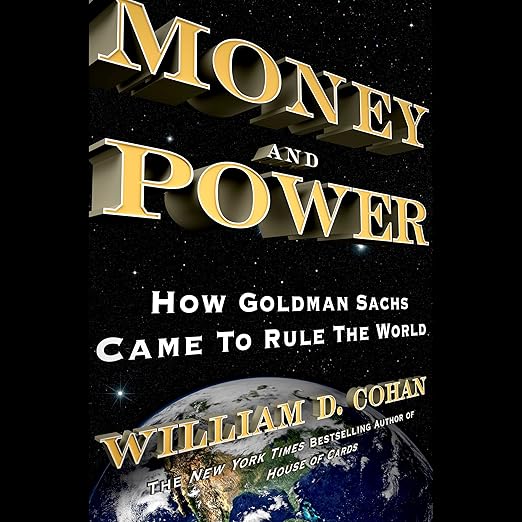
I started Money and Power on a Sunday afternoon and found myself still listening three evenings later, not because William Cohan's prose is particularly propulsive, but because the story he is telling about Goldman Sachs kept pulling me back in ways I did not entirely expect. I had read Michael Lewis's The Big Short and understood the broad outlines of how the mortgage crisis unfolded. What I had not fully grasped was the institution at the center of it all, and thirty hours with Cohan changed that considerably.
Cohan is the author of House of Cards and The Last Tycoons, and he brings the same documentary rigor to Goldman Sachs that he brought to Bear Stearns and Lazard Freres. This is not a polemic dressed up as journalism, even if the subject matter sometimes begs for one. What Cohan achieves instead is something rarer: a genuinely nuanced institutional biography that follows Goldman from its founding through its stunning windfall during the 2008 financial crisis, with access to current CEO Lloyd Blankfein and dozens of insiders along the way.
Goldman's Mortgage Bet and Its Blurred Ethics
The central tension that animates this book is whether Goldman Sachs is a uniquely gifted firm that happens to operate in an industry where ethical lines are congenitally blurry, or whether it is an institution whose culture of power and paranoia has bent those lines so far that they no longer apply. Cohan, to his credit, does not fully resolve this question. He presents evidence for both readings and lets the weight of accumulated detail do the arguing. The firm's notorious bet against the mortgage market in 2007, made while selling mortgage-backed securities to clients, is handled with careful specificity. It is not presented as simply villainous, but the picture that emerges is not flattering either.
One reviewer called this the definitive biography of Goldman, and that assessment feels accurate. The depth of research is extraordinary. The author gained broad access to major figures across multiple decades of Goldman's history, and the result is a portrait with real texture. You understand how the firm's partnership culture shaped its risk tolerance, how its revolving door with the US Treasury and Federal Reserve became institutionalized, and how the famous Goldman ethos of client service coexisted with behaviors that systematically prioritized the firm's own interests.
Shapiro's Measured Read Across Thirty Hours
The audiobook format suits this material particularly well. Rob Shapiro's narration has the measured authority of someone reading from a court document, which sounds like faint praise but is actually appropriate. The facts here are serious and the prose is dense, and Shapiro keeps you oriented through thirty hours without the energy either flagging or becoming overwrought. For listeners who have already read Cohan's work in print, the audio version adds a different kind of immersion, the sense of sitting through a long and comprehensive briefing rather than scanning a page.
What the book does exceptionally well is contextualize Goldman's power not as a matter of illegal activity or secret conspiracy but as the natural consequence of a culture that relentlessly attracts and promotes a very specific kind of intelligence. The scandals Cohan documents, going all the way back to Goldman's founding, accumulate not because the firm is uniquely corrupt but because it operates at a scale and proximity to government power that no other institution matches. That is the book's most unsettling insight, and Cohan lands it without editorializing.
Written in 2011, Shaped by Goldman's Access
The length is a genuine consideration. At thirty hours, this audiobook requires sustained attention, and several reviewers noted that the final quarter loses some momentum as the material becomes more granular and less narrative-driven. The book was also written in 2011, which means the most recent decade of Goldman's history is not covered, and some of the historical framing around emerging markets and geopolitical power reflects assumptions that have since been revised.
There is also a tension in the book's access. One reviewer observed that Goldman clearly supported this project, and while Cohan does not shy away from criticism, the broad access he received may have shaped what questions got asked and how deeply. Readers looking for a sustained takedown will find the book's evenhandedness frustrating. Those looking for genuine complexity will find it satisfying.
Deeper Than a Fast-Paced 2008 Narrative
This one is built for listeners with genuine interest in financial history and institutional power, not as casual background listening but as a committed engagement. Anyone who worked through Cohan's earlier books, or who found John Lanchester's Whoops or Gregory Zuckerman's The Greatest Trade Ever too brief, will find this deeply rewarding. Listeners who want a faster-paced narrative about the 2008 crisis would do better starting with The Big Short. But for the definitive, warts-and-somewhat-intact portrait of the most powerful investment bank in history, there is nothing else quite like this.
Does Money and Power cover Goldman Sachs's role in the 2008 financial crisis in detail?
Yes. The book devotes substantial attention to Goldman's controversial bet against the mortgage market in 2007, including the internal reasoning behind it and the Senate hearings that followed. It is one of the most detailed accounts available.
Is Rob Shapiro's narration suitable for thirty hours of dense financial history?
Shapiro is well-suited to this material. His pacing is measured and clear, and he handles technical financial terminology without stumbling. The narration does not inject dramatic flair, which suits the book's documentary tone.
How current is the information given this was published in 2011?
The book covers Goldman's history from its founding through approximately 2010-2011. The analysis of the financial crisis is thorough and still relevant, but significant Goldman stories from the past decade, including various regulatory actions and its consumer banking venture, are not covered.
Is this book sympathetic or critical of Goldman Sachs?
It is genuinely both, which some readers find frustrating. Cohan documents scandals across Goldman's entire history without pulling punches, but he also presents the firm's perspective and reasoning throughout. One reviewer noted this feels connected to the broad internal access Goldman provided.