Stuxnet crippled a nuclear program. NotPetya shattered global supply chains. Between those two incidents sits an audiobook of thirteen hours and forty minutes that sets out to reconstruct the anatomy of the major cyber operations of the century so far, and to account for what each one cost in the physical world. The ambition is genuine and the material is inexhaustible. What the page never settles is how those hours are ordered, or how much a listener already fluent in this history stands to gain from hearing it again.
Every incident named in the copy is a matter of public record, which sets the bar high for a book like this. Stuxnet, the Sony Pictures breach, WannaCry, the SolarWinds compromise: each has been written up at length more than once, and a listener arriving from tech journalism will know the outlines already. The value has to come from sequencing and from consequence, from arranging the attacks so the pattern becomes legible, rather than from restating any one of them.
Four promises organize the material, and they are worth separating because they serve four different buyers. One is narrative reconstruction of landmark events. One is a taxonomy of method, covering nation-state operations, zero-day exploits, ransomware, distributed denial-of-service campaigns and malware evolution. One is expert commentary from analysts and former government operators. The last is practical defense: vulnerability assessment, incident response, organizational resilience. A book attempting all four in thirteen hours and forty minutes is dividing its attention four ways.
Chronology is the structural question the description leaves unanswered. Cyber history has a shape when told in order, because each operation inherits tooling from the last and the escalation is itself the story. Presented as a set of independent case studies, the same material becomes a catalog, and a catalog is a considerably harder listen than a narrative. Nothing on the page settles which shape this one takes, and the difference is the difference between an argument and a survey.
When a Worm Crippled a Nuclear Program
Consequence is what lifts this subject above a list of exploits, and the copy leads with exactly that. A worm crippled a nuclear program. A blitz shattered global supply chains. Those are physical outcomes produced by code, and stated plainly they accomplish what no amount of technical detail can accomplish for a lay listener. If the book sustains that emphasis, the case-study format earns its length, because every chapter arrives with a visible cost already attached to it.
Defense is the second half of the pitch, and it is the half that justifies the length for a working professional. Vulnerability assessment, incident response and resilience are offered as practice rather than theory, which turns a history into something closer to a briefing. Spoken word is an awkward medium for a checklist and a very good one for the reasoning behind a checklist, and reasoning is precisely what the post-mortem of a real breach supplies.
Audience breadth is the third claim, and it cuts in both directions. The copy addresses cybersecurity professionals, IT managers, policy makers and general enthusiasts inside a single sentence, which amounts to four separate levels of prior knowledge. A book written for all four either pitches to the least informed and bores the rest, or pitches high and loses the largest share of its market. The useful question before buying is which of those four you actually are.
This Recording Credits No Human Narrator
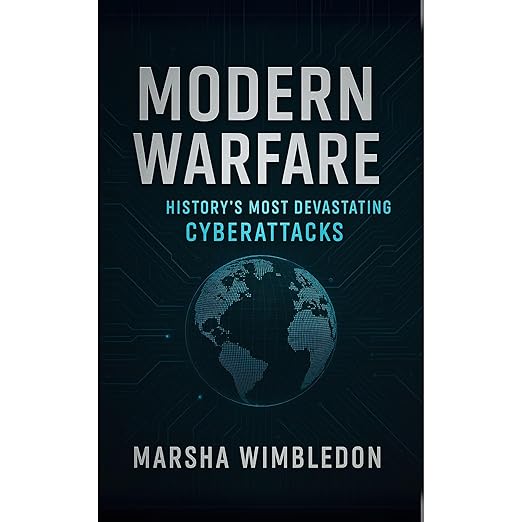
Naming is the first problem here. The listing title runs to two words while the copy inside supplies the full one: Modern Warfare, followed by a subtitle specifying History's Most Devastating Cyberattacks. Stripped of that subtitle, the title becomes a generic phrase shared with a great many unrelated products, and the missing half is the half that tells a browsing listener what the book actually is. Search on the subtitle before assuming you have found the right entry.
No performer is credited on this recording. The reader field reads Virtual Voice, meaning text-to-speech rather than a person in a booth, and on this particular subject the consequence is specific. Security writing is full of strings that are neither ordinary words nor ordinary abbreviations, and a synthesis engine decides silently, occurrence by occurrence, whether to speak one as a word or spell it out. NotPetya and WannaCry read as words. DDoS does not.
Keywords survive at the foot of the description, in a labeled block listing search terms rather than content, and the final line asks you to order your copy today. Both are artifacts of retail copy written for a printed or digital page and left in place on an audio entry. Two ratings sit above them, and at that count the displayed five is arithmetic rather than evidence: two whole-star votes at the ceiling, and not a sentence from either of them.
Explaining the Pattern to a Room of Executives
Security professionals who already know these incidents in detail should treat this as consolidation rather than a source. Having Stuxnet through SolarWinds arranged in one continuous sequence, instead of scattered across a decade of reporting and incident write-ups, has real value when the job involves explaining the pattern to a board, a client or a room of people who authorize budgets without reading advisories.
Buy something else if you need a reference you can search. Spoken audio is the wrong container for a book carrying a taxonomy, and this one carries at least two: a list of attack methods and a list of defensive practices. Neither can be flipped back to when you need it. Anyone chasing the technical mechanics of one specific exploit will be far better served by a written account with diagrams.
Generalists get the better deal. A policy reader, a manager who signs off on security spending without writing code, or anyone who has watched these names scroll past in headlines for fifteen years without ever getting the order straight will find the format fits them well. The cost of entry is a synthetic reading and a listing that hides half its own title. Underneath both, the material is real and shows no sign of dating.
Quick Take
- Subjects: Nation-state cyber operations, ransomware and supply-chain collapse, the distance between an elegant exploit and its physical cost.
- Tone: Methodical and quietly alarming.
- Bottom line: A useful consolidation of two decades of cyber incidents, held back by a synthetic reading and a listing that drops half the title.