
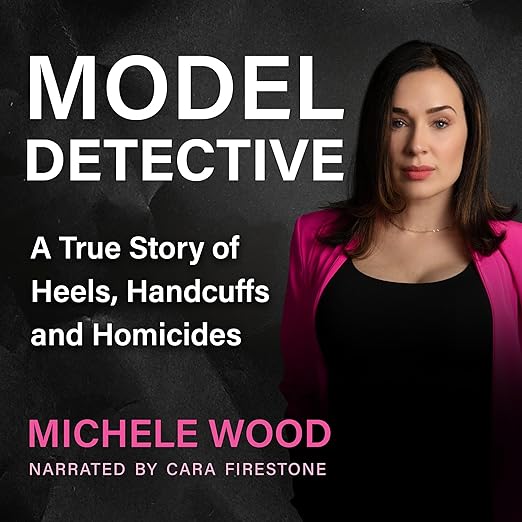
Sergeant Michele Wood walks a crime scene in this audiobook the way she apparently walks every crime scene: reading it. Not decoratively, not with the procedural performance that true crime television has made familiar, but with the specific interpretive intelligence that comes from twenty-five years in the Chicago Police Department and nearly two decades in the Detective Division. Cara Firestone's narration captures both the professional authority and the emotional cost of that career with considerable skill.
The premise of Model Detective is unusual. Wood is a Chicago homicide detective with an extraordinary clearance record and a background that includes working as a flight attendant and moonlighting as a fitness-magazine model before entering law enforcement. She is also a recurring legal expert on ABC's 20/20 and other national crime programs. The combination of these biographical facts could easily tip into celebrity memoir territory. Gave avoids that by keeping the case material primary.
She Reads a Crime Scene Differently
Wood's argument, implicit throughout and occasionally explicit, is that her perspective as a woman has been an asset rather than an obstacle in homicide work. She reads the emotional dynamics in a crime scene differently than her male colleagues. She interrogates witnesses in a register that produces different results. The male-dominated world of the Chicago homicide division is not presented as a simple antagonist; it is a system she learned to work within and eventually to lead. Reviewer Syl notes that 'every chapter prepares you for the next,' which reflects the book's structural logic: Wood is building a case for how she arrived at her methods, not just cataloging her achievements.
The case material is specific enough to function as genuine true crime. Wood walks through how she interprets evidence, how she uses behavioral observation during interviews, and how she develops the instincts that have produced her clearance record. Reviewer Leana C. notes that the book 'strips away the glamorous portrayal of female officers we see on TV,' which is accurate. Wood describes the emotional toll, the long hours, and the specific difficulty of carrying homicide work over time without sentimentalizing any of it.
Firestone Modulates Between Flatness and Reflection
Cara Firestone's narration is a strong match for the material. Wood's voice in print has the directness of someone who gives testimony professionally, and Firestone delivers that quality without the performed authority that can make memoir narration feel like a news broadcast. She modulates between the case recollections, which require a certain flatness to honor the subject matter, and the more personally reflective passages, where Wood is accounting for how the work has shaped her. Reviewer Sophia Jugo's description of being 'pulled in from the very beginning' reflects the pace Firestone helps establish.
The Chicago upbringing sections, which cover Wood's early life and the path that eventually led to law enforcement rather than the more obvious career trajectories available to a woman with her professional range, are where the book's ambition becomes clearest. Wood is not simply recounting cases; she is constructing a self-portrait of professional formation. The flight attendant and modeling chapters are not digressions; they are evidence for how her capacity for reading people, managing situations, and maintaining composure under pressure developed before she put on a badge.
What Modeling and Flight Attendant Work Taught Her
This audiobook sits between memoir and true crime in a way that may not fully satisfy readers looking for either in pure form. The case details are real but treated with a degree of emotional distance that reflects Wood's professional disposition. Listeners who want the narrative immersion of a true crime investigation, with full victim and perpetrator profiles and detailed procedural breakdown, should calibrate their expectations accordingly. What Wood offers is a veteran detective's perspective on how investigation works, not the sensation of a crime narrative reconstructed for dramatic effect.
The policing of Chicago involves contexts, including questions of institutional violence and community trust, that Wood approaches from inside the institution. Her account of navigating a male-dominated system is candid and her critique of certain institutional failures is real, but listeners expecting a systemic critique of American urban policing more broadly will find the book's orientation different from that frame.
The flight attendant and modeling chapters of Wood's background are sometimes treated in coverage of this audiobook as curiosities or branding elements. Wood herself rejects that framing within the narrative. She is specific about what those careers taught her about reading people under pressure, managing difficult interpersonal dynamics across cultural and class boundaries, and maintaining composure in situations where composure is professionally required even when it is personally costly. These are precisely the skills that Chicago homicide investigation demands, and Wood's account of her formation as a detective is more coherent for including them rather than treating them as pre-career detours.
A Career Portrait as Much as a Case File
True crime listeners who want access to a working detective's interpretive framework rather than a dramatized case reconstruction will find this genuinely distinctive. Women navigating male-dominated professional environments will recognize the specific calculus of Wood's career management. Listeners interested in how investigative instincts develop over a long career, rather than in any single case, will find the cumulative portrait of Wood's methods among the most interesting things the book offers.
Listeners who want a traditional memoir arc or a book focused primarily on specific murders rather than on the detective making sense of them should approach with adjusted expectations. Model Detective is a career portrait as much as a case file, and the distinction matters for what kind of listening experience you will have.
The Short Version
- Narration: Cara Firestone captures Wood's professional directness and emotional restraint, modulating cleanly between case recollection and personal reflection throughout the five-hour runtime.
- Themes: Women in law enforcement, professional formation over a long career, reading crime scenes through a distinct interpretive lens
- Mood: Candid and grounded, with the weight of Chicago homicide work underneath the professional surface
- Verdict: A career portrait of a homicide detective whose methods and perspective challenge the genre's usual templates, narrated with matching authority.
Frequently Asked Questions
How does Cara Firestone's narration handle the true crime case material in this audiobook?
Firestone delivers the case sections with the directness of professional testimony rather than dramatized recreation. She maintains the emotional register Wood herself brings to homicide work: present and engaged but not sensationalized. The modulation between case recollections and Wood's more personal reflections on her career is one of the narration's strengths.
Does this audiobook engage with the broader institutional context of Chicago policing?
Wood's account focuses primarily on her own career navigation within the homicide division rather than on systemic critique. She is candid about the difficulties of working in a male-dominated institution and acknowledges certain institutional failures. Listeners expecting extended engagement with questions of policing and community trust will find the book's orientation more personal than structural.
What does Wood's background as a flight attendant and model contribute to the audiobook's story?
Wood frames those earlier careers as relevant to her investigative methods rather than as biographical curiosities. The capacities she developed for reading emotional dynamics, managing high-stress situations, and maintaining composure in unpredictable environments transferred directly into her work as a detective. The book makes this case explicitly rather than just mentioning the biographical facts.







