Quick Take
- Narration: Jonathan Todd Ross delivers a clear, purposeful performance suited to the book’s urgent, argumentative register, propulsive without being breathless.
- Themes: American industrial decline, defense technology competition, the history of wartime production
- Mood: Urgent and polemical, historically grounded
- Verdict: A pointed, well-researched argument about American manufacturing capacity that takes its historical case seriously, compelling even for readers who don’t share all of its conclusions.
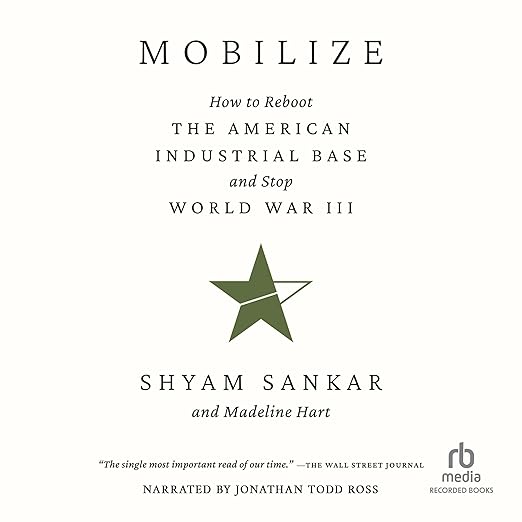
I went into Mobilize expecting a defense-industry manifesto and found something more interesting: a history book with an urgent contemporary argument embedded inside it. Shyam Sankar, Chief Technology Officer of Palantir, has written the kind of book that uses the past as a mirror rather than a prop. The argument is insistent, occasionally repetitive, but the historical reporting underneath it is genuinely engaging, and Jonathan Todd Ross’s narration keeps the nearly ten hours of material moving with appropriate drive.
Sankar’s central claim is straightforward and alarming: the American industrial base that underwrote twentieth-century military dominance has been allowed to atrophy, and the consequences of that atrophy are becoming visible in ways that matter. Where the book gets interesting is in how it makes that case, not through abstract strategic analysis, but through specific stories of the Americans who built the industrial capacity that won World War II, and the institutional decisions that dismantled it afterward.
Our Take on Mobilize
Reviewer Nick Powers called it “one of the rare books that actually shifted how I see the present by reframing the past,” and that is the experience when the book is working at its best. Sankar and his co-author Madeline Johnsen ground the argument in real historical events, the mobilization of General Mills and Chrysler for wartime production, the relationships between innovators and warfighters that produced the technologies of the Cold War era, and those stories are well-researched and vividly told. The contrast with the present situation, in which China leads the world in manufacturing and American defense procurement moves at institutional pace, is developed with genuine rigor.
Why Listen to Mobilize
The audiobook’s release in early 2026 positions it in a specific political moment, and Sankar is not shy about that positioning. Reviewer BF Palo Alto noted that “modern military conflict is less about tanks and more about tech,” and Sankar’s argument is precisely about the infrastructure gap between those two realities. Ross’s narration suits the book’s argumentative rhythm, he reads with conviction but without the hectoring quality that can make polemical nonfiction unbearable in audio form. At just under ten hours, the book is long enough to develop its historical case without overstaying its welcome.
What to Watch For in Mobilize
This is an explicitly partisan book. Sankar comes from Palantir, a defense technology company with strong views about the relationship between the private sector and the American military, and those institutional sympathies are present throughout. The argument that exceptional individuals empowered by capitalism and competition are the answer to American defense challenges is stated directly and will strike some readers as more ideologically motivated than the historical analysis that supports it. That doesn’t make the underlying history false, the industrial decline Sankar describes is real and documented, but it means the book works better as a case for attention to the problem than as a comprehensive solution. Readers who share Sankar’s political orientation will find it clarifying; those who don’t will need to engage more critically with the prescriptive chapters.
Who Should Listen to Mobilize
One thing Sankar does well that many defense policy writers do not: he names specific failures and specific institutions rather than speaking only in the passive voice of systemic dysfunction. That specificity gives the argument teeth and gives listeners something concrete to evaluate. It also means the book will irritate readers with strong institutional loyalties in the Pentagon procurement world, but that irritation is probably part of the point.
Defense policy professionals, national security researchers, and anyone following the US-China technology competition will find this a useful, accessible synthesis. The historical chapters on World War II industrial mobilization are strong enough to reward readers with no particular interest in defense policy, they’re good military and industrial history on their own terms. Those who are skeptical of the defense-tech industry’s self-assessment of its own necessity should approach this as a well-argued position paper rather than a neutral analysis. Either way, the urgency is real and the research is solid.
Frequently Asked Questions
Does Mobilize go into technical detail about specific defense technologies, or is it more focused on industrial and policy arguments?
It’s primarily focused on industrial capacity and institutional policy rather than technical specifications. Sankar uses technology as a lens for examining broader questions about manufacturing, innovation ecosystems, and the relationship between government and industry.
How does Jonathan Todd Ross’s narration handle the book’s shifts between historical narrative and contemporary argument?
Ross manages those transitions smoothly. The historical chapters and the contemporary policy analysis require different registers, and he adjusts his pace and tone accordingly, more expansive for the historical storytelling, more direct for the argument sections.
Is Mobilize written by Shyam Sankar alone, or does it have co-authors?
The book was written with co-author Madeline Johnsen, though Sankar’s name is primary on the cover. The collaboration draws on his experience as Palantir’s CTO alongside broader research into industrial and defense history.
How does Mobilize position itself relative to the current US-China geopolitical competition?
Explicitly. Sankar argues that China’s manufacturing lead represents a strategic threat comparable to the Cold War-era challenge the US faced from the Soviet Union, and that the response requires a similar mobilization of industrial and technological resources. The book is a call to action framed through historical analogy.