
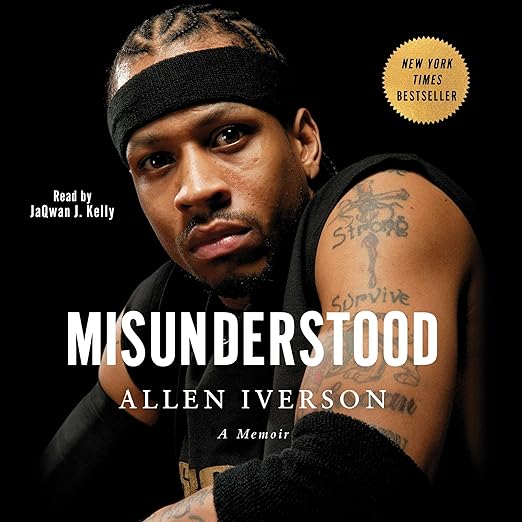
Allen Iverson's Misunderstood audiobook caught me off guard in the best way. I expected sports biography: the statistics, the highlights, the standard arc of triumph-over-adversity. What I got instead was something rawer and more personal than most athletes allow themselves to be in print. Iverson's story begins not on a basketball court but in the Virginia projects, and the memoir never lets you forget that those origins shaped every single thing that followed. His foremost goal, he tells us, was never fame or fortune. It was to lift his family and friends out of poverty and violence, and that purpose runs underneath every chapter, including the difficult ones.
The production clock runs just over nine hours, and JaQwan J. Kelly's narration keeps the pacing tight. Kelly reads with the kind of physical presence you rarely hear in sports memoirs, a voice that has weight behind it. When the prose moves into the hard chapters of Iverson's childhood, poverty, violence, absent fathers, the performance does not sentimentalize or rush. It lets the material breathe at exactly the speed the story requires.
How the Answer Sneaker Outlived the Playing Career
What makes this memoir genuinely compelling is the way it refuses to separate the man from the cultural moment. Iverson was not just a basketball player who wore cornrows and baggy clothes. He was the first major NBA star to make that aesthetic unapologetic and mainstream, and the league spent years trying to legislate against what he represented. The memoir walks through those confrontations with the NBA dress code, the legal troubles, the media narratives, with a clarity that is neither self-pitying nor self-aggrandizing. One reviewer described it as an unfiltered look behind the curtain, and that is accurate. Iverson names his mistakes as his own while also naming the systems that were stacked against him from birth.
The Reebok chapters are illuminating in ways the marketing does not fully prepare you for. Iverson's rise to Vice President of Basketball at Reebok, his role in the Answer sneaker line's cultural resurgence, and the way his identity became a brand that outlasted his playing career are treated with the same candor as his court appearances. The cultural fingerprint is enormous: Post Malone's White Iverson, Kendall Roy's son on Succession, generations of players who came after him and dressed and played with a freedom he spent his whole career fighting to preserve.
Kelly Finds the Ambivalence in John Thompson
Kelly's narration deserves its own discussion. The decision to cast a narrator rather than have Iverson read himself carries some risk in a memoir this personal, but Kelly threads the needle well. He does not impersonate Iverson or perform the voice in an obvious way. Instead, he reads the text as though he understands exactly what is at stake in each sentence. The Georgetown section, centered on Iverson's relationship with legendary coach John Thompson, is particularly well-handled. Thompson appears as a complicated figure, demanding and protective, and the narration finds the nuance without tipping the balance one way or the other. The memoir's description of Thompson as a protector who also made extraordinary demands on Iverson comes through with full ambivalence intact.
The sections on Iverson's mother carry the most emotional weight in the book. She is the thread connecting the poverty of the Virginia projects to the NBA, and Iverson writes about her with a plainspoken love that avoids the typical memoir sentimentality. Kelly reads those passages without embellishment, which is exactly right. The story is powerful enough on its own terms.
Reading a Defense as Much as a Memoir
Anyone coming to this memoir expecting a balanced, journalism-style account of Iverson's career will find it is something more subjective than that. This is Iverson's version of events, written with the first-person force of someone who spent two decades being described by other people. He pushes back on narratives, settles some scores, and there are moments where you are reading a defense as much as a memoir. That is not a weakness. It is honest about what the book is. But if you are looking for deep reporting on the Philadelphia 76ers' organizational history or a thorough dive into the legal specifics of his cases, that is not what is on offer here.
There is also a structural looseness in the middle section that some listeners may notice. Iverson moves associatively rather than chronologically at times, jumping between themes rather than following a strict timeline. Kelly handles these transitions smoothly, but it can make the book feel slightly nonlinear through the mid-career chapters. Given the richness of the material overall, this is a minor note rather than a real criticism.
A Single Unfiltered Point of View for Every Generation
This audiobook is essential for anyone who watched Iverson play and never quite understood why he mattered beyond the points-per-game average. It is also for readers interested in the intersection of race, culture, and professional sports in the 1990s and 2000s, a period that looks very different with two decades of hindsight. Boomers, Gen Xers, millennials, and Gen Zers each have a different relationship with Iverson's name, and this memoir speaks to all of them from a single unfiltered point of view. If you were already a fan, there is enough here that you did not know to make nine hours feel short. If you were skeptical or indifferent to Iverson, this memoir will almost certainly complicate that. Skip it only if you have no patience for first-person accounts that keep their own counsel. Everyone else: this one rewards the time.
Key Details
- Narrator: JaQwan J. Kelly brings gravel and warmth to Iverson's voice, capturing the defiance and the vulnerability in equal measure.
- Subjects: Identity and authenticity, poverty and perseverance, the cost of staying true to yourself
- Tone: Candid, emotional, and unmistakably Philadelphia
- Bottom line: Allen Iverson tells the story only he could tell, and Kelly's narration makes it feel like he is telling it directly to you.
Before You Listen
Is JaQwan J. Kelly the right choice as narrator for this audiobook?
Kelly performs the material with real authority. He does not mimic Iverson's speaking voice, but he captures the emotional register of the prose, especially in the sections dealing with poverty, family, and identity. Listeners who have heard Iverson speak publicly may find the absence of the real voice briefly jarring, but Kelly wins you over within the opening chapters.
How much of the audiobook covers Iverson's time with the Philadelphia 76ers versus his broader cultural impact?
The 76ers years and the Georgetown period form the structural core, but the memoir repeatedly returns to the cultural questions: the dress code, the music, the fashion, the way Iverson's persona reshaped what an NBA star could look like. The basketball and the cultural commentary are woven together rather than separated into distinct sections.







