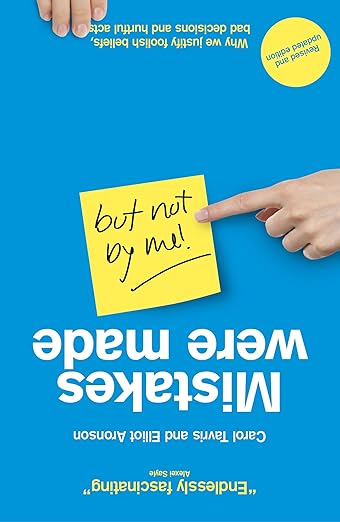
I first encountered Mistakes Were Made (But Not by Me) when a colleague mentioned it after a particularly frustrating editorial meeting in which several people had been demonstrably wrong about something and nobody had acknowledged it afterward. That context stuck with me. Social psychology books often feel like they are describing other people's deficiencies. This one felt uncomfortably personal from the first chapter.
Carol Tavris and Elliot Aronson are both giants in social psychology, and this collaboration brings together Tavris's gift for clear, urgent prose with Aronson's decades of research into cognitive dissonance. The central claim is clean and well-supported: when we make mistakes, we do not simply recognize them and adjust. Instead, we construct narratives that protect our self-image, narratives that often require us to double down, blame others, or reframe events in ways that preserve our sense of being smart, moral, and justified.
The Verdict, Briefly
The research Tavris and Aronson draw on is solid, and they deploy it through concrete examples rather than abstract theorizing. The chapter on marriage is particularly strong: the mechanism by which couples rehearse grievances and gradually construct alternate histories of their relationship, each partner's version of events becoming more self-exonerating over time, is described with a clarity that will make many listeners pause the recording to sit with the discomfort.
The political material is also well-handled. The book examines how the self-justification dynamic operates in law enforcement, politics, and public discourse, and the examples hold up well even across the years since publication. The underlying psychology has not changed, even if some of the specific case studies feel dated in their particulars.
Why Listen to Mistakes Were Made (But Not By Me)
Marsha Mercant's narration is an asset. She reads academic material with the kind of precision that keeps complex ideas legible without flattening the text into monotone. When Tavris and Aronson are being particularly pointed, as they sometimes are, Mercant allows a controlled edge into the delivery that signals the authors' intent without becoming dramatic. The prose itself is described by one reviewer as lively and energetic, which is an accurate characterization, and Mercant honors that quality.
At just over nine hours, the book is thorough without being exhausting. The pacing across chapters is well-managed, moving from foundational explanation of cognitive dissonance through applications in relationships, law, politics, and medical error. The breadth makes it useful for listeners approaching from almost any professional or personal context.
Points to Consider
One reviewer raised a substantive objection worth flagging: the handling of the Wakefield vaccine research controversy. The reviewer argued that the book presents the case from a specific perspective without fully engaging with the complexity of what the original research actually claimed. This is a genuine area where critical listeners should bring their own judgment rather than treating the book's framing as definitive. It is one passage in a long and otherwise carefully researched book, but it illustrates the irony the reviewer identified: a book about self-justification may itself have engaged in some selective presentation.
That caveat noted, the core psychological framework is robust and the examples that make it work do not depend on this controversy. The book's value as a diagnostic tool for recognizing self-justifying thinking, in others and in yourself, remains intact.
Who Should Pick Up Mistakes Were Made (But Not By Me)
Anyone who works in environments where accountability and blame are in tension, which is most workplaces and most relationships, will find this directly applicable. It is not comfort reading. It will make you recognize your own self-justification patterns, which is uncomfortable, and the hope is that recognition creates at least some space for different choices. Tavris and Aronson are honest that awareness alone does not automatically correct the behavior, which is a more useful framing than the promise most self-help books make.
Listeners interested in psychology, political behavior, or the sociology of institutions will get significant value here. The book is often assigned in university psychology courses, which reflects both its accessibility and its substantive contribution to how we understand human self-deception. If you have a person in your life who never admits they are wrong, this book will help you understand why, even if it will not help you convince them.
At a Glance
- Narration: Marsha Mercant delivers the material with crisp academic authority, keeping the prose energetic despite the density of the psychological research.
- Themes: Cognitive dissonance, self-justification, the psychology of blame and moral blindness
- Mood: Sharp and occasionally unsettling, like watching someone describe your own worst mental habits in clinical detail
- Verdict: One of the most genuinely useful books in social psychology, and a useful diagnostic for anyone who has ever watched someone refuse to admit they were wrong.
Common Questions
Does the book only apply to obvious cases of wrongdoing, or does it cover everyday self-justification?
Everyday self-justification is actually the primary focus. The book argues that the same psychological mechanisms that allow politicians to deny scandals operate in ordinary marital arguments, medical error cover-ups, and routine professional failures. The everyday applications are more frequent and more directly useful for most readers.
How does Marsha Mercant handle the book's shifts between academic research and narrative case studies?
She manages the transitions smoothly, adjusting pacing when the text moves from research summary to concrete example. The narration never sounds like a lecture, which is important for material that could easily become dry in less capable hands.
How does this compare to similar books like Robert Cialdini's Influence or Daniel Kahneman's Thinking, Fast and Slow?
It is narrower in scope than either but deeper on its specific topic. Where Kahneman maps the full architecture of cognitive bias, Tavris and Aronson focus specifically on the self-justifying behavior that follows mistakes. The books complement each other well but address different questions.