Quick Take
- Narration: Brian Troxell delivers the archival depth of Gilbert’s reporting with appropriate gravitas, though the shorter runtime means the emotional peaks arrive quickly.
- Themes: American identity and collective pride, the Cold War on ice, how a single sporting event shapes careers and lives for decades
- Mood: Celebratory and substantive, with a journalist’s precision underlying the emotional retelling
- Verdict: The definitive insider account of the 1980 Miracle on Ice, told by someone who was there with access that no subsequent writer has had.
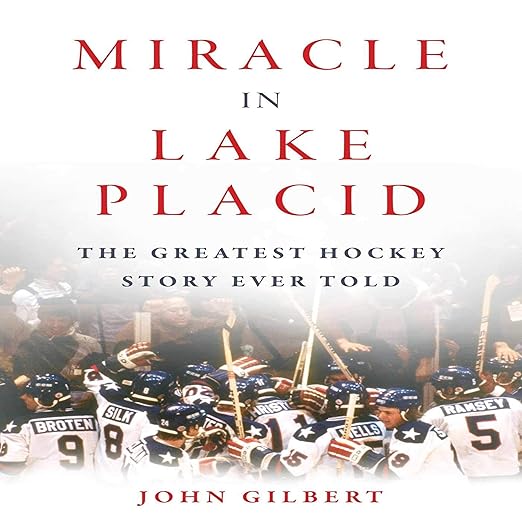
My father watched the US-USSR hockey game in February 1980 in real time and described it as one of the few moments in his life when he stopped whatever he was doing and sat down in front of the television in a way he hadn’t since the moon landing. I’ve been listening to accounts of that game my whole life. John Gilbert’s Miracle in Lake Placid is the best one I’ve encountered, and the reason is simple: Gilbert was actually there and kept records.
The 1980 Olympic hockey tournament at Lake Placid is one of those sports moments that has calcified into myth in a way that can obscure the actual historical specificity of what happened. The US team was assembled from college players. The Soviet team had been the dominant force in international hockey for more than a decade. The geopolitical context, the Iranian hostage crisis, the ongoing Cold War, the Soviet invasion of Afghanistan, meant that the game carried symbolic weight far exceeding what sports ordinarily bear. Gilbert reconstructs all of this with the precision of a journalist who was covering hockey at the time and has continued following the players and coaches through the decades since.
Our Take on Miracle in Lake Placid
What separates this from other accounts of the game is the post-event material. Gilbert traces what the victory meant for Mike Eruzione, Jim Craig, Mark Johnson, Buzz Schneider, Jack O’Callahan, and Herb Brooks in the immediate aftermath and in the years that followed. For some players, the Miracle was a launching pad. For others, it was an impossible peak to follow. That variability in outcome is one of the book’s most honest contributions, and Gilbert handles it with the care of someone who knew these people rather than just researched them. He also addresses how the 2004 film Miracle reinvigorated public interest and brought the story to a generation that had no memory of the original event, which is a more nuanced discussion than you might expect from what is primarily a celebration.
Why Listen to Miracle in Lake Placid
Brian Troxell’s narration is clean and appropriately respectful of the material without sliding into hagiography. At four and a half hours, the book is efficiently sized. It is not trying to be a comprehensive history of American hockey or a political analysis of the Cold War. It is a book about one game, what led to it, what happened in it, and what it did to the people who played it. That focus gives it a clarity that longer, more ambitious treatments of the subject sometimes lack. Reviewers consistently describe this as the best telling of the Miracle on Ice they’ve encountered, which is a meaningful consensus given how many accounts exist.
What to Watch For in Miracle in Lake Placid
The four-and-a-half-hour runtime means the book moves quickly through material that some readers will want to spend more time with. The coverage of individual players beyond the most famous names, Eruzione, Craig, and Brooks, is necessarily compressed. This is a journalistic account rather than a comprehensive oral history. If you want extended personal testimony from every player involved, this book points the direction but does not take you all the way. The reviewer who gave it five stars and finished it in one sitting is describing the correct way to approach it: this is a single-session listen, not a long-form deep dive.
Who Should Listen to Miracle in Lake Placid
Essential for anyone who loves hockey history and wants the fullest account available of the 1980 team’s experience. Also valuable for broader sports history listeners who are interested in how moments of collective victory function in American cultural memory. The book is accessible to non-hockey-fans who understand the Cold War context and want a specific human story within it. If you’ve seen the film Miracle and want to understand what it compressed, invented, or got right, this is the best corrective. Skip it if you want a full history of US Olympic hockey or a deep political analysis of the Cold War as reflected in sport. This book has a narrower and more personal focus than that.
Frequently Asked Questions
Does this book cover the entire 1980 Winter Olympics or just the US-USSR hockey game?
The focus is primarily on the US-USSR game, its context, and its aftermath, along with the full tournament that culminated in the gold medal victory over Finland. It is not a general account of the 1980 Olympics.
How much of this is information that wasn’t in the 2004 film Miracle?
Substantial portions. Gilbert had access to players and coaches over decades and includes perspectives and post-game details that the film either compressed or omitted. He specifically discusses what the film got right and what it dramatized.
Does the book require prior knowledge of hockey rules and gameplay to follow the game descriptions?
Basic knowledge is helpful but not required. Gilbert writes for a general sports audience and provides enough context to follow the key plays and moments without specialized hockey expertise.
Is Brian Troxell’s narration particularly suited to sports history, or does the material carry itself regardless of the narration?
The material is strong enough to carry a less skilled narrator, but Troxell delivers it well. His pacing for the game sequences is appropriately urgent without feeling manufactured, and he handles the post-event reflections with the right tonal shift.