Quick Take
- Narration: Heather Kae Smith delivers cleanly and without affectation, a good match for instructional wellness content that needs to feel calm rather than performed.
- Themes: Present-moment awareness, digital disconnection, stress reduction
- Mood: Calm, direct, practical
- Verdict: A no-frills introduction to mindfulness basics at just over an hour, useful for complete beginners, thin on depth for anyone who has read widely in this space.
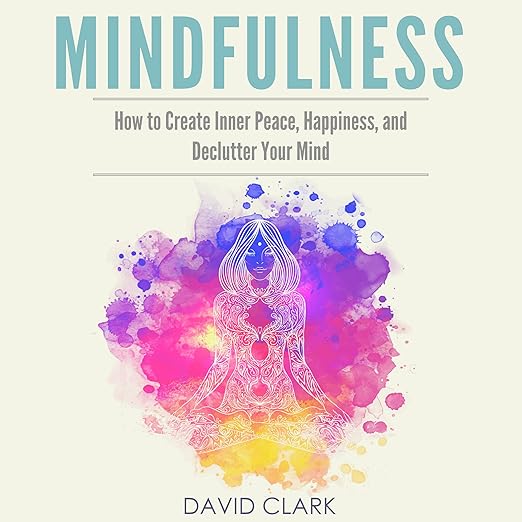
There is a particular category of audiobook that works best when you are not looking for a book at all, when what you actually want is something to listen to on a difficult Wednesday morning before the day fully arrives. I had this one on at roughly seven a.m. on a week that had started badly, and David Clark’s brevity turned out to be the right call. At just over an hour, Mindfulness: How to Create Inner Peace, Happiness, and Declutter Your Mind does not overstay its welcome, which is a virtue that longer titles in this space frequently lack.
Clark’s framing is direct: modern technology keeps us connected to everything except ourselves, and stress and anxiety are the predictable result. He is not offering a novel diagnosis here, this is the foundational argument of secular mindfulness writing, present in everything from Jon Kabat-Zinn’s clinical work to the glut of mindfulness apps. What Clark offers instead is compression. The core ideas, present-moment awareness, the mechanics of how distraction operates, practical techniques for incorporating mindfulness into daily tasks, are delivered without detour. One reviewer described reading a chapter a day and journaling about each one, which is a sensible approach to making the material stick over time.
Our Take on Mindfulness: How to Create Inner Peace
For a listener who has never encountered mindfulness practice in any structured form, this audiobook functions as a clean orientation. The language is plain, the examples are grounded in recognizable daily experience (email checking, social media scrolling, the ambient hum of information overload), and Heather Kae Smith’s narration does not add any unnecessary drama. One reviewer noted that after applying the book’s suggestions, their spouse observed a noticeable change in them, the kind of outcome that suggests the material is practical enough to act on rather than merely acknowledge. Another described reading it the day they received it and finding it opened their mind to things they had not previously understood about how stress accumulates and how the mind responds. The book earns its modest promises.
Why Listen to Mindfulness: How to Create Inner Peace
The hour-long runtime is both the main selling point and the main limitation. For a commuter, someone in a waiting room, or a listener who wants a low-commitment entry point into wellness audio, this works extremely well. Smith’s voice has a quality of settled steadiness that suits the material, she does not perform calm, she simply delivers it, which is more effective than the breathier narration style that some wellness titles adopt. The audio format also suits the content better than the page for some listeners; having the techniques described in a calm human voice while you are walking or driving reinforces the very present-moment quality the book is arguing for.
What to Watch For in Mindfulness: How to Create Inner Peace
If you have read Jon Kabat-Zinn, Thich Nhat Hanh, or any number of secular mindfulness titles, you will find nothing new here. Clark covers the fundamentals competently but without scholarly depth or original framework. The book is self-published, and while the production quality is acceptable, the structure occasionally feels like a listicle given audio form, the chapter on benefits is particularly enumeration-heavy. The Buddhism connection flagged in the genre metadata is loose; this is secular mindfulness with Buddhist roots, not a text with doctrinal engagement. Practitioners or serious students of meditation will want something substantially more rigorous.
Who Should Listen to Mindfulness: How to Create Inner Peace
This is for the person who has been told to try mindfulness and does not know where to start. It is accessible, brief, and free of jargon, and it works in a single sitting. If you already have a meditation practice or have read substantively in this area, it offers nothing you do not already know. Skip it if you want psychological depth, clinical research backing, or a narrator who brings personal spiritual weight to the material. For genuine beginners, though, the brevity is a feature rather than a flaw.
Frequently Asked Questions
Is this audiobook rooted in traditional Buddhist meditation or secular mindfulness practice?
It is secular mindfulness. The Buddhist roots of the practice are acknowledged implicitly through the genre categorization, but David Clark does not engage with Buddhist doctrine or tradition. The techniques are framed in modern, practical language without religious context.
At just over an hour, is there enough content to make a real impact, or does the brevity undermine the material?
The brevity is intentional and appropriate for an introduction. Reviewers who applied the techniques consistently reported genuine shifts in their stress levels. The format works best if you engage with it actively, taking notes, journaling, or revisiting specific sections, rather than treating it as a one-time listen.
How does Heather Kae Smith’s narration compare to narrators on similar wellness titles?
Smith is measured and clean without being clinical. She avoids the artificially soothing tone that some wellness narrators adopt, which makes the material feel more grounded. For instructional content, this approach works better than a more performative delivery.
Would this audiobook work for someone dealing with anxiety related to news and social media overload?
Yes. Clark specifically frames the book around technology-driven disconnection, the pull of emails, Instagram, constant information, making it directly relevant to that experience. The techniques for returning to the present moment are applicable to exactly that kind of ambient digital stress.