- Performance: Jessica Mathison narrates with steady, restrained gravity, treating the psychosis chapters with documentary seriousness rather than melodrama.
- What it covers: Schizophrenia and recovery, homelessness, family estrangement and reunion
- Feel: Harrowing but ultimately hopeful
- Our call: A candid, well-supported recovery memoir best paired with its companion book for the full family perspective.
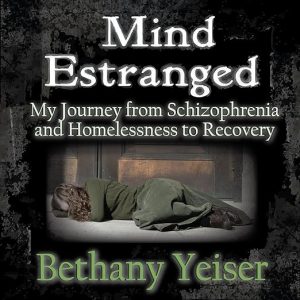
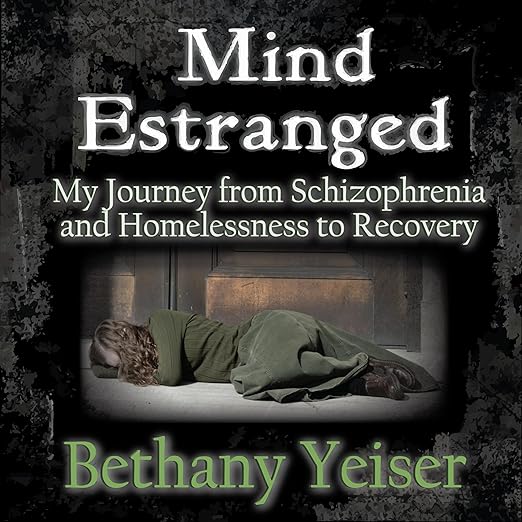
Bethany Yeiser was a promising university student traveling the world when the voices started, and by the time she made it back to the United States she couldn't hold a job, couldn't finish a sentence that made sense to the people around her, and eventually couldn't stay off the streets. Mind Estranged tells that descent in Bethany's own words, and this audiobook doesn't soften the hardest stretch of it: homelessness, delusion, arrest, and a long estrangement from the family trying to reach her. What makes the memoir remarkable isn't just the fall, it's the full recovery that follows, an outcome her own treating psychiatrist has publicly vouched for in the book's own pages.
Living Proof, According to Her Own Psychiatrist
The memoir's structure mirrors its subject matter directly: the early chapters, following a bright, ambitious student across multiple countries, read with a clear, purposeful momentum, and that clarity gradually erodes as the narrative moves into the years Bethany spent unable to trust her own perception of reality. It's an effective, disorienting choice rather than a stylistic accident, letting listeners feel the gradual loss of coherence rather than just being told about it after the fact. One reader who worked through both this book and its companion volume over an entire summer called the experience 'engrossing, gripping, sometimes befuddling and irritating, and ultimately liberating.'
Dr. Henry Nasrallah, the psychiatrist who treated Bethany, contributes a direct assessment included with the book itself, calling her 'living proof that recovery from schizophrenia is possible with good medical care, solid family support and the courage to keep fighting the tormenting voices that ordered her every move and controlled her every thought.' That clinical endorsement matters for a genre where authenticity claims can be hard to verify from outside; here, the treating physician's own words back up the memoir's account of what recovery actually required.
The early travel chapters do important structural work beyond scene-setting: they establish exactly how much promise and capability existed before the illness took hold, which makes the subsequent loss legible rather than abstract. A listener needs to understand who Bethany was, ambitious, curious, functioning at a high level academically and internationally, to feel the full weight of what schizophrenia actually took from her, and narrator Jessica Mathison carries these early chapters with a forward-looking energy that makes the later contrast land harder.
A Mind Becoming a Stranger to the Person
The title itself rewards a second look: 'estranged' usually describes a relationship, a person cut off from family or self, and applying it to 'mind' frames schizophrenia specifically as a kind of internal estrangement, a mind becoming a stranger to the person living inside it, rather than using more clinical language like a psychotic break or a schizophrenic episode. That framing choice carries through the whole memoir; Bethany writes about her own delusions with the same puzzled distance you'd use describing an estranged relative's behavior, someone once familiar who became genuinely unrecognizable, which gives the prose an unusual, effective kind of emotional honesty about how disorienting the experience actually was to live through.
Mind Estranged joins a small but significant shelf of first-person schizophrenia memoirs, alongside books like Elyn Saks' The Center Cannot Hold, that push back against the flattened, frightening cultural image of the illness by insisting on the specific, individual texture of one real recovery. Bethany's version distinguishes itself with its emphasis on total, functional recovery rather than lifelong management, a genuinely less common outcome in the genre and part of why Dr. Nasrallah's endorsement carries real weight rather than reading as routine jacket-copy praise.
Mathison Never Turns the Voices into Spectacle
Jessica Mathison narrates with consistent gravity and real restraint through material that could easily tip into either melodrama or clinical detachment; she avoids both, treating the psychosis sections with the same documentary seriousness she brings to the recovery chapters. That restraint is a deliberate choice that pays off, since over-dramatizing Bethany's delusions would risk sensationalizing an illness that's already widely misunderstood and stigmatized.
A genuine case exists for why first-person mental illness memoirs specifically reward audio: hearing someone else give voice to Bethany's own words creates a kind of witnessed intimacy that silent reading doesn't quite replicate, even though Mathison, however skilled, isn't Bethany herself, and listeners who've heard other schizophrenia memoirs narrated by the actual authors may notice that particular distance here. Gayle, a caregiver for a daughter with the same diagnosis, calls the memoir 'courageous and forthright' and says it 'provides tremendous hope for recovery,' a reaction that speaks directly to the book's core audience.
Mathison's handling of the passages describing the voices themselves, what they said, how persistent and commanding they became, avoids the temptation to perform them as a separate dramatic register, a choice that keeps the focus on Bethany's own exhausted, resistant interiority rather than turning the hallucinations into a spectacle. That restraint is consistent with how the whole book treats the illness: as something happening to a real, specific person, not generic movie-schizophrenia shorthand.
Karen's Side Waits in a Companion Volume
Only one side of this story gets told in Mind Estranged itself; the companion volume, Flight from Reason, covers the same timeline from Bethany's mother Karen's perspective, and listeners who want the fuller picture, what the family experienced trying to reach someone who had cut off contact, will need both books rather than treating this one as complete on its own.
The content here is genuinely intense in places: descriptions of homelessness, active delusion, and the process of involuntary hospitalization aren't softened for a general audience, and listeners currently navigating their own mental health crisis, or close to someone who is, should go in aware of that weight. Bea Daniels, who called the book 'a real eye-opener, an insider's story of the struggles people face in living with, and overcoming mental health issues,' specifically singled out the final chapters, covering treatment and family reunion, as the most rewarding stretch after a genuinely difficult middle.
The recovery portion, Bethany's return to college and eventual honors graduation, moves at a notably faster clip than the years of decline that precede it, which is a defensible structural choice given how much slower and more confusing the actual lived experience of psychosis was. Listeners expecting equal time devoted to the rebuilding process specifically should know the back half compresses years of recovery work into proportionally less runtime than the descent received.
The Hope Gayle's Review Promises Other Caregivers
Family members and caregivers of someone living with schizophrenia or a related psychotic disorder are the audience most directly served here, and Gayle's review speaks to how much hope the recovery narrative specifically offers that group. Anyone drawn to first-person illness memoirs in the tradition of unflinching, specific testimony rather than clinical case studies will also find real value in Bethany's own voice guiding the account.
The mid-book chapters demand real caution from anyone in active crisis themselves, given how detailed the descriptions of delusion, homelessness, and hospitalization get rather than glossed over. Pairing this memoir with Flight from Reason gives the more complete, two-sided version of the story; taken alone, Mind Estranged tells only Bethany's half of a story that clearly involved an entire family.
Frequently Asked Questions
Does this audiobook include graphic descriptions of psychosis or homelessness?
Yes, in detail. The descriptions of delusion, life on the streets, and hospitalization aren't softened, so listeners sensitive to that content should be prepared going in.
How does Jessica Mathison's narration handle the book's darkest chapters?
With restraint. She avoids both over-dramatizing the psychosis and flattening it into clinical distance, which keeps the hardest material grounded and respectful rather than sensationalized.
Is this audiobook appropriate for someone currently struggling with mental illness?
It can be genuinely hopeful, given the full recovery at its center, but the detailed crisis content means listeners in an active crisis themselves should approach it carefully rather than treating it as immediate support.