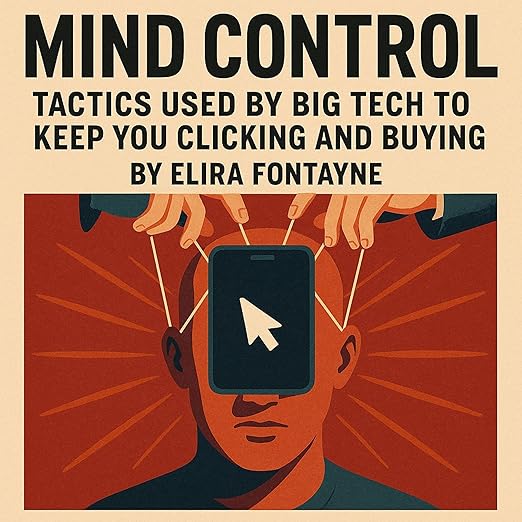
I noticed I had picked up my phone four times during a single paragraph of another audiobook I was listening to. Not for anything specific, just the reaching reflex, the unconscious check. I put it face-down and started Mind Control partly as an act of mild self-accountability. At two hours and sixteen minutes, it is the kind of audiobook you can finish in a single sitting, which felt appropriate given the subject matter.
Mind Control, published under Elira Fontayne's name by Zentara UK, is a guide to the behavioral science embedded in consumer technology. The central argument is direct: your favorite apps, social platforms, streaming services, and e-commerce sites are not neutral tools but engineered environments designed to shape behavior, maximize engagement, and keep you spending time and money within their systems. The book positions itself as pulling back the curtain on practices that most people experience but few can name with precision.
Variable Rewards Explain Why Feeds Never End
The book's diagnostic work is its strongest feature. The explanation of why notification systems feel difficult to ignore, why feeds are designed to have no natural endpoint, and how autoplay removes the decision to continue are each explained with reference to specific behavioral science concepts, variable reward schedules, social validation loops, loss aversion, and friction reduction. These are real mechanisms with real research behind them, and Fontayne presents them with enough specificity to be useful without requiring prior familiarity with behavioral economics or psychology literature.
The framing that your attention is the most valuable currency in the digital economy is not a novel observation at this point, but Mind Control is less interested in the macro-economics of the attention economy and more focused on the specific psychological tricks deployed at the product design level. That granularity is useful. Understanding that the infinite scroll was deliberately designed to remove natural stopping cues, or that the specific timing of notification delivery is calibrated to maximize immediate response, gives you something concrete to work with rather than simply a vague sense that something is being done to you.
Turner's Measured Delivery Skips the Alarm
Mitchell Jon Hugh Turner's narration suits the material's diagnostic register. He reads with the measured clarity of someone presenting evidence, which is appropriate for a book whose job is to make specific claims about specific design choices. There is no alarm or advocacy in his delivery, which keeps the content from feeling like a sermon. The listener is left to draw their own conclusions about what to do with the information, which is a reasonable authorial choice for a topic where prescriptions can quickly become patronizing.
The short runtime is genuinely appropriate for the scope of the book. Fontayne covers the core behavioral mechanisms across the major categories of tech design: social feeds, notification systems, autoplay, and e-commerce prompts. Two hours and sixteen minutes is the right length for an introduction to this framework; stretching it to ten hours would require either padding or depth that exceeds what the book is attempting to deliver. It functions well as a primer that might motivate further reading in the academic literature or longer treatments like Nir Eyal's Hooked or Tristan Harris's more detailed public work on the topic.
Thin Credentials Behind a Diagnosis-Only Book
The book has no reviews available on the Audible page, and the five-star rating is based on a very small sample. That context matters. Mind Control is a recent release from a small UK publisher, and the author Elira Fontayne does not appear to have an established profile as a researcher or practitioner in behavioral technology. The concepts presented are grounded in real behavioral science, but listeners should apply the appropriate skepticism to a short, lightly credentialed text on a subject that has more authoritative treatments available.
The book focuses primarily on diagnosis rather than remedies. If you are looking for practical strategies to manage compulsive technology use, the structural design of habits, or digital minimalism frameworks, Mind Control will give you the vocabulary but not the toolkit. The closing material gestures toward awareness as the beginning of change, but the emphasis is firmly on understanding the problem rather than systematically addressing it.
Two Hours to Name What You Suspected
Ideal as an introduction for listeners who feel vaguely aware that their phone use is manipulated but have not yet encountered the specific behavioral science behind it. Students of media, technology ethics, or consumer behavior will find the overview useful as a jumping-off point. Anyone already familiar with Jaron Lanier's work, Tristan Harris's Center for Humane Technology arguments, or books like Irresistible by Adam Alter will find this covers familiar ground at a more accessible level. At just over two hours, the cost of entry is low enough that even listeners who find it lightweight will not have invested much.