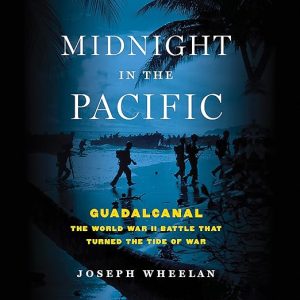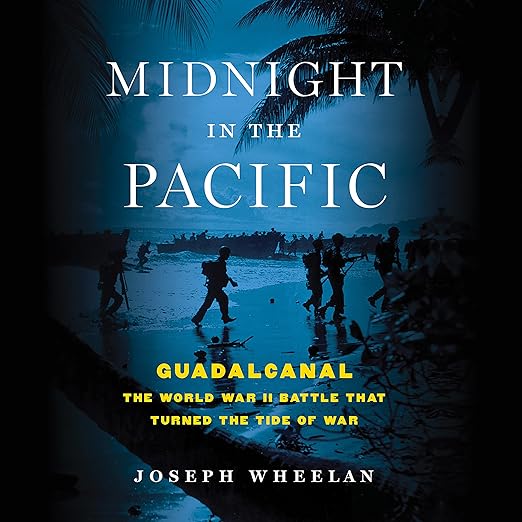
My grandfather never talked much about the Pacific. He served in the Navy and came home, and that was the entirety of what he shared with the family over decades. I spent years afterward reading my way toward what he would not describe, which is how I became the kind of person who downloads sixteen-hour military history audiobooks for long drives and considers it a reasonable use of time rather than an unusual one. I started Midnight in the Pacific by Joseph Wheelan on a ten-hour road trip and finished it two days later. At sixteen hours and fifteen minutes, it asks something of the listener, but it returns that investment in kind.
Wheelan covers the Guadalcanal campaign, which ran from early August through mid-November of 1942, a six-month slugfest across land, sea, and air that ended with America's first major ground victory against Japan in the Pacific War. It is not a campaign that gets the sustained popular attention of, say, Iwo Jima or Midway, partly because its outcome was so long in doubt and partly because the brutality of the conditions, with starving Japanese soldiers calling the island the island of death, makes it difficult to narrativize with conventional heroic structure. Wheelan does not try to impose that structure. He follows the attrition honestly, which is why the book earns its place among serious Pacific War histories.
How Midnight in the Pacific Holds Up
What most distinguishes Midnight in the Pacific from comparable Guadalcanal accounts, including Hornfischer's respected Neptune's Inferno, is its commitment to covering all three domains of the campaign: the land battles fought by Marines and later Army units, the naval engagements that cost the US Navy over 4,500 sailors, and the air war over Henderson Airfield that determined the campaign's outcome as much as anything that happened on the ground or at sea. A retired Navy professional who had read multiple Guadalcanal books, including Hornfischer, stated directly that this book provides a continuous timeline of all three domains and shows how each action related to the others, which Hornfischer's naval-focused account could not provide on its own.
That integration is the book's primary structural achievement. The possession or loss of Henderson Airfield was the campaign's strategic hinge; every action on land and sea was connected to that central fact. Wheelan keeps the reader oriented within that reality while still tracking the human experience of individual Marines, sailors, and pilots whose fates were being decided by decisions made far above their pay grade and by the grinding logic of sustained attrition over months of tropical fighting in conditions that were brutal for both sides.
Why Midnight in the Pacific Works as an Audiobook
Wheelan is direct about the scale of the losses throughout the narrative, and the numbers deserve to land with their full weight rather than being processed abstractly. More American sailors died in the naval battles off Guadalcanal than in all previous US wars combined up to that point. Each side lost 24 warships. Over 1,500 soldiers and Marines died in the land fighting. The air war consumed more than 500 US planes. Japan's losses on the island were equally devastating in different ways: starvation and disease killed more Japanese soldiers than American fire, which gives the campaign a particularly grim character distinct from the more conventionally combat-intensive battles of the Pacific War.
These figures accumulate across the narrative with a weight that prevents the campaign from being aestheticized into something manageable or heroic in a simple sense. Wheelan is writing about a catastrophe that America won, which is a different thing from writing about a triumph. The book draws heavily on firsthand accounts, Marine Corps and Army archives, oral histories, and written accounts by combatants, which grounds the strategic narrative in individual experience without losing the larger shape of what was happening across the island and around it.
Weak Spots in Midnight in the Pacific
Stillwell's narration is well-matched to the material: authoritative without being performative, capable of distinguishing the texture of individual firsthand accounts from the narrative connective tissue without overplaying the shift. For a book that moves between close-in combat description and strategic overview regularly across sixteen hours, a narrator who can manage both registers cleanly is essential, and Stillwell does. The length is real, and some listeners may find the middle sections, where the campaign's daily grind becomes the point rather than any single decisive engagement, challenging to sustain full attention through. That is not a flaw of the narration or the writing; it is a reflection of what the campaign actually felt like to the people inside it over six months.
A reader whose father fought at Guadalcanal described this as particularly valuable for its dual American-Japanese perspective, drawing on documentation from both sides to show why Japanese leadership continued committing men to the island long after the strategic situation had become untenable from any rational calculation. That comparative approach is less common than it should be in Pacific War history.
The Right Listener for Midnight in the Pacific
Listen if: you have a serious interest in the Pacific War, in combined-arms operational history, or in the specific experience of the Marines who fought in the Solomon Islands campaign. The dual American-Japanese perspective and the comprehensive coverage of all three operational domains make this an unusually complete account for a single volume. Pass if: you are new to Pacific War history and would benefit from a shorter, more accessible introduction before committing to sixteen hours of detailed operational and strategic material that assumes some baseline familiarity with the theater.
- Performance: Kevin Stillwell brings steady, authoritative pacing to the combat sequences and the archival testimony sections alike; he handles the scale of the material without losing the individual voices embedded in it.
- What it covers: Pacific War turning point, land-sea-air combined operations, individual courage under attrition
- Feel: Immersive and sobering, rigorously researched, occasionally exhausting in the best way
- Our call: The most comprehensive single-volume account of the Guadalcanal campaign in audio form, and an exceptional choice for anyone who wants to understand the Pacific War's first major American ground victory.
A Few Questions About Midnight in the Pacific
How does Midnight in the Pacific compare to Neptune's Inferno by Hornfischer for covering Guadalcanal?
Hornfischer's book focuses primarily on the naval dimension. Wheelan covers land, sea, and air in an integrated timeline, which several reviewers with experience of both books describe as the more complete account of the overall campaign.
Does the book cover the Japanese perspective as well as the American one?
Yes. Wheelan draws on documentation from both sides, and multiple reviewers specifically praise the dual perspective as one of the book's distinguishing features compared to other Guadalcanal histories.
Is the book accessible to readers without prior knowledge of the Pacific War?
The book assumes some familiarity with the broader context of the Pacific theater. Readers entirely new to the subject may want to start with a shorter introductory Pacific War history before approaching this sixteen-hour account.
Is there a free audiobook version of Midnight in the Pacific available?
Yes, Midnight in the Pacific is listed at $0.00 on Audible for eligible members, making it available as a free audiobook under current membership plans. Check the Audible product page to confirm current availability.