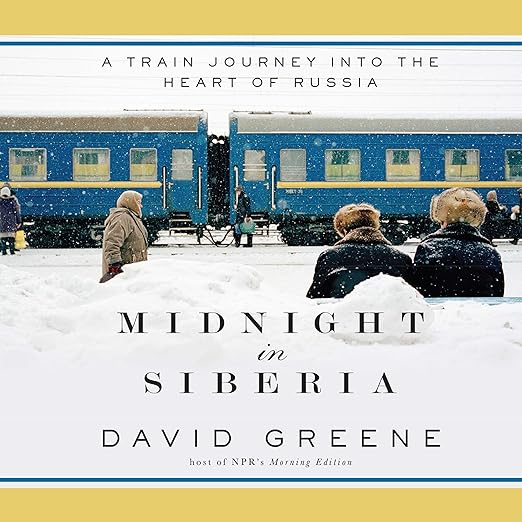
David Greene boarded the Trans-Siberian Express as NPR's Moscow bureau chief, two and a half years into an assignment that had positioned him as a professional interpreter of Russian life to an American audience. Midnight in Siberia, which Greene also narrates in this seven-hour-and-41-minute audiobook, is the product of a 6,000-mile rail journey from Moscow to Vladivostok - not a correspondent's analysis of Russian politics but an attempt to get beyond the Moscow protest movements that dominated Western headlines and speak with people whose lives were shaped by forces considerably more mundane and more enduring than the ones making news.
Babushkas, a Meteor-Rock Teenager, and Weary Activists
Greene's instincts as a radio journalist serve the material well. He is practiced at letting subjects speak in their own voices, at finding the specific detail that carries more meaning than the general claim, and at holding contradictions in view without forcing resolution. The babushkas from Buranovo - singing grandmothers who became unlikely pop culture figures - appear alongside a teenager in Chelyabinsk selling rocks from the previous spring's meteor shower, and environmental activists in the pollution-damaged town of Baikalsk who are fighting with the exhausted determination of people who know the odds. These are not representative figures in a sociological sense; they are particular people, and Greene's restraint in refusing to type them as symbols of the New Russia is one of the book's consistent virtues.
Rail Rhythms Replace Any Artificial Chapter Breaks
The train itself functions as a structural device that works better than it might in less capable hands. The rhythms of rail travel - the repeated arrivals and departures, the temporary intimacy of a shared compartment, the landscape moving past the window - give Greene a natural way to segment the journey without imposing artificial chapter breaks. Reviewer Leo Catalano, who called it one of the best books he had read for understanding the interior life of Russia and its people, noted specifically that Greene's approach was to make friends rather than conduct interviews - an observation that captures the book's relational texture accurately.
Reviewer B767Captain, who has personally traveled the route and brought a navigator's precision to the geography, found the account both accurate and entertaining - a useful data point for listeners who come with specific regional knowledge. The detail about the journey covering nine time zones, and the way Greene builds the social texture of each stop without turning any single location into a caricature, reflects someone who took the reporting seriously rather than using the journey as a frame for impressions he had already formed in Moscow.
Greene's Broadcast Voice Earns Instant Listener Trust
Greene narrating his own work is the right choice for this material. His broadcast voice carries the associations of someone listeners may have heard on NPR, which creates a specific kind of trust that a third-party narrator would have to build from scratch. More practically, his reading has the quality of someone recounting experiences he actually had rather than performing someone else's text - the Siberian cold, the train compartment warmth, the specific awkwardness of trying to communicate through limited shared language all register as remembered rather than imagined.
The audiobook format suits the book's episodic structure particularly well. Each stop on the Trans-Siberian route generates a self-contained human episode before the train moves on, and the natural listening rhythm of arriving at a new scene mirrors the journey's actual progression. Greene's understated narration keeps the pacing steady without allowing any single episode to overstay its welcome in the seven-hour runtime. For listeners who have never been to Russia and are curious about what ordinary life looks like beyond Moscow, this audiobook opens that geography effectively.
Journalist's Instincts Outrun the Political Analysis Here
The book's limitations are worth naming. Greene is a journalist, not a historian or political scientist, and readers expecting deep structural analysis of post-Soviet society will find the book lighter than they might want. The stories he collects are honest and specific, but the connections between them are made through narrative association rather than analytical framework. This is a seven-hour-and-41-minute audiobook that moves at the pace of a long train ride rather than a taut piece of journalism - a feature for listeners who want immersion, a friction point for listeners who want argument.
The book was published at a specific moment in Russia's post-Soviet trajectory, and some of the political context reads differently against subsequent events. Greene does not pretend to be writing history; he is writing impressions from a specific journey at a specific time. The human stories he records have a durability that the political framing does not equally share, which is something worth keeping in mind when evaluating his broader assessments of Russian society.
Nine Time Zones Shape an Emotional Arc
The audiobook also captures something specific about the Trans-Siberian journey that shorter pieces of travel journalism rarely manage: the cumulative effect of crossing nine time zones by land, watching the landscape shift from European Russia through the Urals into the vast distances of Siberia proper. That spatial progression shapes the emotional arc of the book, and Greene earns it hour by hour.
Readers of Conover and Hessler Will Recognize This
The audiobook works best for listeners interested in Russia as a human geography rather than as a geopolitical problem - people who want to understand what ordinary life looks like in places that Western media coverage reaches only when something goes dramatically wrong. Travel writing enthusiasts who enjoy narrative journalism in the tradition of Ted Conover or Peter Hessler will find Greene's approach familiar and satisfying. Skip it if you want a structural account of Russian politics or a rigorous analysis of the post-Soviet transition - there are better books for those purposes, and Midnight in Siberia is honest enough about its own scope not to pretend otherwise.
Quick Take
- Narration: David Greene reads his own book with the understated professionalism of a broadcast journalist - clear, conversational, and rarely showy, which suits the on-the-ground reporting quality but occasionally flattens the emotional register.
- Themes: Post-Soviet Russian identity, the gap between political narrative and lived experience, travel as a form of journalism
- Mood: Curious and warm, with an undercurrent of melancholy that builds as the journey accumulates stories
- Verdict: A travel narrative that earns its authority through listening rather than analysis - Greene lets his subjects speak, and their voices are the book's strongest element.
A Few Questions About Midnight in Siberia
Does David Greene's background as an NPR reporter improve the Midnight in Siberia audiobook?
Primarily yes. His broadcaster's instinct for listening before speaking shapes the entire book, and his self-narration carries the authority of someone reporting from lived experience. The limitation is that his journalistic framing keeps him from the deeper structural analysis that a scholar of Russian politics might bring.
Is this audiobook accurate about Trans-Siberian travel and Russian geography?
Reviewer B767Captain, who has personally traveled the route and brought navigational precision to the geography, found the account both accurate and entertaining. Greene's two-and-a-half years as NPR's Moscow bureau chief give him a baseline credibility on the subject that shows throughout the seven hours.
How political is the Midnight in Siberia audiobook?
Less political than the premise might suggest. Greene explicitly sets aside the Moscow protest movements that dominated Western headlines at the time and focuses on people whose lives run parallel to those headlines. The book is more interested in human texture than political argument, which is both its appeal and its limitation.
At seven hours and 41 minutes, does this audiobook sustain its material across the full runtime?
Yes, though the pace is deliberate rather than propulsive. The structure mirrors the rhythm of the train journey itself - episodic, cumulative, and unhurried. Listeners who appreciate immersive travel writing will find the length appropriate; listeners who want tight journalistic argument may feel it runs longer than needed.