In Brief
- Voice: Greg Willits brings warmth and natural delivery to devotional biography, navigating prayer-petition passages and biographical narrative without tonal inconsistency.
- Big ideas: Ordinary holiness in daily apostolic work, suffering as mission, the legacy of personal relationships that outlast the person who cultivated them.
- Atmosphere: Reflective and devotional, with genuine emotional weight in the accounts of Duppong's final illness and the testimonies it generated.
- Worth it?: A well-crafted piece of devotional biography for Catholic listeners, with a human core that reaches beyond that primary audience.
Her Final Year Became a Twelve-Month Holy Week
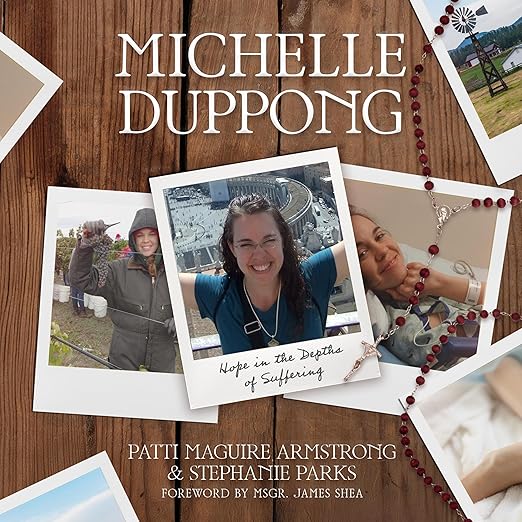
Michelle Duppong's campus ministry in Bismarck, North Dakota produced the kind of results that hagiography tends to attribute to exceptional personality, and Patti Maguire Armstrong's audiobook is at its most interesting when it examines what those results actually looked like in practice. This is an audiobook for a Catholic audience, and it does not pretend otherwise. The framework of Duppong's life as a story of sanctity, the opening of her canonization cause by Bishop David Kagan, and the ongoing collection of reports about graces obtained through her intercession are all treated as real and meaningful rather than as phenomena to be explained away. Greg Willits narrates with a warmth that suits a subject whose primary charism, according to everyone who knew her, was personal and relational rather than spectacular.
Duppong died in 2015 at thirty years old, and the book covers her relatively brief life with more depth than brevity might suggest is possible. Armstrong focuses on the texture of Duppong's daily practice: the way she invited students to weekday Mass, the friendships she cultivated at the University of Mary, the seeds of conversion she sowed during a semester in Rome that came to fruition in people she never knew were affected. Her spiritual director described her final year of illness as a 'twelve-month Holy Week,' and Armstrong gives this dimension of her story significant space, tracing what it looked like when suffering became, in the framework of the book's tradition, an extension of her mission rather than an interruption of it.
The most striking anecdotes in this audiobook are the ones involving people outside Duppong's faith tradition. Caregivers who did not share her Catholic commitments were moved by her peace in ways they found difficult to explain. Friends who arrived to comfort her left feeling comforted instead. These accounts are offered as evidence of something, and what listeners make of that evidence will depend heavily on where they stand in relation to the book's theological framework. Armstrong does not press the argument beyond the testimony; she lets the accounts speak for themselves.
The canonization cause is still in its early stages, and Armstrong is honest about what that means: Michelle Duppong has been declared a Servant of God, which is the first formal step in a lengthy process, not a conclusion. The book is a biography of someone the Church is beginning to evaluate rather than one it has already elevated, and that distinction gives the account a quality of ongoing discovery rather than retrospective celebration.
Willits Avoids the Reverential Flatness of Hagiography
Greg Willits's narration is a genuine asset for this material. He brings the warmth the subject requires without veering into the reverential flatness that can make hagiographic audio productions feel distant from their subjects. Willits navigates the devotional sections, which include direct addresses to Duppong in the prayer-petition register, with the same natural quality he brings to the biographical narrative, which is not a given in audiobooks that move between these modes.
For listeners within the Catholic community who are interested in contemporary witnesses to faith, this audiobook offers something specific and fairly rare: a biography of someone who lived an ordinary apostolic life in an ordinary American college town and who is being considered for canonization not because of dramatic mystical experiences but because of the quality of attention she brought to ordinary relationships. That is a more interesting kind of holiness biography than the more conventionally spectacular accounts, and Armstrong's focus on the specifics of Duppong's daily practice gives it genuine texture.
Her Formation Before FOCUS Stays Mostly Sketched
Listeners who are not within the Catholic tradition, or who are skeptical of the canonization framework, will find this audiobook operates within premises they may not share. Armstrong is not writing for a secular audience or attempting to make the case for Duppong's significance on grounds that bracket her religious commitments. The book is devotional biography, and it is at its most useful and honest for listeners who can engage with it in those terms.
The audiobook is also relatively short at just under five hours, which means some dimensions of Duppong's life are necessarily sketched rather than developed. Her formation before FOCUS, her family background, and some of the institutional history of the movement she helped bring to the University of Mary are treated with less depth than her apostolic work and final illness. Listeners who want a fuller account of her biography in those dimensions may find the proportions slightly skewed toward the devotional conclusion rather than the biographical foundation.
Catholics in the FOCUS and Campus Ministry World
This audiobook is written for and will be most valued by Catholics who are interested in contemporary witnesses to the faith, particularly within the FOCUS and campus ministry communities where Duppong worked. Her story will resonate most strongly with listeners who have some connection to that world, either as participants in the same movement or as people who know someone whose college faith life was shaped by similar communities. Her impact was personal and specific, and the book captures that specificity well.
For listeners at any distance from the Catholic tradition who are drawn to biographical accounts of people who faced terminal illness with unusual peace, the core human story here is accessible. Armstrong's account of Duppong's final year, and the testimony of people who witnessed her dying, is genuinely moving regardless of how one situates the theological framework around it. Willits's narration keeps the material from becoming inaccessible to listeners who may not share all the book's premises, and the relatively short runtime makes it a manageable commitment for curious readers outside the primary audience.
Before You Listen
Is this audiobook appropriate for listeners who are not Catholic?
The book operates within a Catholic devotional framework and does not bracket its theological premises for a secular audience. Non-Catholic listeners interested in biographical accounts of remarkable lives or in how people face terminal illness can engage with the core human story, but the canonization framework is central, not peripheral.
Who was Michelle Duppong and why is her audiobook biography significant?
Michelle Duppong was a Catholic campus minister who helped establish FOCUS at the University of Mary in Bismarck, North Dakota. She died at thirty in 2015, and Bishop David Kagan opened her cause for canonization based on her growing reputation for holiness and reports of graces obtained through her intercession.
Does this audiobook require familiarity with FOCUS or campus ministry to be meaningful?
No. Armstrong provides enough context about FOCUS and Catholic campus ministry to make Duppong's work comprehensible without prior familiarity. The book's primary focus is on Duppong's character and relationships rather than on the institutional structures she worked within.
Is this audiobook suitable for group listening or parish reading groups?
Yes. The relatively short runtime and its accessible narrative style make it well suited for group contexts. The chapters are self-contained enough to generate discussion, and the testimony format throughout invites reflection on what holiness looks like in ordinary circumstances.