Quick Take
- Narration: Michael Palin reads his own work with the dry warmth and timing that made his television journeys essential viewing, this is the rare case where no other narrator would do.
- Themes: Circumnavigation of the Pacific Rim, cultural encounter, the comedy and pathos of remote travel
- Mood: Warm, observational, and quietly funny, like travel writing at its most companionable
- Verdict: Among the finest author-narrated travel audiobooks available, and the most ambitious of Palin’s three major journeys in scope and human texture.
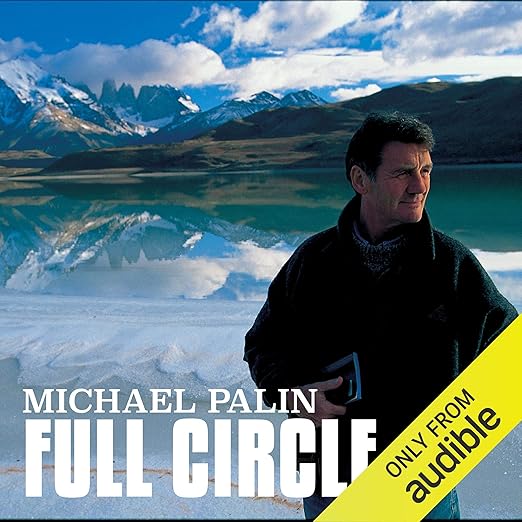
I finished Full Circle on a long weekend when I had nothing more pressing than a stack of unread travel books and a pot of coffee. Michael Palin narrating his own Pacific Rim circumnavigation, a year-long journey through eighteen countries, is exactly the kind of audiobook that earns an entire afternoon. I had seen the BBC television series years ago, but listening to Palin read his own prose is a different experience entirely. The camera cannot capture what the sentences do, and his voice carries the accumulated authority of a man who has been observing the world in public for decades.
The journey is staggering in its scope. Starting from Alaska and the Aleutian Islands, Palin moves through Russia, Japan, Korea, China, the Philippines, Malaysia, Indonesia, Australia, New Zealand, the South Pole, Chile, up through South America, and back to Alaska. One reviewer traced the full route in their review and still seemed slightly awed by it. The world’s largest ocean becomes a governing structure, a shape that forces the journey to confront extraordinary variety without losing coherence as a narrative. The Pacific Rim is not one world but many, and Palin moves through each with the same open curiosity.
Why an Author Reading Himself Is a Different Art
Palin’s narration is the central pleasure here. He has been performing his observations, on television, in live readings, in decades of public life, for long enough that he has arrived at a kind of effortless authority. The dry humor lands cleanly. When he describes eating maggots in Mexico or speaking with head-hunters in Borneo, there is no straining for effect. The tone is that of a traveler who has learned to meet the world’s absurdities with equanimity rather than performance.
One reviewer specifically praised his dry, non-offensive sense of humor and singled out the camel muster in Central Australia as a high point. Another noted that the writing delivers great descriptive writing as well as insights into a wide variety of cultures. Both are accurate. What Palin does particularly well is move between the physical and the human without losing either. A glacier crossing and a conversation with a local fisherman occupy the same register, both observed with equal curiosity and care. The transitions between countries never feel abrupt because Palin’s attention is the constant, not the geography.
The Scale That Sets This Apart From His Earlier Journeys
Full Circle is described as the most ambitious of Palin’s three major travel works, and that ambition is visible in the terrain he has to cover. Mountains, gorges, glaciers, icebergs, and active volcanoes all appear in the same journey. He follows the Yangtze and the Amazon. He reaches some of the most remote inhabited places on earth. The year-long timeline gives the journey a different quality than shorter expeditions, you sense the accumulation of experience, the way the traveler changes slightly across the months without being entirely aware of it until later.
One reviewer who was simultaneously traveling around North and South America while listening found that Palin’s observations mapped usefully onto their own journey, which is perhaps the finest compliment travel writing can receive. The book becomes a companion rather than a spectacle. That is not something every travel writer achieves, and it is worth noting that this recording dates from 2012 and the journey from the 1990s. Approaching it as a historical document of those countries at that particular moment adds a layer of interest rather than diminishing it.
What Makes This Work for Non-Travel-Writing Listeners
Palin is not a confessional writer. He does not go inward at length. The journey is outward, always, and listeners seeking the deep interior emotional reckoning that some travel writing provides will not find it here in large measure. That said, the human texture of what he observes, the people he meets, the conversations he has, the oddities of cultural encounter, carries an emotional weight that accumulates gradually. By the time the journey returns to Alaska, there is a quiet sense of completion that goes beyond mere geography.
The Craft Beneath the Comedy
It is easy to underestimate Palin as a writer because the humor makes the reading feel effortless. But the discipline behind Full Circle is considerable. A year-long journey through eighteen countries generates an overwhelming amount of material, and the editorial decisions about what to include, what to summarize, and what to linger on are what determine whether a travel book becomes an experience or merely a log. Palin chooses consistently well. The encounters that make it onto the page are the ones that illuminate something about a place or a people that the standard travel account would not reach. His eye for the telling detail, the camel muster, the maggots, the head-hunters who are also perfectly hospitable hosts, is the same eye that made his television work essential, applied here to prose with the same reliable instincts.
For listeners who have not yet encountered Palin’s travel work, this is a strong entry point. It is also the audiobook I would give to anyone who has declared that travel writing is not their genre. Palin is the writer who tends to change that opinion, and the combination of his prose and his own voice narrating it makes Full Circle one of the more genuinely pleasurable free audiobook experiences in the travel category.
Frequently Asked Questions
Do I need to have watched the BBC television series before listening to the audiobook?
Not at all. The audiobook stands completely on its own. Several reviewers who loved the television series found the audiobook added new layers through the prose, but no prior familiarity with Palin’s travel programs is required.
How does Full Circle compare to Palin’s other travel audiobooks, like Around the World in 80 Days?
Full Circle is described as the most ambitious of his three major journeys in scope, covering eighteen Pacific Rim countries over almost a year. It trades some of the structured challenge of 80 Days for greater breadth and a more reflective pace across a wider range of cultures.
Is Palin’s narration noticeably different from a professional audiobook narrator?
It is different in the best sense. Palin’s timing and tone are shaped by decades of public performance, and his comedic instincts come through clearly. Reviewers consistently single out his narration as essential to the experience, this is not a case where the author narrating is a compromise.
Is the content family-friendly, or does the Pacific Rim content skew adult?
The book is appropriate for older teens and adults. The content is observational rather than explicit, Palin’s humor is dry and cultural, not edgy. Younger listeners without an established interest in travel writing would likely find the pacing slow.