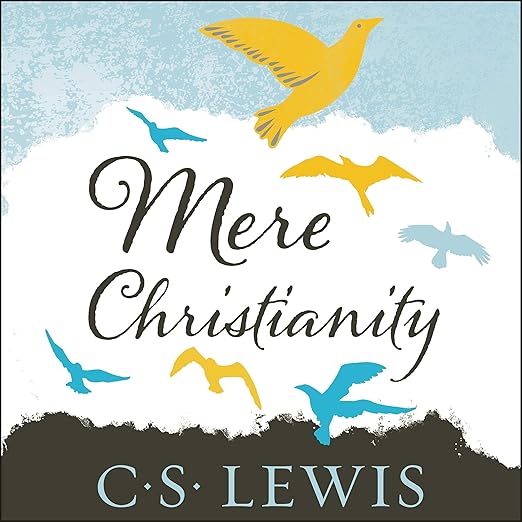
Quick Take
- Narration: Julian Rhind-Tutt brings a measured British intelligence to Lewis’s broadcast lectures, the voice suits the material’s combination of intellectual rigor and accessible warmth.
- Themes: Moral law as evidence for God, Christian ethics, the nature of faith
- Mood: Rational and luminous, with the intimacy of someone speaking directly to you
- Verdict: Lewis’s central achievement, making a rational case for Christianity that neither talks down to skeptics nor alienates believers, holds across seven decades and translates beautifully to audio.
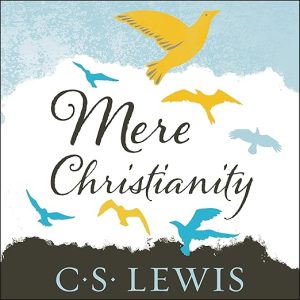
I first read Mere Christianity in my early twenties, skeptical and probably looking for reasons to disagree with it. That didn’t work out the way I expected. Lewis has a quality that few apologetic writers possess: he doesn’t assume his readers are already persuaded, and he doesn’t treat their unpersuadedness as a problem to be overcome by volume. He reasons. And the reasoning, whatever you ultimately conclude from it, is worth following. Returning to the audiobook version, narrated by Julian Rhind-Tutt, felt like picking up a conversation that had been paused rather than ended.
The book originated as a series of BBC radio broadcasts during World War II, which explains both its structure and its register. Lewis was speaking to a general British audience in wartime, not to a seminary class. The chapters are short, the analogies are drawn from everyday experience, and the progression from moral consciousness to the existence of a moral lawgiver to the specific claims of Christianity is built argument by argument rather than assumed at the outset. Anthony Burgess’s description of Lewis as the ideal persuader for the half-convinced is exactly right and remains the most economical characterization of what the book achieves.
Our Take on Mere Christianity
The book’s organizing move is philosophical rather than scriptural: Lewis opens not with the Bible but with the moral law, the near-universal human intuition that some things are genuinely right and wrong, regardless of culture or preference. He argues that this intuition requires explanation, and that the most coherent explanation is a moral being who created the universe. Only after establishing that foundation does Lewis engage with specifically Christian claims about who that moral being is and what the Incarnation means. This sequencing matters because it means a skeptical reader can follow the argument’s logic before committing to any prior faith assumption. One reviewer notes that Lewis is an intellectual and not a member of the clergy, and that the non-denominational approach makes the argument available to a broad readership, the book covers sin, forgiveness, faith, hope, and charity without being beholden to any particular tradition’s specific practices.
Why Listen to Mere Christianity
The audio format recovers something that the original broadcasts had and the printed text loses: the quality of being spoken to. Lewis was addressing listeners, not readers, and Rhind-Tutt’s narration, measured, intelligent, warmly British without being precious, restores that dimension. The seven-hour runtime suits the material’s pace; Lewis doesn’t rush his arguments, and the audio version allows the listener to move through the chapters at a reflective rather than anxious pace. Several readers note returning to the book repeatedly over years, which is consistent with how Lewis builds arguments that reward re-engagement. One reviewer who first read it as a teenager found substantially more in it on a second encounter as an adult, a common experience with this text.
What to Watch For in Mere Christianity
Lewis writes from mid-twentieth-century Britain, and some of the cultural references and social assumptions embedded in the book’s later sections, particularly the discussion of marriage and gender in Book Three, are dated in ways that contemporary readers will notice. Lewis himself acknowledged in later editions that some of his social applications of Christian principles were more culturally contingent than he’d initially presented. The apologetic argument is directed at Christianity specifically rather than theism generally; readers who find the opening moral-law argument convincing but remain unconvinced by specifically Christian claims may find the later books less responsive to their questions than the first. These are not reasons to avoid the book, they are reasons to read it as a mid-century document alongside its permanent contributions.
Who Should Listen to Mere Christianity
This belongs on the shortlist for anyone seriously engaging with Christian thought, whether approaching from belief, skepticism, or somewhere between. Rhind-Tutt’s narration makes it particularly suited to commute or evening listening, the chapter length is right for audio, and the arguments are dense enough to reward active attention. Readers who are already committed to a specific Christian tradition will find Lewis’s non-denominational framing occasionally frustrating, he deliberately avoids settling disputes between Catholic and Protestant positions. But for a reader asking the prior question of whether Christianity is worth investigating at all, the book remains one of the strongest starting points available.
Frequently Asked Questions
Is Mere Christianity appropriate for non-Christians or atheists?
It is specifically designed with non-Christians in mind. Lewis’s opening argument proceeds from moral consciousness rather than scriptural authority, and he builds toward specifically Christian claims only after establishing the case for theism on philosophical grounds. Skeptical readers are the book’s intended primary audience.
How does Julian Rhind-Tutt’s narration fit the material?
Rhind-Tutt brings a distinctly British intellectual register that suits Lewis’s own voice and the BBC broadcast origins of the material. His measured pacing respects the arguments rather than rushing them. Listeners who prefer a more dramatic reading style may find him understated, but for this material, the restraint is appropriate.
Does the book’s wartime British context affect its relevance for contemporary readers?
The core philosophical arguments are timeless and age well. The social applications in the later sections, particularly on marriage, reflect mid-twentieth-century British cultural assumptions that contemporary readers will identify as dated. Lewis himself acknowledged some of these limitations in later editions.
Which part of Mere Christianity tends to generate the most discussion?
Book One, which covers the moral law and its implications for the existence of a lawgiver, draws the most sustained philosophical discussion. Book Four, on the doctrine of the Trinity and Christian practice, tends to be where readers who accept the earlier arguments encounter the specifically theological claims that require a different kind of engagement.