Quick Take
- Narration: Jon Culshaw brings genuine warmth to the Watch ensemble and handles the comedic registers well, though some listeners may find his voice less immediately distinctive than other Discworld narrators.
- Themes: Institutional loyalty versus personal conscience, the explosive politics of giving power to those who have never held it, what makes a city worth defending
- Mood: Funnier than it has any right to be given its actual subject matter, with real darkness running under the jokes
- Verdict: One of the essential City Watch novels, elevated by Pratchett’s most sophisticated plotting to date in the subseries.
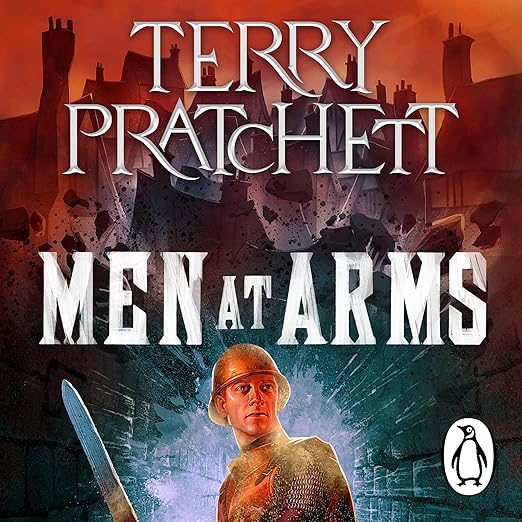
I remember finishing Guards! Guards! for the first time and thinking: this is the best entry point into Discworld I have ever encountered. Sam Vimes, the drunk, terminally underpaid captain of a city watch that the city would prefer to forget about, discovering that he cares about Ankh-Morpork even when Ankh-Morpork is clearly not worth caring about. Then Men at Arms arrived in my queue, and I discovered that Pratchett had been saving something. He had been saving a story about what happens when a weapon enters a world that has organized its power structures around the assumption that no weapon like it exists.
This is, among other things, a novel about guns. It is also a novel about diversity initiatives, institutional identity, and the very particular kind of man who is dangerous not because he wants power but because he genuinely believes he deserves it. Pratchett published this in 1993. He was paying attention.
The New Recruits and What They Break Open
The City Watch is being forced to diversify. This means, in Ankh-Morpork’s terms, taking on representatives of the city’s minority species: Corporal Carrot already stretches the definition of dwarf, but now the Watch has a real dwarf in Cuddy, a troll in Detritus, and a woman who is a werewolf most of the time in Angua. This setup could be broad satire, and it is sometimes played for comedy, but Pratchett is doing something more careful: he is watching what happens when institutions built around certain assumptions are forced to function with people who do not share those assumptions, and finding that the institutions change in ways they did not intend and cannot fully control.
Reviewer SC notes that Carrot has to take on additional responsibilities as Vimes prepares to marry into the nobility, and that the mystery involves a string of guild murders connected to someone who wants to use a legendary weapon to restore the monarchy. This is accurate and also somewhat undersells how the novel’s central gun metaphor operates. The weapon in question changes everyone who holds it. That is what guns do, Pratchett suggests, and the Disc is not ready for what that means.
Jon Culshaw and the Ensemble Comedy
Jon Culshaw is perhaps best known in the UK as an impressionist, which gives him an unusual set of tools for Discworld narration. He handles the character differentiation well, particularly in the Watch ensemble scenes where several distinct voices need to hold their ground simultaneously. His Sam Vimes has the required weight of a man who has stopped drinking because he is afraid of what he becomes when he drinks, and his Carrot is warmly earnest in a way that could tip into simplemindedness and does not. The comedic timing in passages about Nobbs, the character disqualified from the human race on competitive grounds, lands consistently.
Reviewer Gilbert M. Stack correctly identifies the structural core: Vimes leaving the Watch to marry Lady Sybil while a conspiracy to restore the monarchy unfolds, with Carrot in the frame for the big job. What Stack’s review does not address is how carefully Pratchett structures the dramatic irony around Carrot’s unknowing candidacy for kingship, and how that irony becomes genuinely moving rather than just clever in the final act.
Why This Novel Earns Its Reputation
One reviewer cited the Sunday Express calling this the funniest and best crafted book of the year. I would not go that far in terms of absolute ranking within Discworld’s canon, but I would argue it represents a step change in Pratchett’s ambition for the City Watch subseries. Guards! Guards! established the setting and the core characters. Men at Arms establishes that Pratchett intends to use those characters to say things that matter. The comedy is still present on almost every page. But the novel ends differently than it begins, and the tone of that ending is not funny at all. That tonal range is what the best Pratchett novels achieve, and Men at Arms is firmly in that category.
Who Should Listen, Who Should Skip
Listen if you have read Guards! Guards! and want to continue the City Watch subseries. This is the second Watch book in Discworld publication order and the experience is richer for having the first as context. Listen if you like comic fantasy that uses its humor to approach genuinely dark material about power, weapons, and who gets to use them.
Skip if you want a standalone experience with no series baggage. While Men at Arms is technically accessible, the payoff of the Vimes character arc requires Guards! Guards! as foundation. Also skip if you want pure comedy without the weight: this novel is funnier than most things published in any year, but it ends on a note that sits with you.
Frequently Asked Questions
Does Men at Arms need to be read after Guards! Guards!, or can it stand alone?
Pratchett designed Discworld novels to be accessible in any order, and the publisher notes this on the edition. However, Men at Arms is the second City Watch novel, and Sam Vimes’s character arc, including his relationship with Lady Sybil, his recovery from alcoholism, and his complex relationship with Ankh-Morpork, carries significantly more weight if you have Guards! Guards! as context.
How does Jon Culshaw’s narration compare to other Discworld recordings?
The Penguin Audio Discworld series has used multiple narrators, and comparisons are somewhat subjective. Culshaw’s background as an impressionist gives him strong character differentiation skills, which serve the Watch ensemble particularly well. Listeners who have strong preferences for specific previous Discworld narrator styles may need an adjustment period, but Culshaw’s performance is confidently executed.
Is this novel actually about guns, or is that reading the subtext too hard?
Pratchett is fairly explicit about it. The weapon at the center of the mystery is described in terms that make its real-world analogue unmistakable, and the novel’s argument about what weapons do to the people who hold them and the societies that allow them is not subtle. The gun metaphor is the book’s organizing principle, delivered with characteristic Pratchett obliqueness.
Angua is described as a woman ‘most of the time’, is her storyline a significant part of this book?
Yes. Angua and Carrot’s relationship is one of the novel’s primary emotional threads, and the complications introduced by her werewolf nature are handled with considerably more sensitivity and genuine feeling than the comic framing might suggest. It is one of the entries in the ongoing Discworld project of treating characters who are Other in ways that do not reduce them to their difference.