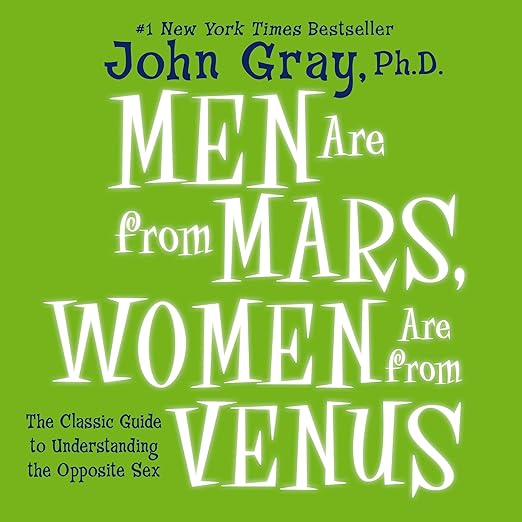
Quick Take
- Narration: John Gray reads his own work, which gives the material authority and directness but also a slightly clinical, seminar-like quality
- Themes: Gender and communication styles, emotional needs in relationships, the dynamics of conflict and withdrawal
- Mood: Earnest and instructional, with occasional warmth
- Verdict: A foundational relationship text whose binary gender framework feels dated but whose core observations about communication needs remain genuinely useful for many couples.
I have complicated feelings about this book, and I think that is the honest place to start. Men Are from Mars, Women Are from Venus by John Gray was published in 1992 and became one of the best-selling nonfiction books of the twentieth century. It has also attracted substantial criticism over the decades for its reliance on broad gender generalizations and its binary framework that leaves no room for the many relationship configurations that do not map onto one man and one woman. Both of these things are true, and a useful review of this audiobook, especially for listeners approaching it now, in 2026, needs to hold both.
At 9 hours and 28 minutes, narrated by Gray himself for Harper, this is a thorough listen. Gray reads his own work with the slightly elevated, seminar-like confidence of someone who has given the same talk many times and has seen it work. That quality is both reassuring and occasionally limiting, the delivery lacks the warmth that a different narrator might bring, but it carries the authority of the author’s conviction in his own material.
Our Take on Men Are from Mars, Women Are from Venus
The core framework is by now so embedded in popular culture that it almost feels like common knowledge, but it is worth restating: Gray argues that men and women approach communication, emotional needs, and conflict resolution with fundamentally different orientations, and that most relationship friction stems from failing to recognize those differences. Men retreat to their proverbial caves when stressed; women want to talk through problems. Men offer solutions when women want to be heard; women offer concern when men want space. The planetary metaphor, Martians and Venusians who learned to accommodate each other before coming to Earth and forgetting, is clumsier than the actual content, but the underlying observations about how miscommunication compounds are often specific enough to be genuinely recognizable.
One reviewer who encountered the book in the late 1990s tracked down the Mars Venus organization to pursue training rights in Australia, a response that speaks to the book’s practical resonance for people in that era. Another described it as something they wished they had read six to ten years earlier, despite advanced degrees and international experience. These are not naive testimonials; they are accounts of recognizing specific patterns in their own relationships. That specificity is where Gray’s book has always derived its power.
Why Listen to Men Are from Mars, Women Are from Venus
The audiobook format suits this material reasonably well. The book is built around examples, vignettes, and practical frameworks that function as much as spoken teaching as written text, the style was clearly shaped by Gray’s background in couples counseling and public speaking. Listening while commuting or doing household tasks works particularly well; this is a book you process partly through your own life as you go, and the listen-while-living format naturally produces the kind of reflection the content is asking for.
Gray narrating his own work means there are no mediation layers between the reader and the material. When he explains why a woman who wants to be heard feels dismissed by a man who immediately offers solutions, the directness of his delivery, this is what I observed in thousands of counseling sessions, this is what I concluded, carries a weight that a second-party narrator might not sustain. Whether or not you agree with his framework, you are in no doubt about what he is arguing.
What to Watch For in Men Are from Mars, Women Are from Venus
The most useful sections are the concrete communication translations, what Gray calls learning to speak the other’s language. These include specific scripts for how to ask for support in ways that are more likely to succeed, how to express emotional needs without triggering defensiveness, and how to recognize when a partner needs space rather than engagement. These practical elements hold up better than the broader gender framework because they are, in essence, observations about different communication preferences that many listeners will recognize in their specific relationships regardless of the larger theoretical claims.
Be aware that the book’s binary assumptions limit its applicability. Same-sex couples, non-binary individuals, and anyone whose communication style does not match Gray’s Mars/Venus defaults will find the framework maps poorly onto their experience. The practical advice is often still extractable, but the framing requires active translation that straight couples in traditional relationship structures will not need to perform.
Who Should Listen to Men Are from Mars, Women Are from Venus
Most useful for listeners in heterosexual relationships who recognize persistent communication disconnects and want a structured vocabulary for discussing them. The book works as a shared listen for couples willing to engage with its framework critically, taking what resonates and setting aside what does not.
Less suited for listeners seeking an intersectional or nuanced treatment of gender and relationships; the book’s binary framework is foundational, not incidental, and cannot simply be opted out of. Also skip if you want current relationship research, Gray’s model predates most of the empirical work in the Gottman tradition and does not engage with it.
Frequently Asked Questions
Does John Gray’s narration of his own book feel like a strength or a weakness compared to a professional narrator?
More strength than weakness, on balance. Gray reads with the confidence of someone who has taught this material for decades, and that authority suits the content. The limitation is that his delivery tends toward seminar rather than storytelling, it lacks the warmth a skilled narrator might bring to the more emotionally resonant passages. Listeners who want instruction will be satisfied; those who want emotional engagement may occasionally miss a more flexible narrator.
How does the book hold up in 2026 given how much the conversation around gender has changed since 1992?
The binary gender framework is genuinely dated and the book does not accommodate it. Same-sex couples, non-binary individuals, and anyone whose communication style does not match Gray’s baseline assumptions will find the model maps poorly. The specific observations about communication needs and conflict patterns, the so-called cave behavior, the impulse to offer solutions versus the desire to be heard, remain recognizable for many listeners, but they require active separation from the gender framework to apply broadly.
Is this book helpful if only one partner listens to it, or does it work best when both listen?
It can help one partner understand specific dynamics better and respond more effectively, but the translation exercises Gray proposes work best when both people share the vocabulary. Reviewers who describe major shifts in their relationships typically encountered the book with their partner or used it to start conversations. One person applying the framework while the other is unaware of it is a more limited experience.
What is the practical value of the ‘translations’ Gray offers for communication between partners?
Considerable, for the right listener. Gray offers specific scripts, ways to ask for space, ways to signal that you need to be heard rather than advised, ways to recognize withdrawal as a processing strategy rather than rejection. These concrete tools are the most durable part of the book and survive the theoretical framework better than the planetary metaphor does. Reviewers consistently mention these practical elements as the most actionable takeaway.