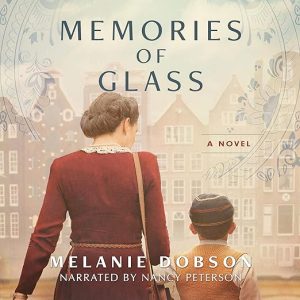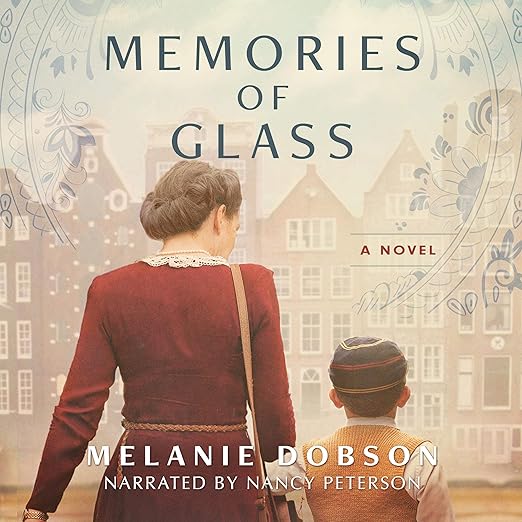
Melanie Dobson's Memories of Glass sits squarely in the dual-timeline historical fiction tradition that Diane Ackerman's The Zookeeper's Wife helped popularize: a documented WWII rescue story braided together with a present-day investigation into buried family secrets. This audiobook splits its attention between 1942 Amsterdam, where childhood friends Josie van Rees and Eliese Linden work to smuggle Jewish children out of a theater used as a deportation holding site, and a contemporary thread following Ava Drake, who begins to suspect her celebrated great-grandfather was not the war hero he claimed to be.
Written by Dobson and narrated by Nancy Peterson, this eleven-hour-and-eight-minute audiobook holds 4.6 out of 5 from 700 ratings on Audible, a strong number reflecting an author reviewers describe as an established name in inspirational historical fiction.
A Closer Look at Memories of Glass
The 1942 storyline draws on real, well-documented history: the Dutch resistance's efforts to move Jewish children to safety across German-occupied Holland, work that genuinely saved hundreds of children who would otherwise have faced deportation. Dobson grounds Josie and Eliese's fictional rescue mission in that documented resistance activity, and the novel's own warning that 'only one will escape' gives the historical thread real narrative tension rather than treating the history as simple backdrop. Reviewer B. Burnham confirms the book is 'inspired by the heroics of the Dutch resistance,' and structures the story across three points of view.
The contemporary half, Ava Drake's investigation into her great-grandfather William Kingston's possibly fabricated wartime heroism, adds a second, quieter kind of tension: institutional reputation versus buried truth. Her work as director of the Kingston Family Foundation and the connection uncovered through Landon West's Ugandan coffee plantation give the present-day plot its own stakes, distinct from but thematically linked to the 1942 story, both concerned with what people choose to hide and what surfaces seventy-five years later.
The title itself rewards a second look. Glass is fragile and can shatter without warning, exactly what threatens Josie and Eliese's operation and friendship throughout the 1942 sections, but glass is also what you look through to see clearly, and what old photographs and keepsakes get preserved behind. Both meanings are doing real work across the novel's two timelines: memory as something breakable, and memory as the transparent medium through which Ava eventually sees her family's true history.
Ava's specific position, director of the very foundation built to celebrate her family's name, sharpens the contemporary plot considerably. She is not an outside investigator stumbling onto a mystery; she is professionally responsible for maintaining a myth she is simultaneously discovering may be false, which puts her in the same kind of double bind, protecting a public story while privately doubting it, that echoes Josie and Eliese's own secret-keeping seventy-five years earlier.
Nancy Peterson's narration favors a clean emotional register over exaggerated accent work, a choice that serves a dual-timeline structure well since it keeps Josie, Eliese, and Ava tonally distinct without tipping into caricature. That restraint matters especially in the wartime sections, where overplaying the emotional beats would risk turning real historical suffering into melodrama, and Peterson's steadier approach avoids that trap.
Reviewer S.C. calls the story 'compelling, heartbreaking, sweet, gut-wrenching and simply beautiful,' unable to put it down, while A Payne describes it as a 'complex story that has stuck with me,' specifically noting it is based on true accounts of Dutch children secreted to safety. That combination, emotionally overwhelming per one reader, intellectually sticky per another, suggests Dobson lands both the feeling and the historical weight rather than sacrificing one for the other.
Dobson's standing as an established, award-winning voice in inspirational historical fiction, referenced directly in the synopsis, shows in how confidently the novel handles its historical research without the pacing slowing into a lecture. The 1942 sections carry real documentary weight, resistance logistics, the danger of moving children through occupied Amsterdam, without ever reading as a history lesson interrupting the story rather than driving it.
The geographic leap from occupied Amsterdam to a contemporary Ugandan coffee plantation is a bolder structural choice than the synopsis's brief mention suggests, and it fits a pattern reviewers associate with Dobson generally: her novels are described as transporting listeners across both time and place rather than staying anchored to one setting. That willingness to let the present-day mystery unfold somewhere genuinely unexpected, rather than in a more predictable American or European setting, keeps the contemporary half from feeling like a lesser, purely functional frame around the historical story.
Things to Know Before Starting Memories of Glass
This is explicitly Christian fiction, a framing reviewer A Payne names directly, and listeners should know that going in even though the synopsis itself does not foreground it. The faith framework shapes how forgiveness, sacrifice, and redemption get handled across both timelines, which will read as a meaningful throughline for listeners aligned with that lens and as an added layer to navigate for listeners who prefer secular historical fiction.
Three distinct points of view across two widely separated timelines is also a genuine structural demand. Listeners need to track Josie, Eliese, and Ava's separate arcs and hold both 1942 Holland and contemporary Uganda and the Kingston Foundation in mind simultaneously, which asks more sustained attention than a single-timeline novel would. At over eleven hours, that structure has room to breathe, but it is not a book suited to distracted, in-and-out listening.
The novel's own promise that only one of the two friends will escape functions as a genuine structural engine rather than simple jacket copy. It sets up Josie and Eliese's fates as a live question the entire 1942 timeline builds toward, which raises the emotional stakes of every choice they make along the way. Listeners should know going in that this means the wartime storyline carries real, sustained dread rather than the gentler historical-fiction register some listeners might expect from the cover description alone.
Who Melanie Dobson Is Writing For
Readers of Kristin Hannah or Kate Quinn specifically, or anyone drawn to WWII fiction centered on ordinary women's resistance rather than battlefield action, will find familiar and rewarding ground here. Listeners comfortable with or actively seeking a Christian fiction framework, and anyone who enjoys dual-timeline structures that connect a documented past to a mystery-driven present, are the clearest audience.
Skip this if you specifically want secular historical fiction without a faith framework, or if dual-timeline structures with three separate points of view tend to frustrate rather than engage you. Readers wanting a tightly focused single-period WWII narrative rather than one split across 1942 Holland and present-day Uganda should also look elsewhere.
Key Details
- Performance: Nancy Peterson brings a clean, restrained emotional register that keeps three points of view distinct without slipping into melodrama.
- What it covers: Dutch WWII resistance, buried family secrets, Christian faith and forgiveness
- Feel: Emotional, layered, and quietly suspenseful
- Our call: A well-reviewed dual-timeline historical novel for readers of Kristin Hannah and Kate Quinn, best suited to those open to its Christian fiction framing.