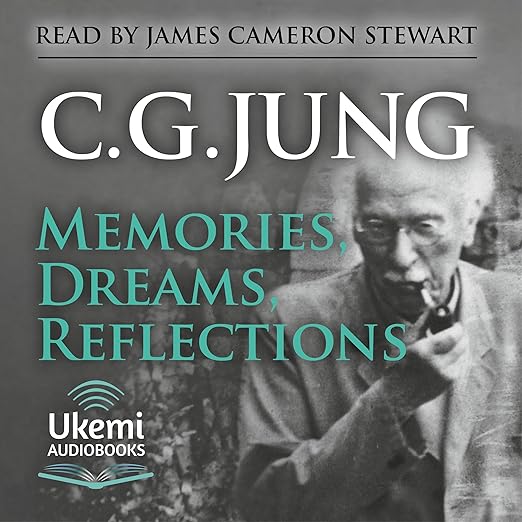
Picture an eighty-two-year-old Carl Jung, four years from his own death, finally agreeing to tell his life story, and then watch that project refuse to behave like a normal autobiography. That refusal is the whole appeal of this audiobook. Jung began dictating what became Memories, Dreams, Reflections in 1957 in collaboration with Aniela Jaffe, and what starts as a conventional life account quickly turns into something closer to a frank statement of faith, philosophy, and psychological method, sixteen hours and fifty-one minutes of a man trying to understand himself the only way he ever trusted, from the inside out.
Reviewer Morgan describes trying a secondary book about Jung first and getting nowhere, then going, in her words, straight for the horse's mouth. That is roughly my own advice too: this is a primary source, not an introduction, and it rewards listeners accordingly.
Where Introvert, Extrovert, and Archetype Actually Began
Jung's own framing line sets the terms early: he can understand himself, he says, only in the light of inner happenings, and that becomes the book's organizing logic instead of a simple chronology of achievements. The material ranges enormously, his relationship with Sigmund Freud and their eventual split, the development of analytical psychology and dream interpretation, and an extended engagement with world religions including Christianity and Buddhism. Jung is also the figure who named introvert and extrovert, animus and anima, and archetypes like the wise old man and the mother, and hearing him describe where those ideas actually came from, rather than reading them secondhand in a textbook, is the book's real value.
Reviewer IndigoJane calls it a Jung-authorized compilation drawn from later-life interviews, which reads easier than a straight academic memoir despite its density. Reviewer Luke A Trevelyan makes the useful point that Jung was never just a psychiatrist; he was a founding figure of modern psychology, and this book is where he explains that legacy in his own words rather than a biographer's.
A little biographical grounding helps place this correctly: Jung was born in 1875 in Switzerland and died in 1961, and he began this project in 1957, genuinely near the end of his life rather than as a mid-career reflection. That proximity to death shapes the material's tone throughout; this reads as a man settling his own accounts rather than building a public legacy, which is part of why it feels more candid than a typical statesman's memoir.
The book's publication history is itself part of its authority. Jaffe compiled and edited the material from direct interviews and Jung's own dictated pages, then saw it published only after his death, with later editions restoring material Jung's family had initially asked to keep private. That editorial layering means listeners are hearing a text that was shaped collaboratively, not a single unfiltered transcript, which is worth knowing going in.
The genre tagging here, filed under both biography and social sciences, actually makes sense rather than reading as a mismatch: Jung's ideas reached far beyond clinical psychology into anthropology, comparative religion, and literary theory, and this text connects his own inner life directly to that wider intellectual reach, discussing myth and religion not as case studies but as material he lived inside personally.
Elizabeth Proud Reads Jaffe's Introduction Before Jung's Voice
James Cameron Stewart narrates the bulk of the text, and dense introspective material like this asks for exactly the kind of measured, contemplative delivery that avoids either rushing past difficult ideas or over-dramatizing what is, at its core, a man thinking out loud about his own mind. Keeping sixteen-plus hours of interior reflection from feeling monotonous is a real craft challenge, and pacing that respects the material's own unhurried rhythm is the right approach.
One detail worth flagging specifically: Aniela Jaffe's introduction is read by a separate narrator, Elizabeth Proud, which gives listeners a clear scholarly frame before Jung's own voice takes over. That two-narrator structure is a small production choice, but it usefully signals the shift from editorial context into Jung's first-person account, and it is a nice touch for a book this reliant on distinguishing whose perspective you are actually hearing.
Two Ratings, Three Reviews, Best Heard Unhurried
This is not a chronological life story in the conventional biographical sense, dates and career milestones, and listeners expecting that shape may find the structure disorienting at first. It moves thematically, circling back to dreams, myths, and inner experience rather than marching forward year by year, which is intentional but worth knowing before you start.
Only two ratings are attached despite three substantive reviews, so the audiobook-specific data here is thin even though the reception among those who have engaged with it is uniformly strong. This also genuinely rewards some existing interest in psychology or Jung's ideas; it is not designed as a gentle on-ramp for someone with zero background.
It is also useful to compare this against Freud's own scattered autobiographical writing, which was far more guarded and clinical by comparison. Jung's willingness to discuss dreams, visions, and what he frankly calls his own inner happenings as primary evidence, rather than incidental color, is a genuinely unusual choice for a scientist of his era, and it is exactly what makes the book feel closer to philosophy or memoir than to a standard case-study-driven psychology text.
The Times review quoted in the synopsis, praising Jung's single-minded humility and his passion to unearth truth, captures something real about the listening experience specifically: this never reads as a man defending his legacy. It reads as someone still genuinely working through unresolved questions right up to the end, which is a rarer quality in this kind of late-career reflection than it might sound.
Listen in longer, unhurried stretches if you can manage it; this is not a book that rewards being chopped into five-minute commute segments, since Jung's train of thought often takes a full chapter to arrive at its actual point.
Freud Readers Get the Other Side of the Relationship
This is for psychology students and Jungian-curious listeners, readers of Freud's own writing looking for the other side of that relationship, and anyone who wants primary-source reflection rather than a secondary pop-psychology explainer of Jung's ideas.
Skip it if you want a linear, chronological biography of Jung's career and achievements, or if you are looking for breezy, self-help-adjacent psychology content. This is introspective and demanding in the best sense, and it asks for real patience in return.
Before You Listen
Who reads the introduction in the Memories, Dreams, Reflections audiobook, and is it different from the narrator of Jung's own text?
Yes. Aniela Jaffe's introduction is read by Elizabeth Proud, while James Cameron Stewart narrates the main body of Jung's own reflections.
Is Memories, Dreams, Reflections a good introduction to Carl Jung's ideas, or is it better after reading a secondary source first?
It works best as a primary source rather than a first introduction. Listeners with at least some prior exposure to Jung's core concepts will get more out of it than complete newcomers.
Does the audiobook cover Jung's break with Freud?
Yes, his relationship with Freud and their eventual professional split is covered as part of the book's account of how Jung developed his own analytical psychology.
Is this audiobook a chronological life story or more of a thematic reflection?
It is organized thematically around Jung's inner experience, dreams, myths, and ideas, rather than marching through his career chronologically, which sets it apart from a conventional biography.