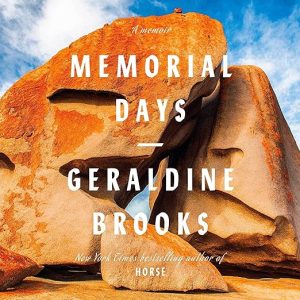
Geraldine Brooks reads her own memoir here, and that credit is the most consequential thing on this audiobook page, though nobody in the review column brings it up. Four hours and fifty-six minutes from Penguin Audio, dated February 2025: that is the entire technical record. The book itself covers the day her husband of more than three decades collapsed and died on a Washington, D. C. sidewalk, and the three years it took her to find room to grieve him properly. A bereavement account delivered by the bereaved is a different proposition from a hired voice, and this listing gives you no help at all in judging how that goes.
The Administrative Blur, Then the Chosen Solitude
The spine of the book is a gap. Tony Horwitz died on Memorial Day 2019, sixty years old and, as far as Brooks knew, vigorous and healthy. What followed was red tape and to-do lists, the version of mourning that contemporary life hands you in place of the withdrawal older traditions expect. Three years passed before she booked a flight to a remote island, rented a shack on a rugged coast, and spent stretches of days without seeing another person. The memoir moves between those two conditions, the administrative blur and the chosen solitude, and yet the alternation never feels like a device; it is what puts pressure on a short book.
The five written responses agree about the register more than about anything else. The response signed Love Hearts closes a brief entry with the observation that the book is not self pitying, and that is the note the column keeps returning to in other words. A. Brown singles out a passage in which Brooks imagines the alternate versions of herself that might have existed had she never met Tony at all, and calls those reflections honest and brave. The one entry below five stars, signed Jane, spends most of its length on what helped and what did not, and on the things the couple wished they had settled in advance.
Brooks Stands as Her Own Only Reader
So why take it in audio. The obvious answer is the voice: Brooks is credited as her own reader, which means the sentences about Tony Horwitz are spoken by the person who lived them. That arrangement can go two ways and the page will not tell you which. What it does tell you is that no professional stands between the writing and your ear, and that the running time is short enough to sit through in one afternoon. Not one of the five responses says a word about the recording, and here the silence actually matters, because the whole proposition of this edition rests on who is doing the reading.
Structure rewards continuous listening here more than most memoirs do. Because the book cuts between 2019 and the island three years later, you are asked to hold two timelines at once, and taking it in five-minute scraps would blunt that. Jane's practical thread is worth flagging as a pleasure in itself: the response reads the book partly as advice, noting what the couple had not settled and what the rest of us might want to settle while we can. That is an unusual thing to want from a grief memoir, and it suggests the book works as something other than an elegy.
One response places the book on an identifiable shelf. Writing under dpd, a reviewer calls it the third Brooks title they have read after Horse and March, then names the company it keeps: Joan Didion's The Year of Magical Thinking, and Calvin Trillin's Alice. Whether Memorial Days belongs on that shelf is a judgment this page cannot settle for you, but the comparison is useful as an expectation-setter. This is a widow's book in a tradition of widows' and widowers' books, and the widow is the one reading it aloud.
A Column of Reviews That Won't Finish
Before you reach a sentence about the book, the description makes you walk past a wall of citations: a bestseller line, an award finalist line, a run of notable-book and best-of selections from most of the American review press, then two pull quotes. All of it may be accurate, and none of it describes the listening experience. If you are trying to decide whether four hours and fifty-six minutes of this will suit you, the useful material starts roughly halfway down the description and the top half can be skipped without any loss.
Two details on this page do not line up. The description sends Brooks to a remote island off the coast of Australia; the entry from Love Hearts places the shack off Tasmania. Both can be true at once, and the page never says which the book uses, so treat the location as unsettled until you hear it. Separately, dpd describes the book as a short gem at just over 200 pages. That is a print fact sitting in the review column of an audio edition, and it is a reminder that most of these responses were written by people holding a physical copy.
The column is damaged as well. Most of the five bodies break off before they finish, and one breaks off at the worst possible moment. A. Brown builds toward the single reservation in an otherwise admiring entry, writes that if one absence had to be named it would be that Brooks, and the text ends right there. The only criticism anyone offers across five responses is the sentence that never finishes. Bonnie Brody breaks off mid-clause too, and so does dpd. Read the column knowing you are seeing beginnings.
A Retreat That Requires Money and Time
This suits people who want a bereavement narrative that keeps its scale small and its voice dry. It suits readers who came to Brooks through Horse or March and want to hear her without the apparatus of fiction. Under five hours, it also suits anyone who wants a memoir they can finish in one sitting, which for this subject is closer to a mercy than a convenience. And it suits anyone who treats the self-narration as the reason to choose this edition instead of the printed one.
Two groups should be careful. Jane raises the obvious objection: the retreat at the center of the book requires money and free time that most grieving people do not have, and a listener who finds that gap irritating will find it irritating for four hours. The second group is anyone hoping for the sustained, analytical grief writing the comparison titles promise, since this is shorter and more particular than that. Look elsewhere if you want the tradition instead of this one specific loss.
Does Geraldine Brooks narrating her own memoir change how Memorial Days lands?
It changes the stakes. The credit names her as the reader of her own book, so every line about a husband who died in 2019 arrives in the voice of the widow who wrote it. No response in the column comments on the delivery, which means you are buying that arrangement unheard. For most listeners it will decide the purchase one way or the other.
How long is the Memorial Days audiobook, and does it work in one sitting?
Four hours and fifty-six minutes, which puts it inside a single afternoon. The book cuts between the days around the 2019 death and a solitary stay on an island three years later, and holding both timelines is easier in one continuous run than across a week of short scattered sessions.
Why do reviewers mention page counts on an audiobook listing like this one?
Because most of the people writing here held a physical copy. One entry sizes the book at a little over 200 pages, a detail that belongs to print and tells you nothing about this edition. It is common on listings of this kind, and it means the column is judging prose, not performance.