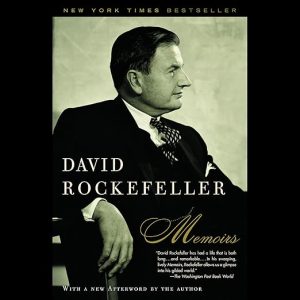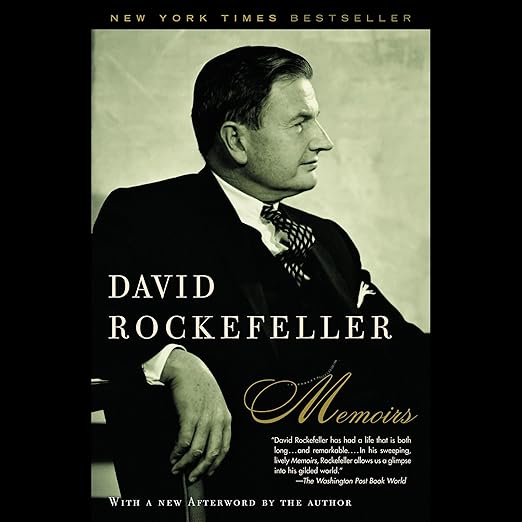
I came to David Rockefeller's Memoirs on a rainy Tuesday in January, during the kind of week when you want something with genuine historical weight. I had just finished Ron Chernow's biography of John D. Rockefeller Sr. and felt compelled to follow the dynasty forward another generation, into boardrooms and diplomatic salons rather than oil refineries. What I found was something both more and less than a conventional autobiography: it is the carefully curated self-portrait of a man who moved through the twentieth century at an altitude most of us can barely imagine, alongside heads of state and central bankers and art patrons, and who has very specific ideas about how that story should be told.
At over twenty-four hours of listening, this is a substantial commitment. Dan Woren narrates with a composed dignity that fits the material well. His voice is smooth and unhurried, the kind of narration that communicates gravitas without editorializing. For long stretches discussing Chase Manhattan's international expansion or the founding of the Trilateral Commission, that measured pace works. In livelier anecdotes, though, Woren's evenness occasionally irons out what might have been more vivid storytelling. The author's voice appears in an afterword, and that brief appearance is itself a document worth hearing.
Chase Manhattan and the Making of a Worldview
What makes this audiobook genuinely valuable is how openly Rockefeller stakes out his worldview. He was not hiding: he believed deeply in American-led internationalism, in the civilizing potential of global capital markets, and in the responsibility of the very wealthy to shape public institutions. Those convictions are woven into every chapter. His account of meetings with Zhou Enlai, Anwar Sadat, and Mikhail Gorbachev reads less like personal memoir and more like diplomatic dispatch, stripped of the emotional texture you might find in, say, George Kennan's journals. That is not necessarily a flaw. Rockefeller was operating in a register where discretion was a professional requirement, and the audiobook reflects that.
One reviewer with an MBA background singled out the Chase Manhattan chapters as the book's intellectual core, and I agree. The account of how Rockefeller rebuilt Chase into a genuinely international institution, navigating Cold War constraints, Arab oil money, and the emerging markets of Latin America, is the kind of financial history that reads differently now than it did when the book was first published in 2002. The Rockefeller Center sections are similarly rich for anyone interested in mid-century American urbanism and the intersection of private wealth with civic identity.
What Inherited Wealth Owes the Public
There is a particular pleasure in autobiography that comes not from what the subject chooses to reveal but from what they cannot resist revealing. Rockefeller is far more candid about his ambitions than he seems to realize. His account of the family's philanthropic philosophy, rooted in his father John D. Jr.'s stewardship of the family fortune and his mother Abby Aldrich's passionate support of modern art, illuminates how inherited wealth transmutes itself into cultural authority across generations. For listeners who came to this book from Chernow's Titan, as one reviewer noted doing, the transition from the rough accumulation of Standard Oil money to the cultivated internationalism of David's career is genuinely fascinating to trace.
The memoir is also unusually honest about its own limits. Rockefeller acknowledges, with characteristic understatement, that his access to power was inseparable from his name and fortune. He does not pretend to have been a self-made man. What he argues, implicitly, is that the obligations attached to inherited wealth require a kind of rigorous public service. Whether you find that argument convincing will shape how you receive almost everything else in the book.
The Gaslighting Charge Against Rockefeller's Diplomacy
The most contested territory in any listening of this book involves Rockefeller's long career as an informal diplomat. He served as a kind of private-sector ambassador to heads of state across Africa, the Middle East, Latin America, and the Soviet bloc, using Chase's international reach as both tool and justification. One dissenting review accused him of gaslighting, of presenting himself as a passive presence while wielding enormous influence over global economic arrangements. That critique has substance. Rockefeller describes his meetings with figures like the Shah of Iran or Augusto Pinochet in almost entirely transactional terms, with little acknowledgment of what American banking interests meant for ordinary citizens in those countries.
Listeners who approach this audiobook as a piece of American social history rather than a straightforward life story will get the most from it. Read it the way you might read a government white paper: attentive to what is emphasized, what is glossed, and what is simply absent.
Twenty-Four Hours With a Formidably Accomplished Man
This audiobook is well suited to listeners with a serious interest in twentieth-century American finance, Cold War diplomacy, or the history of American philanthropy and urban development. It rewards those who come prepared with some background in the period. Readers of Chernow's Rockefeller biography or Walter Isaacson's profiles of American power will find natural continuity here. Listeners looking for personal warmth, narrative drama, or self-critical reflection will likely find it frustrating. The Rockefeller who emerges from these pages is formidably accomplished and genuinely committed to his vision of the world, but he is also, perhaps inevitably, a man shaped more by his position than by his inner life. That is its own kind of historical document.
Does this audiobook cover David Rockefeller's role in the Trilateral Commission and global finance institutions?
Yes, Rockefeller discusses the Trilateral Commission, Chase Manhattan's international expansion, and his philosophy of American-led economic internationalism at considerable length. These passages form the intellectual backbone of the book.
How does Dan Woren's narration hold up over more than 24 hours?
Woren is professional and composed throughout. His measured pace suits the formal diplomatic sections well, though it can feel flat during the more personal anecdotes. The author reading his own afterword adds a worthwhile contrast.
How does the audiobook handle criticism of Rockefeller's influence on global affairs?
It largely doesn't. Rockefeller presents his diplomatic activities in broadly positive, transactional terms. Critical perspectives on American banking's role in supporting authoritarian regimes are absent. Listeners should bring those questions themselves.