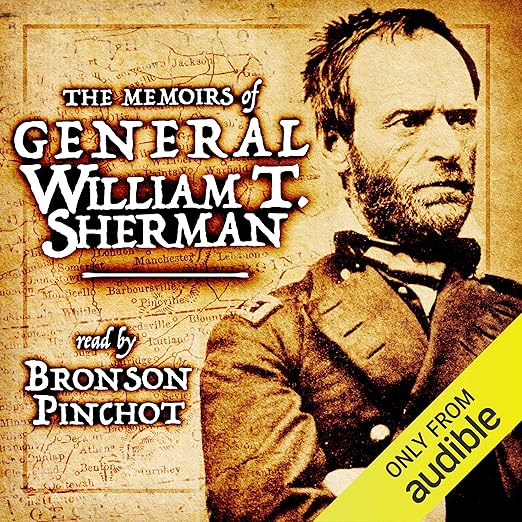
Atlanta burned in November 1864, and the man who ordered it watched from a hilltop as smoke columns rose across the Georgia skyline. William T. Sherman describes that moment in his memoir with exactly the same unadorned practicality he brings to everything else in this audiobook: no romantic gauze over the destruction, no retrospective apology, no inflated rhetoric. He reports what happened, why it happened, and what it cost. That quality of plain truthfulness is what makes this memoir - first published in 1875, running to nearly 35 hours in Bronson Pinchot's narration - a genuinely valuable primary document rather than a piece of self-congratulation dressed up as history.
Sherman was explicit about why he wrote it. No satisfactory history of the Civil War yet existed, he said, and he was in a position to fill part of that gap. He also invited any witness who disagreed with his account to publish their own version. That combination of confidence and intellectual honesty runs through the entire memoir. This is a man who was not asking for absolution and was not performing humility. He was reporting, and the clarity of that reportorial stance is what separates his account from most military autobiography of any era - including, arguably, Grant's memoirs, which cover similar territory with more gravity and less impatience.
Grant's Gravity, Sherman's Unfinished Argument
One of the more surprising qualities of this memoir is how engaging the pre-war sections are. Sherman's life before the conflict included shipwrecks, banking disasters, the California Gold Rush, and a period of prolonged professional uncertainty that reads, in retrospect, as something very close to clinical depression. He struggled to find his footing for years before the war gave him a context in which his particular gifts - logistical clarity, strategic vision, psychological resilience under pressure - became exactly what the situation required. That backstory gives the later military chapters a grounding in character that purely strategic history rarely achieves. The March to the Sea is a different experience when you know who ordered it and what he had been through to get to that point.
The comparison reviewers draw to Julius Caesar and Ulysses Grant as soldier-writers is apt. Grant's memoirs are widely considered a classic of American autobiography, and Sherman's are frequently overlooked in that context despite offering an equally valuable perspective on the same conflict. Where Grant wrote with the gravity of a man settling accounts late in life, Sherman wrote with the directness of a man who was not yet finished arguing. The tone is different and the experience of listening is different, but the quality of the underlying intelligence is equivalent.
Pinchot's Steady Register Prevents the Blur
Bronson Pinchot brings the same clean delivery to this material that Sherman brought to his prose. Pinchot does not try to dramatize what Sherman wrote plainly; he reads at a pace that allows the directness to register without rushing past it. There are sections - particularly the long operational chapters covering the Atlanta campaign and the March to the Sea, with their dense accumulations of place names, troop movements, and supply calculations - where the sheer documentary weight of the text makes sustained listening genuinely demanding. Pinchot's steady register prevents those sections from becoming a blur, and the extraordinary passages earn their weight precisely because of the plainness surrounding them.
Sherman's farewell address to his army, his account of Lincoln's assassination through the lens of what Johnston told him when he received the news, and his extended correspondence with Grant in the memoir's later chapters are among the most valuable primary sources in the book. They land harder because of the surrounding practicality. When a man who describes everything else in clear logistical terms suddenly reaches for something approaching feeling, the effect is considerable and earned. The lows make the highs possible.
Reading Letters Aloud Restores Their Urgency
The memoir makes no attempt to rehabilitate itself for a later audience. Sherman does not revisit his most controversial decisions with the softening lens of modern moral sensibility. His account of the scorched-earth policy of the March to the Sea is measured and procedural; he was more interested in what those decisions achieved militarily than in their human cost to the civilian population in their path. Readers looking for remorse will not find it. Readers trying to understand how a commander of that era thought about the relationship between destruction and strategic necessity will find the memoir more illuminating than any retrospective account could be.
The relationship between Sherman and Grant is a continuous undercurrent worth tracking throughout. One reviewer argues that Sherman had the superior strategic grasp - the ability to see the whole theater rather than just the operational level - and Sherman's own account is consistent with that assessment without being immodest about it. He writes about Grant with genuine respect while maintaining a clear sense of his own distinct approach to the war. Their extended correspondence in the memoir's final section is one of the most revealing documents in American military history, and audio is a particularly effective format for it: reading letters aloud restores something of their original communicative urgency.
A Natural Companion Piece to Grant's Memoirs
Listeners with a serious interest in the Civil War and enough stamina for 35 hours of primary-source military memoir will find this audiobook more rewarding than most secondary accounts of the same campaigns. Those who have already listened to Grant's memoirs in audio will find Sherman's account a natural companion piece: same war, different temperament, different vantage, equally direct about what it cost. The audiobook rewards dipping into particular sections - the Atlanta campaign, the March to the Sea, the war's final months - as much as it rewards linear listening from the beginning. Casual history listeners who need narrative propulsion over documentary density should know that the long operational sections test patience, and they should make that judgment before committing to the full runtime.
How does this audiobook compare to Grant's memoirs as a Civil War listening experience?
Grant's memoirs are more literary and carry the gravity of a man settling accounts near death. Sherman's are more impatient and operational - written with the directness of a man who had not finished arguing. Both are valuable primary sources; Sherman's pre-war sections are arguably more engaging as biography, while Grant's are more polished as prose.
Is Bronson Pinchot's narration suited to military history audiobooks of this length?
Pinchot's delivery is clean and appropriately undramatized, which is exactly right for Sherman's plain prose style. The long operational sections with dense troop movements and place names are genuinely challenging at 35 hours, but Pinchot's steady register prevents them from collapsing into background noise. He serves the material rather than performing it.
Does Sherman address the burning of Atlanta and the March to the Sea directly in this audiobook?
Yes, and without apology or retrospective softening. Sherman treats those decisions the same way he treats everything else: as operational choices made in a specific strategic context. He was more interested in what those decisions achieved militarily than in their human cost, and the memoir reflects that priority without trying to rehabilitate it for a later audience.
Is this audiobook accessible to listeners without deep Civil War knowledge, or does it assume prior familiarity?
It helps considerably to have some prior knowledge of the war's major campaigns and personalities. Sherman's memoir is a primary source, not a narrative history, and it does not explain context that Sherman assumed his 1875 readers already knew. Listeners new to Civil War history will follow the main events but will get more from it with some background reading in hand.