Quick Take
- Narration: Justin Cabanting delivers a restrained, respectful performance that honors the gravity of Odachi’s testimony without dramatizing it, the right call for first-person witness material.
- Themes: Coerced sacrifice, survivor guilt, post-war erasure
- Mood: Quiet, reckoning, historically sobering
- Verdict: A primary-source testimony unlike anything else in WWII audio, Odachi’s account of being an unknowing teenage kamikaze pilot demands to be heard on its own terms.
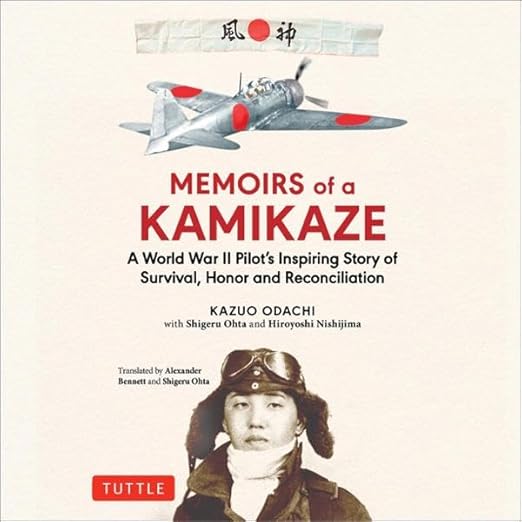
I came to this one on a Sunday afternoon, mid-way through a longer stretch of Pacific Theater reading, and I remember pausing it just a few minutes in because I realized I needed to pay a different kind of attention than I usually give military history. This is not analysis. It is not reconstruction. It is the voice of a man who was sixteen years old when he joined the Imperial Japanese Navy, who was assigned to the Kamikaze Special Attack Corps without being told what that meant, and who kept that secret for seven decades. Kazuo Odachi, now well into his nineties, agreed to nearly seventy hours of interviews with authors who know him personally. What you’re listening to is a transcript of those words.
That distinction matters enormously. In a genre crowded with reconstructed accounts and scholarly syntheses, Memoirs of a Kamikaze operates on a different register entirely. There is no narrator imposing retrospective meaning on these events. Odachi tells you what he saw, what he felt, and what he refused to feel in order to survive, and the restraint of that telling is where the book’s power lives.
The Weight of an Unknowing Assignment
The detail the synopsis provides, that Odachi was assigned to the Kamikaze Special Attack Corps without being told he was being assigned to die, is not a hook. It is the central ethical horror of the book. Their call sign was “ten dead, zero alive.” Young men were handed missions framed as honorable service, with the actual nature of those missions revealed only incrementally, if at all. Odachi describes training alongside other cadets, watching some of them crash into mountainsides during maneuvers, and gradually understanding the arc of what was being asked of him. The psychological mechanism he developed to manage that knowledge, what he calls a “samurai spirit” that his admirers might read as courage and a harder reading might call a survival-necessary dissociation, is the emotional spine of the whole book.
What the reviews surface, and what bears emphasis here, is that Odachi is equally illuminating about what came after. Japan’s rush to rebuild meant that the sacrifice of kamikaze pilots was largely buried. The men who survived, those whose last missions were cut short by Japan’s surrender, as Odachi’s was, found themselves in a country that had little space for their particular kind of witness. He spent decades as a kendo instructor, a police officer, a detective. He said nothing. This book is the thing he finally said.
A New Accounting of Command Failure
Where Memoirs of a Kamikaze becomes most politically pointed is in Odachi’s framing of the men who gave the orders. His core argument, articulated with the quiet authority of someone who was there, is that kamikaze pilots were unsuspecting teenagers and young men asked to do the bidding of superior officers who were never held to account. That framing cuts against both the romanticized Western narrative (fanatics who chose death) and the sanitized Japanese postwar narrative (glorious sacrifice for the nation). Odachi’s account strips both versions down to something colder: institutional manipulation of teenagers by men who had every reason to know the war was already lost.
One reviewer noted that the pilot was nineteen years old when the war ended, worth holding onto as a number. He was sixteen when he enlisted. The war lasted nearly three years in his experience of it, which means the entire arc from naive navy recruit to combat-ready kamikaze pilot happened within a few years of adolescence. The book does not editorialize this. It doesn’t need to.
What Cabanting’s Narration Brings
Justin Cabanting is a measured, controlled narrator for this material, and that restraint is earned. There is a temptation with testimony-based audio to let grief or horror creep into the delivery, to underline what the listener should feel. Cabanting largely resists this. He reads the text with the kind of even pace that suggests he understands his role is transmission, not interpretation. The result is occasionally flat in the early training passages, the sections where Odachi is describing technical aspects of flight school, but when the emotional density increases in the latter half, the controlled register pays off. Quietness is the right voice for a man who kept this secret for seventy years.
The IPPY Award this title carries signals that the book landed well with independent publishing circles, and the 330 ratings at a 4.5 average reflect genuinely strong listener engagement. At just under seven hours, it reads closer to a sustained interview than an exhaustive military history, which is precisely what it is.
For Testimony Listeners and Those Who Can Wait
Listen to this if you read Pacific Theater history and want the kind of inside testimony that strategic overviews cannot provide. Listen to this if you have any interest in what coercion and institutional loyalty look like from the inside of a military apparatus in collapse. Listen to this if you care about the long silence that follows wars, what survivors carry and what governments erase.
Skip this if you want tactical detail, operational maps, or the kind of analytical framework you’d find in academic military history. Memoirs of a Kamikaze is not that. It is a life told in plain language by someone who survived something designed to kill him, and who spent most of that life not talking about it. The simplicity is the point.
Frequently Asked Questions
Was Odachi actually a volunteer for the Kamikaze Special Attack Corps?
No. According to Odachi’s own account, he was unknowingly assigned to the corps, the nature of the mission was not made clear to him at the time of assignment. This is one of the book’s central revelations: that many pilots were teenage conscripts placed into suicide roles without full understanding of what they were signing up for.
How does this compare to other first-person WWII Pacific accounts from the Japanese perspective?
First-person Japanese military testimony is genuinely rare in English translation, and kamikaze accounts specifically are almost nonexistent. Most available histories are either American-authored strategic analyses or postwar Japanese academic works. Odachi’s account, drawn from nearly seventy hours of personal interviews, sits in a category by itself as direct witness testimony.
Does the book cover Odachi’s post-war life in detail?
Yes, his decades as a kendo instructor, police officer, and detective get meaningful attention. The book frames his postwar silence as part of the same story: a government and society that swept the sacrifice of kamikaze pilots under the rug in the rush to rebuild, leaving survivors with nowhere to place their experience.
Is this audiobook suitable for younger listeners interested in WWII history?
The material involves psychological trauma, combat preparation, and the deaths of fellow pilots during training, but Odachi’s storytelling is restrained rather than graphic. It would work well for high school students with an interest in WWII or Japanese history, the emotional weight is real but the delivery is measured.