Before You Press Play
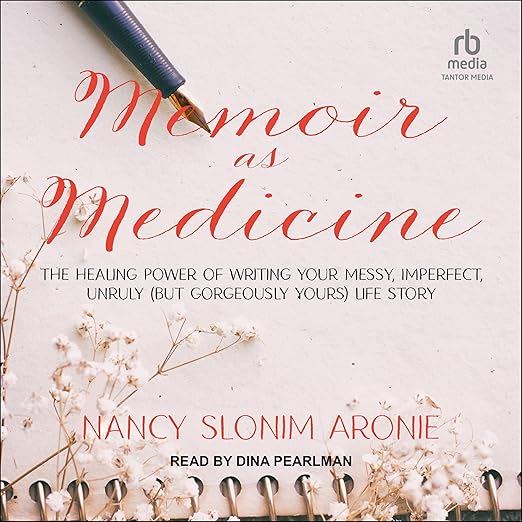
- Read by: Dina Pearlman reads Nancy Slonim Aronie's prompts with warmth and clarity that keeps a vulnerable subject approachable.
- At its heart: memoir writing as healing, grief transformed into teaching, finding your own story worth telling.
- Vibe: Gentle, encouraging, quietly moving.
- Short version: A genuinely accessible entry point for anyone intimidated by writing their own story.
Nancy Slonim Aronie's son Dan was diagnosed with diabetes at nine months old, and then, at twenty-two, with multiple sclerosis; he died at thirty-eight, and somewhere across those decades of caregiving, Aronie discovered that writing functioned for her as something closer to medicine than hobby. That personal history sits underneath every page of this audiobook, a guide to memoir writing built less around technical craft rules than around Aronie's decades of experience teaching people that everyone genuinely has a story worth telling. Narrator Dina Pearlman reads Aronie's own set of prompts, directions, and examples, developed and refined across years of workshops, aimed at helping listeners write their way into deep understanding, real healing, and sometimes even unexpected joy.
Pearlman's Warmth Keeps Six Hours Accessible
Aronie's core teaching premise is disarmingly simple and genuinely useful: sharing who you are, what shaped you, and where you are now unlocks something close to magic for both the writer and whoever eventually reads or hears the result. That premise translates into concrete, repeatable prompts rather than abstract encouragement, and the book's real value lies in how specific and actionable those prompts are compared to vaguer find-your-voice writing-guide platitudes common elsewhere in the genre. Decades of actual classroom experience, watching what specific exercises reliably unlock honest writing in real students, backs the material throughout.
Dina Pearlman's narration favors warmth and clarity over dramatic flourish, a fitting choice for a book whose whole argument depends on making memoir writing feel accessible rather than intimidating to listeners who may never have written anything personal before. At six hours and eighteen minutes, the runtime stays disciplined and focused, moving through Aronie's prompts and examples without padding, which suits a book built to be genuinely used, workshop-style, rather than simply consumed once and shelved.
Prompts Tested on Real Workshop Students
Aronie's own decades of hands-on teaching experience, developing and refining these specific prompts across countless workshop sessions rather than compiling them from theory, gives her material a tested quality a first-time writing-guide author could not easily replicate. These are not exercises dreamed up for a book proposal; they are prompts shaped by watching real students, many of them lifelong non-writers, find their way into their own difficult material session after session.
Listening to Aronie's prompts delivered aloud approximates something closer to sitting in one of her actual workshops than reading the same material silently on a page would; a spoken prompt, paced and warm, mimics how the exercises were originally designed to be delivered to a room of real students. For listeners who have never attended an in-person writing workshop and feel intimidated by the idea, this audiobook format may be the most natural, low-stakes entry point into that experience currently available.
Fifty-Five Years of Silence, Broken in Six Pages
One reviewer describes the personal stories throughout as intimate, raw, revealing, truthful, human, and awe-inspiring, the kind of description that suggests Aronie practices exactly what she teaches, modeling vulnerable disclosure rather than only prescribing it from a safe instructional distance. Another reviewer, describing herself as someone who could not or would not write for fifty-five years, credits the book specifically with giving her the courage to approach her own memoir within its first six pages, a striking, specific testimonial about how quickly the material can shift someone's relationship to their own story. A third reviewer describes Aronie's own gentle, specific encouragement as words she never once heard from a schoolteacher.
A 4.7 rating across 127 ratings is strong for a niche writing-craft title, and the consistency of the reviews, each independently describing feeling personally moved or unlocked rather than simply informed, suggests the book succeeds at its actual stated goal: not teaching technique in the abstract, but genuinely lowering the barrier between a listener and their own difficult, unwritten stories.
Aronie's teaching philosophy runs deliberately against the grain of more gatekept writing-craft traditions that treat memoir as a technical skill reserved for trained writers. Her premise, that everyone already has a story worth telling and simply needs the right prompt to access it, is democratic in a way that specifically serves listeners who have never identified as writers at all, and that framing is part of why the reviews attached to this title skew so heavily toward first-time, previously intimidated writers rather than working authors polishing an existing draft.
The synopsis promises not just healing but unexpected joy as an outcome of this kind of writing, a pairing worth taking seriously rather than reading as marketing overstatement. Grief and humor sit closer together than most writing guides acknowledge, and Aronie leans into that proximity directly in her own teaching, treating a laugh that surfaces inside a difficult memory as a sign of honest writing rather than a tonal mistake to edit out.
Grief Runs Through Every Writing Prompt Here
Like other writing-guide and workbook-adjacent titles, some of Aronie's specific prompts and exercises are clearly designed to be completed on paper, in real time, rather than simply absorbed passively while listening. Listeners wanting the full workshop-style benefit should plan to pause the audiobook and actually write in response to prompts as they arrive, notebook in hand, rather than treating this purely as background listening; the instructional content and philosophy translate cleanly to audio on their own, but the exercise portion specifically needs an active, written component to do its intended work.
Because Aronie's own teaching philosophy grew directly out of caring for a chronically ill child and eventually losing him, listeners should expect real grief woven throughout, not just craft advice delivered in a vacuum. This is handled with hard-won wisdom rather than raw, unprocessed pain, but anyone currently navigating their own caregiving grief or loss should know the emotional register here runs deeper than a typical how-to writing guide, closer to memoir itself at points than pure instruction.
At six hours and eighteen minutes, this runs noticeably shorter than many comparable writing-craft audiobooks, which favors listeners wanting a focused, efficient entry point over an exhaustive reference; it does mean the coverage stays intentionally narrow, built around Aronie's specific prompt method rather than surveying memoir-writing approaches broadly. Listeners wanting a wider survey of memoir craft theory alongside this prompt-based approach should treat it as one strong tool among several rather than a complete writing education on its own.
Caregivers Get Practical Value From These Prompts
Recommended for aspiring memoirists intimidated by the idea of writing about themselves, for anyone who has tried and failed to start a personal writing project and needs a genuinely different entry point, and for listeners drawn to teacher-memoirists who blend craft instruction with real personal disclosure. Grief counselors, caregivers, and support-group facilitators may also find real practical value in Aronie's specific prompts as a tool for helping others process difficult experience through writing.
Skip it if you want a technical, structure-focused writing craft book, three-act plotting, scene-versus-summary mechanics, rather than an emotionally driven, prompt-based approach to unlocking personal material. For anyone ready to actually sit down and write their own story, though, few guides currently in audio make that first step feel as achievable as this one does.
Do I need writing experience before starting this audiobook?
No. Aronie's whole teaching approach is built for people who have never written anything personal before, using concrete prompts rather than assuming prior craft knowledge or vocabulary.
Does this audiobook include writing exercises I can complete while listening?
It includes the prompts and directions, but getting full value means pausing to actually write, notebook or laptop in hand, rather than listening passively straight through.
Is Memoir as Medicine mostly about Nancy Slonim Aronie's own life, or about teaching writing?
Both, woven together. Her son Dan's illness and death inform the teaching philosophy throughout, but the bulk of the audiobook is instructional, built around prompts and workshop-tested exercises.
Is this audiobook emotionally heavy given Aronie's son's death?
It carries real emotional weight in places, since her teaching grew directly from that loss, but the tone stays grounded in hard-won wisdom rather than raw, unprocessed grief.