At a Glance
- Narrator: Alan Sklar brings a measured investigative authority to this financial exposé, with a delivery that suits the book's alternation between institutional history and human-scale moral failure.
- Subjects: Institutional rot in elite finance, the gap between Swiss banking reputation and reality, the systemic enablement of scandal by corporate culture
- Tone: Controlled outrage with a reporter's instinct for detail
- Bottom line: A meticulously reported account of Credit Suisse's collapse, rendered with enough narrative momentum to make 166 years of Swiss banking feel like a thriller.
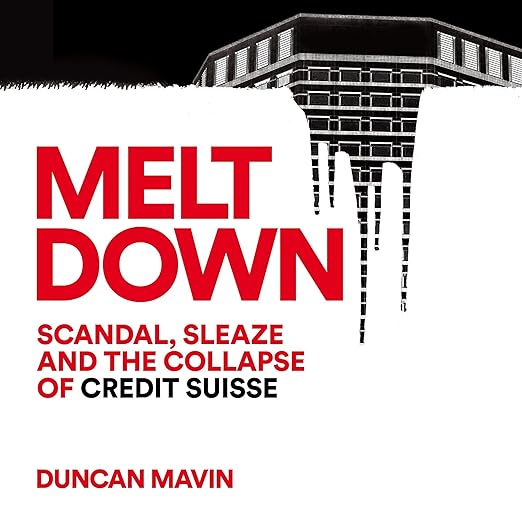
Credit Suisse was founded in 1856, and it took 166 years to bring it down. The audiobook of Meltdown, narrated by Alan Sklar across just under six and a half hours, is Bloomberg investigative journalist Duncan Mavin's account of how that happened, told from inside the bank's marble corridors through sources Mavin cultivated during years of reporting. The book's metadata lists Thomas E. Woods Jr. as author, but the synopsis and every review in the edition confirm this as Mavin's work, his previous book "Pyramid of Lies" covered related territory in the financial services sector. This is a banking collapse book with a clear investigative lineage, and Mavin brings the Bloomberg discipline of sourcing and precision to a story that is both more specific and more damning than general financial crisis narratives tend to be.
Mavin Argues Secrecy Itself Was the Product
The case Mavin builds is not that Credit Suisse's collapse was a sudden catastrophe but that it was a long-running institutional failure, visible in retrospect at almost every decision point across several decades. The bank's clientele included dictators, drug dealers, and former Nazi officers. It helped fleece its own clients out of billions of dollars. It expanded aggressively while its internal culture rewarded the executives who drove that expansion and insulated them from consequences when it went wrong. Bonus structures that enriched senior leadership regardless of performance were not peripheral to the bank's failure; they were, Mavin argues, central to it.
The structure is chronological, moving from leader to leader across the bank's recent history. This sequencing is both a strength and a constraint. It allows Mavin to trace how each CEO's decisions compounded the problems of their predecessor, which is the right analytical frame for understanding an institutional collapse. But with a cast of characters as large as Credit Suisse's revolving door of senior executives, listeners need to stay actively engaged to track who is making which consequential decision in which era. The audiobook's relatively tight runtime of six and a half hours means Mavin compresses the leadership history without losing the throughline.
The most striking material concerns the Swiss banking culture that served as the bank's context and enablement. Switzerland's banking secrecy tradition created the conditions for decades of client abuse precisely because opacity was the product being sold. When the veil of secrecy eventually came down, through regulatory pressure, whistleblower disclosures, and the collapse itself, what was revealed was not merely one bank's bad decisions but a systemic failure that the secrecy infrastructure had been protecting for years. Mavin makes this argument not through polemic but through accumulated specific detail, which is the right journalistic method.
Sklar's Controlled Delivery Suits the Institutional Facts
Sklar's narration handles the financial complexity of the material with appropriate precision. Banking exposés require a narrator who can read the institutional and regulatory terminology without losing the human drama underneath, and Sklar navigates that balance effectively. His delivery is controlled rather than theatrical, which suits a book whose power comes from the facts themselves rather than from narrative embellishment. Reviewers with corporate finance backgrounds found the book engaging without finding it simplistic, which suggests the audio version maintains the analytical register of the reporting.
The book's comparative value is also worth noting. Mavin's account of Credit Suisse's failure is specific enough to be useful to readers who want to understand this particular collapse, while also illuminating structural features of investment banking culture that extend beyond any single institution. The patterns he identifies, executives insulated from consequences, bonus structures misaligned with long-term performance, cultural deference to secrecy over transparency, recur across the sector's recent history, and Mavin is careful to connect the Credit Suisse story to that larger pattern without overgeneralizing.
Leadership Transitions Are Hard to Track in Audio
The cast of characters is genuinely large, and the leadership transitions within the bank happen at a pace that can be challenging to track in audio. Credit Suisse ran through senior executives rapidly in its final years, and Mavin's chronological structure means you're introduced to new leadership figures at regular intervals. Listeners who find it difficult to retain names in audio without visual reference may want to take notes or access a supplementary character guide during the early chapters.
The book's regulatory and technical details are also denser than a general-interest narrative history of the same events would be. Mavin is writing for readers who can follow a discussion of capital adequacy ratios, regulatory pressure from FINMA, and the specific mechanics of the UBS forced merger without needing each term explained from scratch. This is appropriate for the material, but listeners with no financial background should be prepared for a steeper learning curve in the earlier chapters than the book's conversational tone suggests.
The forced UBS merger ordered by the Swiss government deserves specific attention as a narrative endpoint. Mavin treats it not as a resolution but as an exposure: the conditions under which a government compels one private bank to absorb another, overriding normal shareholder processes, are themselves a kind of verdict on how thoroughly Credit Suisse's leadership had exhausted every conventional option. The merger's aftermath, the questions it raised about Swiss banking secrecy, about regulatory responsibility, about the concentration of financial power, provides Mavin with a conclusion that is structurally complete without being comforting. Sklar's narration handles this closing section with appropriate gravity, allowing the institutional weight of the outcome to land without editorial inflation.
General Readers May Find the Technical Depth Demanding
This audiobook is well suited to readers with some background in financial journalism or corporate finance who want a reported, detailed account of the Credit Suisse collapse rather than a simplified summary. It also works well for listeners who have followed the broader story in the financial press and want the longer narrative context that Mavin's book-length treatment provides. Fans of books like "Bad Blood," "Den of Thieves," or "Billion Dollar Whale" will recognize the investigative register and find this in the same tradition.
Skip this one if you need a primer on how investment banking works before the institutional failure narrative becomes meaningful. Mavin writes with the assumption that his readers have basic financial literacy, and the book is stronger for that assumption. General-interest readers who want a more accessible introduction to the 2023 banking crisis may find the technical depth here more demanding than they're looking for.
Good to Know
Does the audiobook require specialized financial knowledge to follow?
Basic financial literacy helps. Mavin is a Bloomberg journalist writing for a financially engaged audience, and he uses banking terminology, regulatory concepts, and investment structures without extensive definition. Listeners with corporate or finance backgrounds will find the technical sections familiar. Those without that background may need to supplement with some external context during the early chapters.
Does the audiobook address what happens to the bankers responsible for Credit Suisse's collapse?
Mavin covers the regulatory and legal consequences that reached individual executives, including the Swiss government's handling of the forced merger and the accountability discussions that followed the collapse. The book does not end with a tidy reckoning for every figure it profiles, in part because the full consequences of the collapse were still unfolding at the time of publication, but the accountability question is taken seriously throughout.