Quick Take
- Narration: John H. Mayer handles a 36-hour biography with consistent professionalism, his measured pace suits the scholarly weight of Cannadine’s prose without making the listening experience feel like work.
- Themes: American capitalism and its discontents, the loneliness of extraordinary wealth, the political cost of staying too long
- Mood: Magisterial and unhurried, this rewards listeners who bring patience to history
- Verdict: The definitive biography of one of America’s most consequential and most forgotten financial figures, delivered in a format that rewards the commitment.
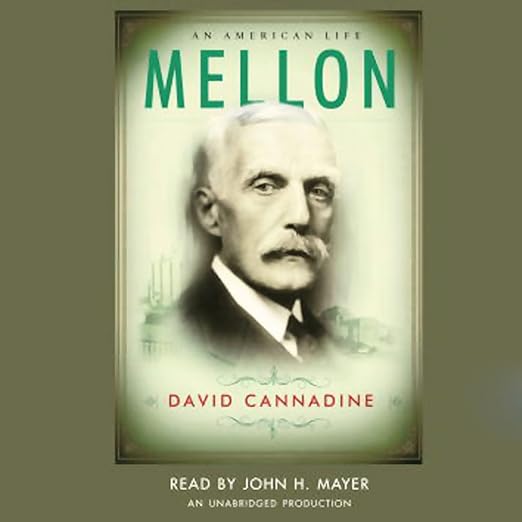
Nearly 36 hours of biography is a commitment that requires something in return: a subject who repays sustained attention, a biographer who can sustain intellectual momentum across that span, and a narrator who does not become furniture. David Cannadine’s Mellon provides the first two convincingly. John H. Mayer provides the third with quiet reliability. I came to this biography knowing Mellon primarily as the man whose name appears on a gallery in Washington, knowing, in other words, the philanthropist’s residue without knowing the man. Cannadine’s biography is a corrective to that partial image.
Andrew Mellon was born in Pittsburgh in 1855, the son of a banker with clear ideas about money and success. He overcame what Cannadine describes as a painfully shy temperament to build one of the greatest private fortunes in American history, spreading across banking, aluminum, oil, and industrial enterprise. His wealth tracked alongside America’s own rise to global economic supremacy, so the two histories illuminate each other. Mellon’s personal happiness was another matter. He was bred to accumulate and accumulate he did, with a brilliance that his biographer takes seriously without sentimentalizing.
Our Take on Mellon
The most compelling section of the biography covers Mellon’s years as Treasury Secretary under Harding, Coolidge, and Hoover, a tenure that made him the architect of the Roaring Twenties tax policy and eventually the scapegoat for the Great Depression. Cannadine is clear-eyed about this trajectory without being polemical: Mellon stayed too long, held too rigidly to convictions that had served a different era, and was destroyed politically in a way that his wealth could not prevent. The fallen-idol arc is one of biography’s most reliable structures, and Cannadine handles it with the precision of a historian who knows the difference between tragedy and culpability.
Why Listen to Mellon
One reviewer notes that the biography gives too much space to Mellon’s art purchases, and there is something to that criticism, Cannadine’s treatment of the collection that would eventually become the National Gallery of Art is thorough to the point of periodically stalling the biographical momentum. But that thoroughness is also what makes this the definitive work on its subject. The first published biography of a figure of this stature is under an obligation to be complete, and Cannadine honors that obligation. John H. Mayer’s narration keeps the academic prose accessible across the full length; his pacing never condescends and never rushes, which is the right approach for material that requires time to absorb.
What to Watch For in Mellon
At 35 hours and 57 minutes, this is among the longest single biographical audiobooks you will encounter. The middle sections covering Mellon’s political dominance in Pennsylvania and his years at the Treasury are dense with names, relationships, and policy detail. Listeners who prefer biography as narrative to biography as scholarship may find those sections demanding. The personal sections, particularly the deeply unhappy marriage and divorce that Cannadine treats with genuine sensitivity, are the most human parts of the book and arrive as relief after long stretches of financial and political history. A reviewer describes the work as could have been a little shorter, and that is honest: the depth serves scholars more than general listeners in places.
It is also worth noting what the biography does with Mellon’s role as a collector. The collection that became the National Gallery of Art was not incidental to his life, it was one of the few avenues through which a man bred for financial accumulation could express something resembling private feeling. Cannadine understands this and treats the art history with the same analytical care he brings to the financial and political history. Even readers who find those passages long will likely come away with a richer sense of what Mellon was trying to accomplish in his final years.
Who Should Listen to Mellon
Readers of American economic and political history who want the full portrait of a figure whose influence on the 20th century is poorly understood will find this essential. The biography is also valuable for listeners interested in the psychology of extraordinary wealth, how a man who built so much personal fortune remained so personally isolated, and what that pattern says about the culture that produced him. This is not a casual listen. It is a major biography in the tradition of Robert Caro, demanding equivalent commitment and delivering equivalent reward for listeners who bring that commitment to it.
Frequently Asked Questions
Is the 36-hour runtime justified, or does Cannadine over-research his subject?
Mostly justified, with one legitimate caveat: the sections on Mellon’s art acquisitions are longer than the narrative needs them to be. As the first published biography of this subject, Cannadine felt the obligation to be comprehensive, and the result is thorough more than it is perfectly paced. Listeners who come for the financial and political history will find those sections rewarding; the art passages less so.
Does the biography require prior knowledge of early 20th-century American financial history?
No. Cannadine is writing for a general educated audience and provides the historical context as he goes. Some familiarity with the Harding, Coolidge, and Hoover presidencies is helpful but not required, the relevant political context is built into the biography.
How does Cannadine handle the question of Mellon’s responsibility for the Great Depression?
With historical precision and no ideological agenda. Cannadine presents the case against Mellon’s Treasury policies and their contribution to the Depression’s severity, but he also contextualizes them within the economic thinking of the era. The conclusion is nuanced: Mellon was not uniquely culpable, but he stayed too long and held too rigidly to convictions that had stopped serving their purpose.
Is John H. Mayer’s narration engaging enough to sustain 36 hours of scholarly biography?
Yes, though this is not a performance-driven narration. Mayer reads with consistent clarity and a measured pace that suits the scholarly prose. Listeners looking for dramatic vocal interpretation will not find it here, but listeners who want a reliable, unobtrusive guide through dense text will find Mayer exactly right.