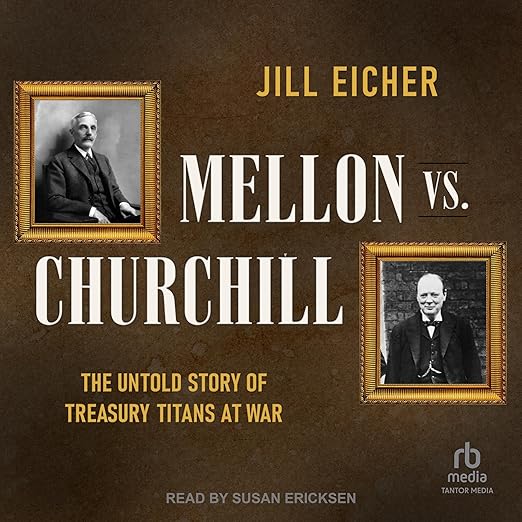
Meetings between the two men numbered five, and this audiobook builds itself on the claim that no mention of any of them appears in the official biographies of either. Jill Eicher's subject is the argument they had: Andrew Mellon at the US Treasury, tasked with collecting war debts from European governments still wrecked by the last war, and Winston Churchill at the Exchequer, representing the largest debtor of them all and becoming the loudest critic of American policy while he held the post.
Shy and Diffident and Brilliant, the Discovery Here
Pairing is the risky move, and Christian Schlect, writing in March 2025, names the risk precisely: the narrative tie between the two men runs a bit thin, while the underlying economic story is worth the retelling. That matches my reading. Five meetings across a handful of years is not a rivalry in the sense the title promises, and a book leaning on the head-to-head framing has to keep reminding you why these two particular officials matter more than the policies they administered.
Mellon is the discovery here and the description says so without apology: one of the most accomplished businessmen of his era, almost unknown today, shy and diffident and brilliant, handed the least enviable assignment at the US Treasury. Churchill needs no introduction and receives an unfamiliar one, seen entirely through his service as Chancellor of the Exchequer when Britain was the largest debtor to the United States. Anybody who has met him only through the years everybody knows will find this version strange, and the strangeness is the book's best asset.
Debt is the actual subject and it is a better one than the title suggests. What Churchill called the monstrous war debts sat at the center of European recovery, and the disagreement over whether to collect, forgive or restructure them made frequent headlines on both sides of the Atlantic. Twelve and a half hours leaves ample room to make that argument comprehensible to somebody who has never read a page of interwar economic history, which is the harder half of what Eicher set out to do.
Ericksen Must Carry Every Footnote in the Line
Footnotes are praised in the column and footnotes are exactly what audio cannot deliver. Mike, writing that same March, singles out extensive notes adding depth and credibility to the research, and none of that apparatus reaches a listener: no page to glance at, no citation to check, no visible marker separating a documented quotation from a reconstructed scene. Susan Ericksen has to carry every attribution inside the spoken line, and across twelve and a half hours crowded with treasury officials, ministries, sums and dates, that is a heavier load than the runtime by itself suggests.
Clarity is not a nicety on an economic history of this length, it is the entire delivery mechanism. A listener cannot reread a sentence about sterling parity or a repayment schedule without losing thirty seconds and the thread along with it. Eicher's decision to explain rather than assume is what separates a book you finish from one you set down somewhere in the fourth hour, and the promise of vignettes brought to vivid life points in the same direction.
Relevance is the argument the description leaves half-made. Sovereign debt, austerity and the politics of who ultimately pays are not historical curiosities, and watching the same mechanism run a century ago removes the temptation to treat the present as unprecedented. This material was public property at the time, and its disappearance from both men's official biographies is the more interesting historiographical question the book raises almost in passing.
All Three Reviews Fall on the Wrong Side of Release
Dates are the first thing to check here, and all three of them fall on the wrong side of the release. Tantor Media put the recording out on May 20, 2025, and the newest entry, filed from Brazil by Edimilson Mario, comes four days short of that date, with the other two older still. Whatever those grades measure, it is not this reading. The column has been pooled from a print edition, which happens often enough and is worth knowing when a 4.2 badge is the first number a buyer meets.
Portuguese is the language of that newest entry, and its content is warm and general: an engaging book, fluid and pleasant to read, on a historical subject little known and highly relevant. Nothing wrong with any of that, and nothing in it a buyer could act on either. Set the thin written column against fifty-three ratings and the page offers a buyer almost no help. Committing twelve and a half hours is no small thing, and the only substantive assessment on offer comes from two entries filed within a week of each other, both nearly two months before the file existed.
Patience With Balance Sheets Is the Entry Fee
Interwar history is the shelf this belongs on, and the best-served buyer is somebody who feels they already know the period, because the pleasure here is a familiar decade viewed from the Treasury rather than from the chancelleries. It also works for anybody curious about how temperament shapes fiscal policy, since the contrast the title sells, a shy American administrator against a combative British politician, is real even where the rivalry framing overreaches.
Numbers are the barrier here rather than the prose. Expect a great many ministry names and a great many sums, both of which are harder to hold in your head without a page in front of you. A 4.2 average is the lowest figure on this record's own terms, and the column offers no explanation for it that a buyer can inspect. Patience with balance sheets is the actual entry fee, and given that, twelve and a half hours spent on a forgotten argument between two finance ministers is better company than the description makes it sound.
Quick Take
- Narrator: One credited voice, Susan Ericksen, across a twelve-and-a-half-hour Tantor Media production, with no second reader for either of the two men the title sets against each other.
- Subjects: War debts and reparations after the Great War, Anglo-American economic rivalry, a dispute missing from both men's official biographies
- Tone: Measured and archival, with a real argument running underneath
- Bottom line: Worth twelve hours if interwar economics interests you more than the head-to-head framing does.