Quick Take
- Narration: Dorsey Armstrong narrates her own lectures with the warm authority of someone who genuinely loves this material, the self-narration adds intimacy and precision that a third-party reader rarely achieves.
- Themes: Medieval revisionism, myth versus history, cultural legacy
- Mood: Curious and lively, like the best undergraduate lecture you never got to take
- Verdict: If you have ever wondered whether King Arthur was real or why we still tell stories about the Black Death, Armstrong gives you ten hours of satisfying, well-researched answers.
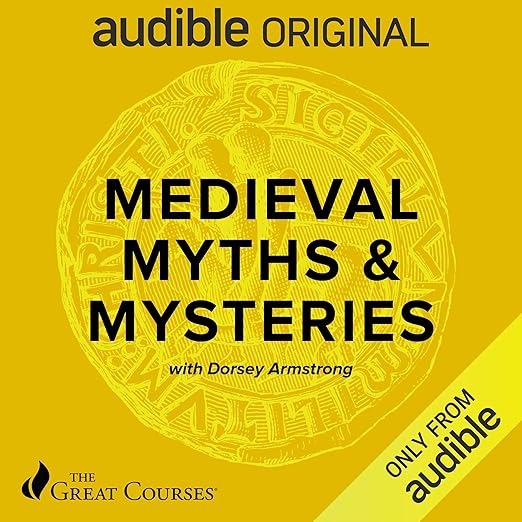
I started listening to Medieval Myths and Mysteries on a long drive through rural country, the kind of landscape that makes you half-expect to spot a castle on a hill. Dorsey Armstrong’s voice came on, steady, enthusiastic, and just self-deprecatingly funny enough, and two hours dissolved before I noticed. That almost never happens with lecture-format audiobooks, which can easily tip into the droning monotone of a conference call.
Armstrong is a medieval scholar who clearly has a bone to pick with popular history, and this Audible Original gives her a platform to say so in ten compact lectures. The organizing principle is clever: instead of marching through the medieval period chronologically, she picks up the myths and legends we inherited from those centuries and holds each one to the light. King Arthur. Robin Hood. The Knights Templar. Unicorns. The Black Death. The witch trials. Each lecture peels back the romantic or sinister image and asks what was actually there.
Our Take on Medieval Myths and Mysteries
What Armstrong does well, and what separates this from generic popular history, is that she refuses to deliver a simple debunking. The pleasure is not in learning that Robin Hood probably never existed as a single person, but in understanding why later generations needed him to exist. She traces how stories get manufactured and remade, how the Victorian era was particularly guilty of inventing a Middle Ages that suited its own anxieties, and how films like Braveheart and Excalibur carried those inventions into the twentieth century with enormous confidence and very little accuracy.
The lecture on the Black Death is particularly strong. Armstrong contextualizes the plague not as a catastrophe that interrupted history but as an event that restructured European society in ways we are still living with. Her treatment of the witch trial myths is equally rigorous: the famous claim that millions were burned turns out to be a nineteenth-century exaggeration, and the reality, while still horrific, is considerably more complicated than the popular image suggests.
Why Listen to Medieval Myths and Mysteries
The self-narration is a genuine asset here. Armstrong did not just read a script into a microphone; she delivers these lectures with the rhythm and slight improvisational energy of someone who has given versions of them in a classroom. Reviewers singled her out as delightful, and the word fits. She catches herself mid-argument, throws in a wry observation, and keeps the material moving at a pace that respects your time. At five hours and six minutes, this is lean content, you will not find yourself skipping sections.
The Game of Thrones angle in the final lecture, which one reviewer described as examining how the show relates to actual medieval history and legend, is handled with care. Armstrong does not treat it as a gimmick but as a legitimate entry point for discussing how medieval imagery functions in contemporary storytelling. It is a smart way to land the series.
What to Watch For in Medieval Myths and Mysteries
There are a few constraints worth naming. With only ten lectures and a runtime under six hours, the depth any single topic receives is necessarily limited. The Knights Templar, for instance, could sustain an entire audiobook on their own, and have, many times over. Listeners who want a complete historical treatment of any of these subjects will need to follow up elsewhere. Think of this as an exceptional orientation rather than a comprehensive education.
The rating count is also very small (five reviews at time of writing), which makes the perfect 5.0 score less meaningful than it might otherwise appear. That said, every reviewer who left a substantive comment praised the lectures in specific terms, citing particular topics they found illuminating. That specificity counts for more than a star rating anyway.
Who Should Listen to Medieval Myths and Mysteries
This works well for listeners who enjoy popular history but find straight chronological surveys dry. It is also a solid choice for anyone who has consumed a lot of medieval fantasy, whether in books, games, or film, and wants to know how much of that world is grounded in anything real. Listeners who prefer deep archival scholarship over accessible overview lectures will likely want something denser. But as an entry point into the medieval period that is both honest about its popular format and genuinely informative? Armstrong earns the recommendation.
Frequently Asked Questions
Do I need prior knowledge of medieval history to follow these lectures?
Not at all. Armstrong structures the lectures to meet listeners wherever they are, using familiar pop culture touchstones like Braveheart and Game of Thrones as on-ramps before moving into the historical material.
Is this an Audible Original, and does that affect the format?
Yes, it is an Audible Original released in 2019. The lecture format is the entire structure, there is no companion book, though the audio stands completely on its own.
Does Armstrong address the witch trial myth specifically, and is her treatment balanced?
Yes, she devotes a lecture to it. Her approach is methodical: she cites the inflated figures that circulated in the nineteenth century, then works through what the historical record actually shows. It is rigorous without being dry.
How does the King Arthur lecture handle the question of whether he was a real person?
Armstrong treats Arthur as almost certainly rooted in a real post-Roman military leader, though not a king named Arthur. She traces how the legend grew through centuries of literary elaboration, from Geoffrey of Monmouth through Malory to the Victorian reinventions.