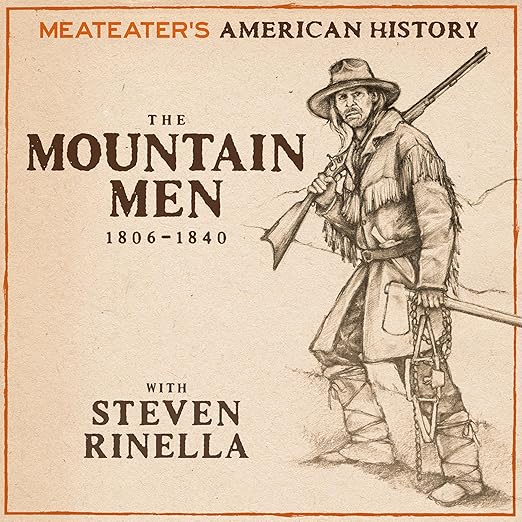
Steven Rinella narrating his own audiobook about Jim Bridger, Hugh Glass, and the mountain men of the Rocky Mountain fur trade is not a neutral choice. Rinella is a hunter, outdoorsman, and host of the MeatEater podcast, which means he brings to this material a practitioner's knowledge that academic historians of the same period cannot replicate. When he describes what it takes to live in the Rockies off the land in winter, he is not reconstructing from archives alone. That embodied relationship with the landscape makes this audiobook original a different kind of listening experience than a standard narrative history, and it registers from the first chapter.
The mountain men of the early nineteenth century are a celebrated and systematically misunderstood subject. The mythological version, all buckskin and rugged individualism, tends to obscure the actual conditions of the fur trade: the economic structure that drove men into the Rockies, the sophisticated knowledge systems they developed about Native American cultures and western geography, and the brutal mortality rate that the synopsis quantifies precisely. One in ten mountain men died a violent death in the wilds of the Rockies. That number grounds the romance in the actual. Rinella is not interested in mythology; he is interested in what it actually took to do what these men did.
The figures at the center of the book are well-chosen. Jim Bridger, Jedidiah Smith, and Hugh Glass are the canonical names of the era, and Rinella handles each with specificity rather than hagiography. Glass's story, familiar to modern audiences largely through the 2015 film The Revenant, is given the fuller treatment it deserves: the actual record of his survival after the grizzly attack and subsequent abandonment, which is stranger and more humanly complicated than the film's version. Reviewer Andrew Norling specifically names Beckwith and Bridger alongside Glass as highlights, and Rinella's treatment of the interconnections among these men conveys the small-fraternity quality of the era, never more than a few hundred active at any one time.
Rinella Is the Exception to a Real Risk
Author narration is not always an advantage in history. Academics who cannot perform their own material, or who default to a lecture register that suits the classroom but not the ear, often produce audiobooks that would have been better served by a professional narrator. Rinella is an exception. His MeatEater podcast has given him years of practice explaining complex outdoor and natural history subjects to general audiences, and his narration here carries that skill. He is direct, warm, and specific. He does not condescend to his listeners or over-explain, and when he gets to the harrowing passages, his delivery earns the gravity of the material.
The audiobook is part of the MeatEater's American History series, which the synopsis notes also includes the Campfire Stories audio series and other New York Times bestselling audio content. The series has an established voice and listener relationship, and this installment builds on that foundation. Reviewer Wyatt describes it as 'fantastic and informative,' and reviewer Andrew Norling notes it 'delights and entertains' while providing genuine historical understanding. Both are accurate: Rinella's gift is making serious historical argument entertaining without making it shallow.
European Hat Fashion Ended the Beaver Trade
The book covers the era from 1806 to 1840, which is the span of the Rocky Mountain beaver trade from its establishment following the Louisiana Purchase through its collapse when European hat fashions shifted away from beaver felt. That collapse is handled with genuine analytical weight: the mountain men's world did not end with heroic last stands but with an economic and ecological shift that made the trade unviable. Rinella traces the legacy of the era not in terms of the wilderness archetype they established, though he acknowledges that, but in terms of the specific geographic and cultural knowledge they accumulated about the western landscape.
The treatment of Native American relationships is worth noting. The synopsis identifies mountain men's 'relationships with Native people' as a defining feature of their existence, and Rinella approaches this with more nuance than frontier mythology typically allows. The relationships were complex, often violent, often interdependent, and the book does not resolve them into a simple narrative. At seven hours and thirty-two minutes, the audiobook covers significant ground across a thirty-four-year period without feeling compressed.
The audiobook's treatment of the era's ecological consequences is also worth noting. The beaver trade was not only economically unsustainable; it was ecologically transformative, reducing beaver populations in large portions of the Rocky Mountains to near-extinction levels within the span of the fur trade era. Rinella, as someone deeply engaged with questions of wildlife conservation and hunting ethics, handles this dimension without polemicism but without evasion either. The mountain men whose exploits he celebrates were also participants in a resource extraction enterprise that changed the western landscape in ways that took more than a century to begin recovering from. That complexity is part of what makes this audiobook more serious than a simple celebration of frontier legend.
For Anyone Who Watched The Revenant First
Listeners who follow the MeatEater podcast and want Rinella's historical depth applied to the mountain men era will find this audiobook exactly what the series promises. History listeners who have encountered the mountain men primarily through popular mythology and want the actual record of what the fur trade era involved will find Rinella's account the most accessible entry point currently available. Outdoor enthusiasts who want the western landscape history that contextualizes modern wilderness culture will find the environmental and ecological dimensions particularly resonant. This is also a strong choice for anyone who encountered Hugh Glass through The Revenant and wants the fuller, more accurate story behind the film.
In Brief
- Performance: Rinella self-narrates with the practitioner's authority and podcast-honed accessibility that distinguishes this from standard academic treatments of the same material.
- What it covers: Fur trade economics and ecological collapse, Native American relationships, the gap between frontier mythology and historical reality
- Feel: Grounded and vivid, with a hunter's attentiveness to landscape and survival that makes the history feel embodied
- Our call: The most accessible and practice-informed account of the mountain men era currently available in audio form, benefiting enormously from Rinella's self-narration.