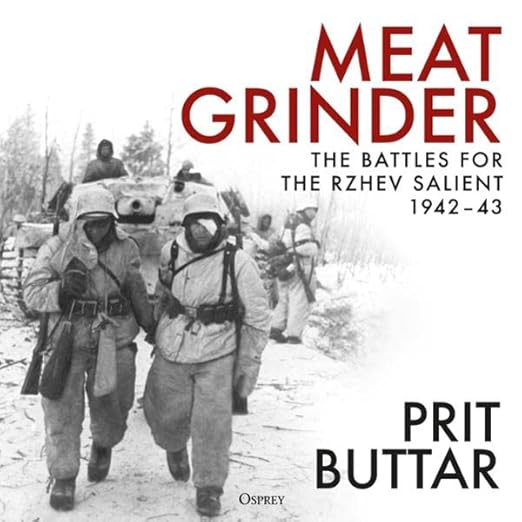
Quick Take
- Narration: Nathan Osgood delivers Buttar’s dense operational prose with steadiness and authority, keeping the chronology clear across a complex, multi-front campaign.
- Themes: Forgotten Eastern Front campaigns, the catastrophic cost of tactical failure, institutional learning under catastrophic loss
- Mood: Heavy and relentless, with occasional moments of human clarity amid the carnage
- Verdict: Readers who have followed the Eastern Front through Stahel or Glantz will find Buttar’s bilateral focus on Rzhev indispensable, though the map shortage is a genuine frustration.
I came to Meat Grinder on the recommendation of a colleague who studies Soviet military doctrine, and I started it on a long train ride from Paris to Brussels, expecting something roughly in the vein of Buttar’s earlier Eastern Front work. What I did not expect was the sheer density of the material. By the time the train pulled into Midi station I had logged nearly four hours and was only into the second major Soviet offensive against the Rzhev Salient. The book demands attention. It rewards it too, but it demands it first.
Prit Buttar has carved out a well-earned reputation as one of the most reliable Anglophone historians of the Eastern Front. His gift, as more than one reviewer here notes, is for communicating what one reader calls the "weft and warp amidst the chaos" of large-scale land battles. That gift is on full display in Meat Grinder, which tackles a campaign so brutal that the soldiers themselves gave it the name: the Rzhev Salient, a grinding two-year struggle that consumed more than two million men killed, wounded, or missing, yet barely registers in most Western accounts of the Second World War.
Our Take on Meat Grinder
What Buttar achieves here that most operational histories do not is a genuinely bilateral account. He draws from German and Russian first-hand memoirs, diaries, and daily operations reports, and the result is a narrative that refuses to flatten either side into abstraction. You feel the German infantry’s exhaustion defending a salient they knew was strategically indefensible. You feel the Red Army’s serial catastrophes, offensive after offensive smashed against prepared defenses, each failure costing lives at a scale that strains comprehension. The book is unflinching about Soviet command failures in this period, and equally clear about how those failures eventually forced a painful institutional reckoning that would bear fruit at Bagration in 1944.
The audiobook runs to over twenty-one hours, and Nathan Osgood’s narration is exactly what this material needs: measured, clear, never dramatic for its own sake. He handles unit designations, Russian and German proper names, and the technical terminology of mechanized warfare without stumbling, which matters enormously when you are trying to track multiple corps across a shifting front without being able to pause and check a map.
Why Listen to Meat Grinder
The audio format is actually well-suited to Buttar’s prose style, which is expository rather than cinematic. He is not trying to put you inside the foxhole the way some narrative historians do; he is trying to help you understand what was decided, at what level, and what the consequences were. Osgood supports that approach by keeping his delivery consistent and authoritative. The passages drawn from personal memoirs have a slightly warmer texture, and Osgood calibrates to that without overplaying it. It is a restrained but effective performance across a very long run time.
What to Watch For in Meat Grinder
The map problem, which several reviewers flag, is real. Buttar references specific villages, ridgelines, and river crossings with precision, and without a detailed map of the Rzhev area open beside you, some passages can feel abstract. I found myself pausing and pulling up topographic references online more than I would have liked. This is not a failure of writing so much as a production constraint that Osprey Publishing has not fully resolved for the audio edition. If you are listening while commuting or exercising, you will miss some of the geographic granularity. That said, the strategic and human dimensions come through clearly regardless.
The book is also genuinely dense. Buttar covers five major Soviet offensive operations across two years, and the accumulation of unit numbers, commander names, and tactical outcomes can blur if you are not paying close attention. This is not a gateway audiobook to the Eastern Front; it rewards prior knowledge of the period, and listeners who come in cold may find themselves frequently rewinding to reorient.
Who Should Listen to Meat Grinder
If you have read Glantz on Zhukov’s failures, Stahel on Operation Typhoon, or Buttar’s own earlier volumes on the Eastern Front, this is essential listening. It fills a genuine gap in Anglophone historiography and does so with the rigor and compassion the subject demands. If WWII Eastern Front history is new to you, start elsewhere and come back. Casual listeners seeking fast-moving narrative will likely find the operational depth more obstacle than reward. But for anyone seriously engaged with this theater of the war, Meat Grinder at 4.6 stars from nearly 240 ratings is exactly as good as its reputation suggests.
Frequently Asked Questions
Do I need to have read Buttar’s earlier Eastern Front books before starting Meat Grinder?
Prior familiarity with the Eastern Front helps enormously, but Meat Grinder works as a standalone. Readers who know Buttar’s Collision of Empires or Between Giants will recognize his methodology. Total newcomers to the theater may want some background context first.
How does Nathan Osgood handle the Russian and German proper names and unit designations?
Osgood is consistent and careful with both German and Russian names. He does not attempt character voices, which suits the operational history format well. The narration is authoritative rather than performative.
Is the map shortage in the audiobook edition a serious problem?
It is a real limitation. Buttar is precise about geography, so having a map of the Rzhev Salient area open while listening will substantially improve the experience. Several reviewers note this issue, and it reflects a production gap rather than a writing flaw.
Does the book cover the eventual German evacuation of the salient in March 1943, and what conclusions does Buttar draw?
Yes. Operation Buffalo, the German withdrawal in March 1943, is covered in full. Buttar argues that the Red Army’s serial failures at Rzhev, while catastrophic, forced an institutional analysis that directly informed the successful operations of 1944, making the Rzhev defeats a grim but consequential turning point.