In Brief
- Voice: Grover Gardner has narrated the LBJ series consistently across all volumes and brings a gravitas and forensic control to the material that reflects the weight of Caro's research.
- Big ideas: The moral cost of unchecked political ambition, the transition from retail politics to media-driven image manipulation, election fraud and the corruption of democratic process
- Atmosphere: Dense, meticulous, and ultimately damning; Caro does not let the listener look away from what he has documented
- Worth it?: The most focused and arguably most morally devastating volume in the Years of Lyndon Johnson series, centered on the 87 votes that changed American history.
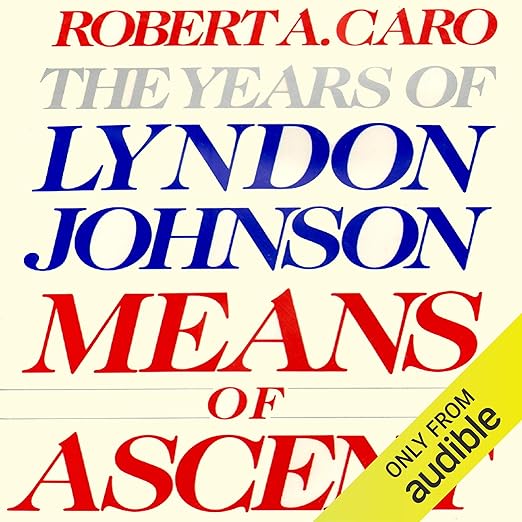
Robert Caro is the biographer who makes you understand why biography, at its best, is also philosophy. Not the authorized account delivered with institutional cooperation, not the celebrity profile constructed around access, but the decades-long forensic excavation of a single life that produces something closer to a moral argument about power than a chronological account of events. Means of Ascent is the second volume in Caro's multi-decade project on Lyndon Johnson, and it is, by most accounts, the sharpest, most concentrated, and most morally unsparing of the series.
Grover Gardner has narrated this series consistently across all volumes, and his authority with the material is evident from the first chapter. At 22 hours and 8 minutes, this is not a casual commitment, but Caro's prose rewards sustained attention in a way that few works of narrative nonfiction do. I listened to portions during a long cross-country flight, and found that the density of detail, which can feel overwhelming in print, translates better than expected to audio because Gardner's measured pacing gives each revelation room to land and accumulate its full weight before the next one arrives.
The center of this book is the 1948 Texas Senate race, the election in which Johnson defeated Governor Coke Stevenson by a margin of 87 votes that Caro demonstrates, with the accumulation of specific and documented evidence that is his signature method, was not legitimate. The fraud was elaborate, systematic, and personally supervised. Johnson understood precisely what he was doing, understood that without it he faced certain political death, and did it anyway. Caro's subtitle for this section, the 87 votes that changed history, is not hyperbole: had Stevenson won, there is no path to a Johnson vice presidency, no Kennedy assassination placing Johnson in the Oval Office, no Civil Rights Act of 1964 passing in the form it did.
What makes this more than a simple account of political corruption is Caro's framing. The contest between Johnson and Stevenson is not just a story about a stolen election. It is a story about the transition between two kinds of American political culture. Stevenson was, in Caro's portrait, a man of genuine principle and old-fashioned integrity who ran on his record and refused to use his opponents' tactics against them. He lost. Johnson's new politics of mass media, money, helicopter campaigning, and image manipulation won. Caro makes no secret of his grief over that outcome, and the book is more honest for it.
Why Means of Ascent Works as an Audiobook
Reviewer Kurt Harding's description of reading Means of Ascent as stripping away any residual redemption Johnson had earned in the first volume is a precise account of Caro's method at work. He is not interested in balanced portraiture in the conventional sense. He is interested in truth as revealed by exhaustive and documented evidence, and the truth of how Johnson ascended is unsparing across every dimension: the radio station acquisition that made him wealthy through means that would not survive legal scrutiny, the World War II service record that bore little resemblance to the medal and the myth Johnson constructed around it, the 87 votes and everything that surrounded them.
Reviewer Daniel Garcia called the volume painstaking in detail yet wonderfully written, and both halves of that description carry equal weight. Caro's sentences are not Homeric prose, but they have the precision of legal documents: every word placed where it will carry maximum evidentiary weight. The wonder is that writing of this kind, which could easily become arid or monotonous, remains compulsively readable across hundreds of pages. Gardner's narration is the right vehicle for it: measured, authoritative, never rushed, treating each piece of evidence as exactly the weight Caro assigned it.
Weak Spots in Means of Ascent
Means of Ascent covers fewer years than any other volume in the series, roughly 1941 to 1948. That compression is part of its power. Caro spends the book's full runtime on a period most biographers would summarize in a chapter, and the result is a level of textural and evidentiary detail that transforms your understanding of the choices that led to the Johnson presidency and to everything Johnson's presidency made possible and destroyed. If you have not read The Path to Power, you can follow this volume, but the portrait of who Johnson was before this period enriches everything Caro documents here in ways that make the investment worthwhile.
For listeners new to Caro, this is a reasonable entry point to the series, though the full impact builds across multiple volumes. For those who have been living with Caro's LBJ for years, Means of Ascent remains the volume that most precisely isolates the moral question at the heart of the entire project: what does it mean to want power this badly, and what does a democracy lose when that kind of wanting wins?
The Right Listener for Means of Ascent
There is a specific kind of attention that Caro's prose requires, and it is worth naming it directly for listeners considering this audiobook. He builds his arguments through accumulation: individual facts, specific testimony, documented instances that seem unremarkable in isolation and devastating in combination. Gardner's narration honors this method by maintaining the same deliberate pace across the most mundane detail and the most explosive revelation, which is precisely correct. Rushing the buildup would undermine the impact of the conclusions.
Reviewer Harding's phrase about Caro stripping away any redemption Johnson had earned in the first volume is accurate as a description of the reading experience, but it also points at something about Caro's method that is worth taking seriously as a limitation as well as a strength. He is building a case rather than painting a complete portrait, and the completeness of the case he builds against Johnson in this volume means that the Johnson who emerges is a moral argument as much as a historical figure. That is worth carrying into your listening as a frame, not to dismiss Caro's evidence, but to understand what kind of truth it is producing.
Questions Listeners Ask
Can Means of Ascent be listened to without having read The Path to Power first?
Yes. Caro provides enough context for the narrative to stand on its own. However, The Path to Power establishes who Johnson was before 1941, which deepens the portrait of the choices this volume documents. If you intend to read the full series, starting from the beginning adds considerably to the experience.
Is Grover Gardner's narration consistent across different volumes of the LBJ series?
Gardner has narrated the series consistently and brings an authority and forensic control to the material that suits Caro's method precisely. His pacing is deliberate throughout, which matches both the density of the prose and the gravity of what is being documented.
Caro's treatment of Johnson has been called unfair by some critics. How should listeners approach the question of bias?
Caro's critics have argued that his portrait is relentlessly negative in ways that shortchange Johnson's genuine legislative achievements, particularly on civil rights. The biographer's defenders counter that Caro goes wherever the documented evidence leads. Means of Ascent is most productively listened to alongside accounts that treat the full arc of Johnson's career and presidency rather than in isolation.