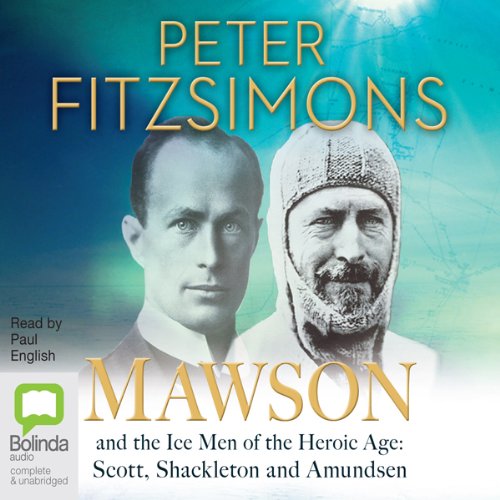
Quick Take
- Narration: Paul English brings strong Australian energy to FitzSimons’ expansive prose, capturing the popular history register without reducing the horror of what Mawson endured. A confident, warm performance across nearly 24 hours.
- Themes: Extreme survival at the edge of what the body can endure, the Heroic Age of Antarctic exploration, ambition and catastrophe intertwined
- Mood: Sweeping and urgent, with moments of genuine physiological horror that FitzSimons does not soften
- Verdict: The definitive popular account of Douglas Mawson and one of the most gripping survival narratives in the Antarctic genre.
Peter FitzSimons is Australia’s most prolific popular historian, a former Wallabies rugby player turned biographer and narrator of national stories, and Mawson is one of his best books. I came to it having already spent several months with Scott, Shackleton, and Amundsen, the three figures who typically absorb all the oxygen in discussions of the Heroic Age of Antarctic exploration, and I was genuinely unprepared for the story waiting in these pages. Douglas Mawson’s survival after the death of his two companions in December 1912 is, by any measure, among the most extreme personal ordeals in the history of exploration.
To understand why, you need to know what happened in those eighteen days after Belgrave Ninnis fell into a crevasse, taking with him the tent, most of the food, and the strongest dogs. Mawson and Xavier Mertz were left 160 miles from safety with a six-week journey ahead and provisions for ten days. They ate the remaining dogs. Mertz died, possibly from hypervitaminosis A caused by eating dog liver, though the medical picture is more complicated than that simple explanation suggests. Mawson’s own skin began to fall off. His hair fell out. He developed a kind of double sole on his feet, the outer layer peeling away, and tied it back with bandages. He walked 100 miles alone, across Antarctic terrain, in this condition, to arrive at the base camp just in time to see his rescue ship disappearing over the horizon.
FitzSimons and the Art of Popular History
FitzSimons writes popular history in the best sense of that phrase: narrative-driven, character-rich, thoroughly researched, and unashamed of dramatic storytelling. He is sometimes criticized in academic circles for this approach, but the criticism misses what he does well. The 265 reviewers who have rated Mawson on Audible and produced a 4.5-star average are not wrong. This is a book that makes a largely forgotten figure comprehensible and present for contemporary readers who might otherwise encounter Mawson only as a face on the Australian hundred-dollar bill.
The decision to interweave the other Heroic Age explorers with Mawson’s story is both FitzSimons’ most ambitious structural choice and his most contentious one. Scott, Shackleton, and Amundsen appear extensively, and while this provides valuable context and genuine comparative interest, it means Mawson occasionally loses the center of his own book. Readers who want Mawson exclusively may find the structural reach too wide, but those who come to him through the broader Heroic Age period will find the contextualization illuminating. FitzSimons is particularly strong at showing how these four men were aware of each other, competitive with each other, and measuring their achievements against each other in real time.
The Survival Ordeal in Physiological Detail
The chapters covering the actual survival ordeal are the book’s heart, and FitzSimons does not look away from the physiological details. The description of Mawson’s skin peeling and the makeshift repairs he made to his own body while continuing to navigate by compass across featureless ice is one of those passages that stays with you long after the book ends. FitzSimons’ Australian directness serves him particularly well here. He is not embarrassed by the body, by its failures and its desperate adaptations, and the result is a survival account that feels genuinely biological rather than mythologized. This is not a story of a superman. It is a story of what an ordinary body does when the alternative to continuing is dying.
The moment of arrival at the base camp, documented in real accounts and rendered by FitzSimons with appropriate emotional impact, produces one of those rare effects in narrative history where the reader simultaneously knows what is going to happen and is devastated by it happening. The ship has gone. Mawson has survived something that should have killed him three times over. And he has to wait another year for rescue. FitzSimons gives this moment the space it deserves.
Paul English and the Nearly 24-Hour Runtime
At just under 24 hours, Mawson is a significant listen, and Paul English’s narration makes it considerably less daunting than that runtime suggests. He brings the right kind of energy to FitzSimons’ prose: not artificially dramatic, but genuinely engaged, with a natural feel for the Australian vernacular that FitzSimons employs when writing about his own nation’s history. The sections set in Britain or Norway, where the other explorers’ stories are told, are handled with equal competence but slightly less warmth, which is probably appropriate.
The Right Reader for This Journey
Ideal for listeners who love the Heroic Age of Antarctic exploration and feel they already know the Scott-Shackleton-Amundsen story well. Mawson fills a genuine gap in the popular record. Also excellent for readers interested in extreme survival narratives who want deep context for what happened and why. Those who prefer tightly focused narrative over the broader FitzSimons approach may find the structural reach too wide. But as popular history of a genuinely extraordinary person in genuinely extraordinary circumstances, this is among the best of its kind.
Frequently Asked Questions
Is the hypervitaminosis A explanation for Mertz’s death settled, or still medically debated?
FitzSimons addresses this, and the medical explanation for Mertz’s death remains a subject of some scientific debate. Hypervitaminosis A from dog liver consumption is the most frequently cited cause and FitzSimons treats it as the likely explanation, but researchers have raised other possibilities including general starvation and psychological deterioration. The book presents the evidence fairly without overstating certainty.
Does the book cover Mawson’s later career, or does it focus only on the 1911-1914 expedition?
Mawson led a second Antarctic expedition in 1929-1931 and remained a significant figure in Australian science for decades, receiving his knighthood in 1914. FitzSimons covers the broader arc of Mawson’s life, but the 1911-1914 expedition and particularly the Ninnis-Mertz disaster is the structural and emotional center of the book.
Is Mawson a good entry point for readers new to Antarctic exploration history?
It is an excellent entry point, particularly because FitzSimons provides context for the broader Heroic Age period. Those who want a single prior anchor might read or listen to something on Shackleton or Scott first, but it is not required. FitzSimons explains what he needs to explain as he goes.
How does this compare to Lennard Bickel’s earlier Mawson biography This Accursed Land?
Bickel’s 1977 book was the first major popular biography of Mawson and focuses more tightly on the survival ordeal itself. FitzSimons’ account is broader, more contextually rich, and benefits from later historical scholarship. Both are worth reading for serious students of the subject, but FitzSimons is the more complete modern treatment.