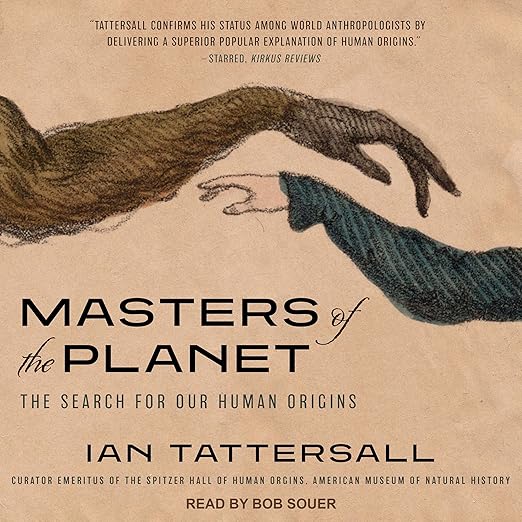
Quick Take
- Narration: Bob Souer delivers a composed, academic tone that suits Tattersall’s scholarly prose without making it feel inaccessible.
- Themes: Human origins, cognitive evolution, the emergence of language and symbolic thought
- Mood: Intellectually immersive and quietly astonishing
- Verdict: An essential listen for anyone genuinely curious about why Homo sapiens outlasted every rival species that ever walked the earth.
I was somewhere on the highway between Chicago and Milwaukee, in the flat predawn dark, when Ian Tattersall started talking about the moment Homo sapiens arrived on the evolutionary stage. Not gradually. Not incrementally. But suddenly, in what he calls a punctuational event, a combination of traits that had been accumulating separately for millions of years snapped into place and produced something the planet had never seen before. I actually said “huh” out loud in my car. That does not happen often.
Tattersall is curator emeritus at the American Museum of Natural History, and this audiobook carries that credential with weight. He is not a popularizer in the shallow sense. He is a working scientist writing for a general audience, which means the book demands a bit more from you than most popular science titles, but it also offers considerably more in return. The free audiobook access through Audible makes the barrier to entry practically nonexistent, and I would say the eight and a half hours pass with the velocity of a much shorter book.
A Fossil Record That Refuses to Tell a Clean Story
One of the genuine pleasures of Masters of the Planet is Tattersall’s willingness to sit with uncertainty. He surveys a field of evidence that spans bipedality, tool use, brain development, and symbolic behavior, and he refuses to sand the rough edges into a tidy linear narrative. When he writes that our memory is personal and not historical, and that modern science is still struggling to create a coherent narrative about Homo sapien origins, that is not a disclaimer. That is the thesis.
The book opens deep in the fossil record, roughly seven million years ago, then walks steadily forward through a landscape populated by multiple coexisting hominid species. What emerges is not the story most of us were taught in school. Our ancestors were not the inevitable winners of a long march toward progress. They were one lineage among several, competing and sometimes interbreeding, until something tilted decisively in their favor. Tattersall’s argument is that the winning combination of traits appeared rapidly, not through patient refinement, and that timing may have been more luck than design. This argument runs directly against the popular conception of human evolution as a steady upward arc, and Tattersall defends it with the rigor of a scientist who has spent his career reading the actual bones.
Language, Symbols, and the Capacity That Waited
The chapter I found most compelling concerns language and symbolic cognition. Tattersall makes the case that the capacity for language may have preceded its actual use by a considerable stretch of time, lying dormant until cultural conditions activated it. The biological hardware arrived first; the software came later. It is a subtle but radical argument, and it reframes everything that follows. Once you accept it, the Cro-Magnon cave paintings at Chauvet look less like the first expression of a gradual awakening and more like the sudden detonation of a capability that was already fully loaded.
One reviewer, a scientist himself, praised Tattersall for applying a lifetime of logical thinking to sift out fantasies and legends that sometimes blossom in paleoanthropology. That restraint is evident throughout. He declines to take sides in ongoing controversies between competing schools of interpretation. Instead, he explains the evidence that each position relies on and lets listeners make their own assessments. In a field where academic feuds can be fierce and public, that kind of intellectual generosity is worth noting. Another reviewer described the book as well balanced in describing bones, tools, genetics, and symbolic artifacts, which is a fair characterization of how deliberately Tattersall distributes his attention across the different lines of evidence.
Where the Argument Slows and Why
The honest caveat here involves the final chapter. More than one listener noted that the ending arrived with something of an abrupt quality, substituting speculation for the rigorous analysis that characterized the earlier sections. One reviewer described it as a bucket of speculation rather than a completion of the story. I can see what they mean. Tattersall is vastly more comfortable in the deep past than he is at the edges of contemporary anthropology, and the book’s momentum slows perceptibly as it approaches the present. The sections on H. heidelbergensis and H. neanderthalensis are among the strongest in the book, handled with the precision of a specialist. The final passages on the planetary spread of Homo sapiens feel more like a draft than a conclusion.
Bob Souer’s narration is measured and clear without being sterile. He does not perform the text so much as he presents it, which is exactly right for material this dense. You can take notes or follow along with a skeptical ear, and the pace accommodates both. The audiobook format suits the material well because Tattersall’s prose is constructed for the ear, with sentences that unfold deliberately and reward patience.
Listeners Who Will Get the Most from This Book
Listen to this if you want a serious, scientist-authored account of human origins that does not oversimplify the evidence or flatten the genuine mysteries that remain. It rewards listeners who are comfortable with a scientific framework and prepared to sit with open questions. The book is particularly strong for anyone who has read popular treatments of human evolution and found them either too credulous about the narrative or too thin on actual fossil evidence. Tattersall provides the corrective: disciplined, skeptical, and honest about the limits of what the record can actually tell us.
Skip it if you prefer a more narrative-driven approach, or if you’re hoping for resolution on contested questions about early human cognition. Also note: the final chapter will not satisfy everyone. But the preceding eight-plus hours are among the most intellectually honest treatments of the subject available in audio form. Among recent books on human origins, this stands apart for the quality of its critical thinking and the author’s refusal to dress up uncertainty as settled science.
Frequently Asked Questions
Does Ian Tattersall argue that Homo sapiens were destined to dominate, or does he offer a different explanation?
Tattersall explicitly rejects the idea of inevitable dominance. His central argument is that Homo sapiens acquired a winning combination of traits not through long-term refinement but through a rapid, almost accidental convergence that gave them a sudden decisive advantage over competing species.
Is this audiobook too technical for a general listener, or is it accessible to non-scientists?
Tattersall writes for a general audience and is careful to explain scientific concepts without oversimplifying them. Listeners with a genuine curiosity about the subject will find it accessible, though it asks more of you than a typical popular science title. The reviewer who called it brilliant thinking about key science matters was not a professional scientist.
Does the book cover Neanderthals and their relationship to modern humans?
Yes, and that section is particularly strong. Tattersall addresses H. heidelbergensis and H. neanderthalensis directly, making clear that Neanderthals are not our direct ancestors. He treats the interbreeding evidence carefully and explains what the fossil and genetic record actually shows versus what is inferred.
One review mentioned the final chapter felt unfinished. Is that a significant problem?
It is worth knowing going in. The last chapter shifts from the careful evidence-based analysis of earlier sections toward more speculative territory about the planetary spread of Homo sapiens. Most listeners find the preceding content more than worth the slight letdown at the end, but if strong conclusions matter to you, temper your expectations for the finale.