Quick Take
- Narration: Dini Steyn delivers clear, consistent Dutch and English phrasing, professional enough for the format, though the content limitations undercut the listening value.
- Themes: Dutch vocabulary in sentence context, practical word frequency, learner-independent vocabulary building
- Mood: Measured and repetitive in structure, more useful as a reference dip than a sustained listen
- Verdict: Over 3,000 Dutch words with sentence context is a reasonable resource concept, but content quality concerns, including reviewer complaints about word selection, make this a cautious recommendation.
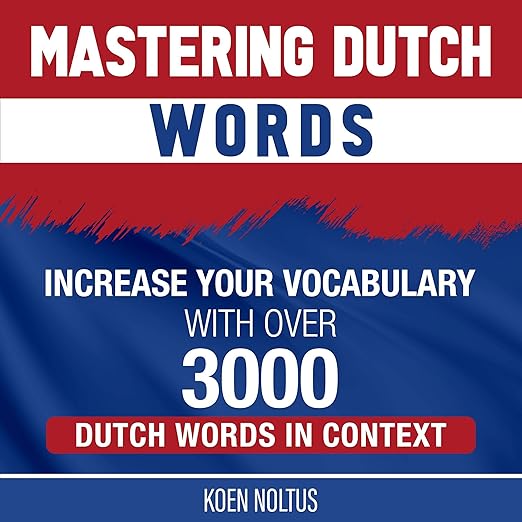
There is a particular kind of language-learning book that promises volume as its primary virtue. Three thousand words. Five thousand most common phrases. The top 1,000 vocabulary items you need to know. These products serve a genuine need, vocabulary acquisition is a genuine bottleneck in language learning, and there is real value in a well-curated, high-frequency word list with contextual sentences. The question is always whether the curation lives up to the promise. With Mastering Dutch Words by Koen Noltus, the answer is mixed.
The concept is sound. Rather than presenting words as bare translations, the book provides a sentence for each entry, giving learners context for meaning and usage. This is a meaningful improvement over a raw vocabulary list. Hearing “bank” defined as a financial institution is less useful than hearing it used in a sentence about making a deposit. The sentence-context approach, if executed well, mimics the natural vocabulary acquisition process more closely than dictionary-style presentation.
The Content Quality Question
The single available review raises a substantive concern that is worth taking seriously: the word list includes a significant number of proper names, Jenny, Phil, Linda, Maggie, Lewis, categorized alongside Dutch vocabulary. The reviewer, clearly an intermediate learner rather than a complete beginner, found this appalling. It is a fair point. Proper names are not Dutch words in any meaningful sense; they are phonologically and culturally universal to the degree that they require no language learning at all. Their inclusion in a resource promising 3,000 essential Dutch words suggests that the selection criteria were not as rigorous as the synopsis implies.
The 3.5 average rating from eight reviews reflects this content concern. For a vocabulary audiobook that runs nearly twelve hours, uneven word selection is a significant problem. The usefulness of the product depends entirely on whether the 3,000 items are the right 3,000 items, high-frequency, genuinely Dutch, contextually important. If a portion of that list consists of names and other filler content, the actual instructional value is lower than the runtime suggests.
Dini Steyn’s Narration as the Stable Element
What the audiobook has working in its favor is Dini Steyn’s delivery. A vocabulary audiobook lives or dies on narration clarity, because the learner is using the audio as a pronunciation model for every word encountered. Steyn maintains consistent, intelligible Dutch pronunciation throughout the nearly twelve-hour runtime, a non-trivial achievement. The pacing allows time for the English translation and sentence context to register before the next entry appears. For the words that are genuinely useful Dutch vocabulary, the listening experience is functional.
The companion PDF mentioned in the product description, available in the Audible Library alongside the audio, is essential for this format. A vocabulary course heard without a written reference is significantly harder to review and reinforce. The PDF allows learners to check spelling, see words in written form, and make their own notes. Whether this companion is accessible on all platforms is worth verifying before purchase.
Dutch in the European Language Context
Dutch sits in an interesting position for English speakers. It is grammatically closer to English than German is, shares a significant amount of cognate vocabulary, and is spoken by a population that generally speaks excellent English, which reduces the pressure of making mistakes. For learners approaching Dutch through vocabulary acquisition, the cognate density is genuinely useful: words like “water,” “lamp,” “hotel,” and hundreds of others require almost no effort. A well-curated Dutch word list would lean into this overlap strategically, identifying which items are near-freebies and which require genuine memorization effort.
Whether this product makes those distinctions well is unclear from the available data. The content concern raised in reviews, the modest rating across a small sample, and the lack of detailed positive assessment from listeners who have worked through the material suggest treating this as a supplementary resource rather than a primary one.
Who Should Listen, Who Should Skip
Listen if you want a lengthy vocabulary-in-context audio resource for Dutch and are comfortable accepting some unevenness in word selection, treat it as a supplement alongside a structured course rather than a standalone system. The PDF companion and Steyn’s clear narration add value. Skip if you are looking for a carefully curated, linguistics-informed high-frequency word list with rigorous selection criteria; the available evidence suggests this does not meet that standard. For Dutch learners at beginner level, a program like Paul Noble’s or Pimsleur Dutch offers more methodological rigor for building a functional foundation.
Frequently Asked Questions
Does Mastering Dutch Words teach grammar alongside vocabulary?
No. The focus is vocabulary acquisition, each word is presented with a sentence example showing its usage. Grammar explanation is not part of the format. Learners who need Dutch grammatical structure alongside vocabulary will need a separate resource.
Is the companion PDF included with the audiobook, and how do I access it?
The product description states that a companion PDF is available in your Audible Library alongside the audio. Access may be more reliable through the desktop Audible site than the mobile app, worth checking after purchase.
What proficiency level is this audiobook designed for?
The synopsis targets learners who ‘know nothing’ about Dutch, suggesting an absolute beginner focus. However, reviewer feedback indicates the word selection may frustrate intermediate learners expecting rigorous high-frequency curation. The sentence-context approach is more useful for beginners than for learners with existing vocabulary.
How does nearly 12 hours of vocabulary instruction compare to other Dutch learning audiobooks?
The runtime is substantial for a vocabulary course. By comparison, a Pimsleur Dutch level runs approximately 7-8 hours and focuses on conversational production rather than vocabulary lists. The Earworms Dutch series uses a shorter music-based format. Mastering Dutch Words occupies a different niche, broad vocabulary coverage, but its value depends on word selection quality, which current reviews flag as inconsistent.