Quick Take
- Narration: Chino Ramos handles the dense, list-heavy structure with energy and clarity, making what could have been a dry recitation of steps feel like coaching.
- Themes: Stage presence, imposter syndrome, structured preparation and rhetorical technique
- Mood: High-energy and practical, with a personal-action-plan architecture
- Verdict: Unusually comprehensive for the genre, covering everything from nerve management to ethical persuasion, and the 4.8 rating with 75 reviews reflects genuine reader satisfaction with the results.
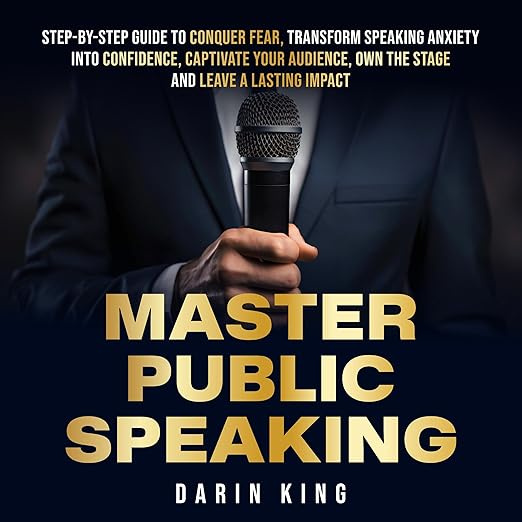
I came across Master Public Speaking on a Saturday morning when I was looking at several public speaking guides in sequence, trying to understand how they differentiated from each other. Most of them cluster around the same core advice. Darin King’s book distinguished itself immediately by the sheer density of its content structure. The synopsis lists over twenty rhetorical techniques, over thirty script preparation approaches, and a seven-day practice sequence. That kind of promise usually signals filler. In this case, it mostly delivers.
The 13-step architecture is explicit from the first chapter. King organizes the guide around a personal action plan that listeners build as they progress through the book, which is an unusual structural choice. Rather than presenting principles and leaving application to the reader’s imagination, the book is designed so that you emerge from it with something tangible: a customized approach to your particular challenges as a speaker. Reviewer An Hai described it as “down-to-earth, step-by-step” and specifically appreciated that it doesn’t treat fear as a flaw but rather shows how to work with nerves through “simple mindset shifts, breathing techniques, and rehearsal habits.”
The Imposter Syndrome Chapter
The section on imposter syndrome stood out to multiple reviewers and stood out to me as well. This is not new territory in public speaking literature, but King treats it with more psychological specificity than most. Reviewer Leon Edward noted that the “science-backed methods for claiming your authority and authenticity resonate deeply, especially in a world where self-doubt can often overshadow our capabilities.” What King does well here is connect the internal experience of imposter syndrome to specific external behaviors it produces, and then give discrete interventions for each behavior. It’s the kind of granularity that makes the advice actually usable.
Chino Ramos narrates with a quality that matches the material’s energy. He’s not the kind of narrator who disappears into the text. He brings a coaching sensibility to the delivery, which means the list-heavy sections, which could easily become tedious in a drier voice, maintain their forward momentum. At just under five hours, the pacing works.
What the Lists Actually Contain
The density of the content structure is worth examining honestly. Twenty-plus rhetorical techniques sounds impressive but runs the risk of producing a catalog you browse rather than a methodology you internalize. King partly addresses this by organizing the techniques into categories based on their function, which gives the listener a mental architecture for deciding which tools apply in which contexts. Reviewer Leroy Malloy called it “a clear, motivating, and highly practical book that turns fear and anxiety into confident stage presence through structured, step by step guidance.” The step-by-step description is accurate. The book respects the difference between knowing a technique and having a plan to practice it.
The material on handling unexpected situations is particularly useful. Most public speaking guides spend their time on prepared presentations and leave the Q&A, the technical failure, the hostile questioner largely unaddressed. King devotes genuine attention to the real-time problem-solving skills that separate adequate speakers from resilient ones.
The Rating and What It Reflects
A 4.8 from 75 reviewers is a strong signal in this category, where books with inflated descriptions frequently disappoint. The reviewer feedback suggests the material holds up when applied, not just when read. The guides that earn that kind of sustained endorsement tend to be ones that set honest expectations and then meet them, and Master Public Speaking operates that way. It doesn’t promise charisma transplants or overnight transformation. It promises a structured process and a customizable plan, and it delivers those things.
Listen if: You want the most comprehensive single-volume treatment of public speaking available at this runtime, covering everything from nerve management to rhetorical technique to handling unexpected situations.
Skip if: You’re looking specifically for mindset-level work rather than a structured, exercise-heavy program, or if you find densely itemized guides harder to retain than narrative-driven ones.
Frequently Asked Questions
Is the 13-step structure meant to be worked through sequentially, or can listeners jump to specific chapters?
The personal action plan framework is designed to build sequentially, with earlier steps informing later ones. King recommends working through it in order, though individual chapters on specific techniques can be revisited independently once you have the overall architecture.
How does the seven-day practice sequence work in an audio format?
The seven-day sequence requires active engagement outside of listening. King outlines what each day’s practice should involve, but you’ll need to stop and do the work. Listeners who treat this as passive background audio will miss much of what the book offers.
Does the ethical persuasion section have a clear framework, or is it vague?
Reviewers don’t specifically address this section, but the book’s overall approach to techniques is specific rather than vague. Based on the pattern throughout, expect concrete principles with examples rather than abstract commentary on the importance of being ethical.
How does Master Public Speaking handle the specific challenge of imposter syndrome for professionals presenting in expert contexts?
This is one of the book’s stronger sections according to multiple reviewers. King uses science-backed methods and connects imposter syndrome directly to observable behaviors, then offers specific interventions. It’s more granular than most public speaking guides on this topic.